If Homer Simpson drank wine

Toh Friulano

Toh! or is it Doh!

Tocai or Tocai Friulano is an old Friulian name for Sauvignonasse, a widely planted white varietal in northeastern Italy. It’s a productive, late-budding varietal that produces a light-bodied wine with floral and almond notes best consumed in its youth. In addition to the Friuli region in Italy, this varietal is also planted in California, in the Hudson Valley in New York State as well as a touch in Argentina.

This varietal is not related to Tokay d’Alsace, an Alsatian synonym for the Pinot Grigio, which can be found alongside the Tocai in Friulano. It also has nothing to do with Hungary’s great wine, Tokaji, which is probably why the Hungarians succeeded in convincing the EU to ban Italy’s use of the term in 2007.

Tocai is the most popular and widely planted white grape region of the Friuli region and old names can die hard. di Lenardo has honored the varietal’s original name by giving his wine the proprietary name, “Toh!”. Massimo’s family has been making wine in the area since the late 1800s. All of their grapes are picked by hand and the Toh! is their most popular wine. Greenish-yellow in color, the wine had a delicate nose of white flowers and bitter almonds. It had great acidity, but was round and delicate rather than angular on the palate. Homer might opt for a burger or a donut, but I think you’d find a better match with shellfish.

More good news – it retails for around $14.

3 Comments

Filed under Wine

For you tough guys

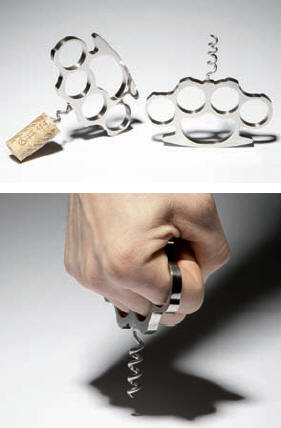
brass-knuckles-wine-openerYup, a brass knuckle wine opener.  I’ve seen a lot of commentary about this online – Samurai sommelier jokes, gang members who don’t like beer – but, I can’t seem to find a place to buy one.

Jonathan Sabine designed with what he calls the Bourgeois Brass Knuckles in 2007.  He describes the product as “a cross between two iconic objects whose cultural and socio-economic associations lie at opposite ends of the spectrum from one another.”

While I like his design, I object to his statement – wine is for refined rich folks and poor people are violent?  Wine is for everyone, even nut-jobs who like to wear brass knuckles!  If I had these brass knuckles I’d use them to open a bottle of brass monkey.

3 Comments

Filed under Gadgets

Playing second fiddle

Instead of heading north of Bordeaux, we’ll head south-east to a drier, warmer climate where there’s a long, rich history of local consumption of spirits made by individual producers rather than major brands.  We’ve covered Cognac so now we’re going to Armagnac (are-muhn-YACK), France’s second great controlled appellation for grape spirits.

The center of the trade is the city of Condom (tell that to your friends with a straight face).  While Cognac is broken down into 6 regions, Armagnac has 3 that were defined in 1936: Bas-Armagnac, the most westerly and home to the best spirits, Ténarèze in the center where the fullest-bodied styles come from and Haut-Armagnac to the east, where the wines are often sold off rather than distilled – you’ll see them labeled as Vin de Pays des Côtes de Gascgone. When purchasing an Armagnac, the name of the subregion will appear on the label.

Only white grapes can be used for Armagnac production and you’ll recognize some of the names from Cognac production like Ugni Blanc and Folle Blanche.  There are a few others, too – Colombard, Meslier, Jurançon and a hybrid called Baco 22A (sometimes called Baco Blanc).  It’s a hybrid because it’s a cross between the French vitis vinifera Folle Blanche and the American vitis labrusca Noah.  Noah itself is a cross between vitis labrusca and vitis riparia.  Hybrid=cross across species.

Since 1972 the use of pot stills has been allowed, just like in Cognac, but many producers still use the more primitive and traditional Armagnac still, a continuous still with two copper columns.  Another difference between the two regions lies in the oak aging.  Most Armagnac producers use the local, sappy Monlezun oak.  The combination of still and aging tends to make Armagnac a more rustic version of Cognac.  Cognacs may have more floral and grape-y notes while Armagnacs will have more dried fruit and prune characters.  Cognacs retain their bite, while Armagnacs are fuller-bodied and rounder.

Some of the labeling terms will be familiar to you, but the minimum aging requirements are a touch different.  *** (often written as VS) is one year old, VSOP is 4 years old and XO is five years old.  Hors d’Age means the youngest component in the blend is 10 years old.  Many producers will age individual casks from a single distillation and sell these with a vintage date.

For a fun and refreshing drink, look for Floc de Gascogne, a fortified sweet wine made with 1/3 Armagnac and 2/3 grape juice from the region.  The alcohol clocks in at 16-18%  and there are notes of honey, almond and jasmine.  I kept my bottle in the fridge and used it as an aperitif.

2 Comments

Filed under Lessons, Spirits

A shot at the bar?

A lot of things pair well with drinking – watching sports, eating peanuts/pizza/burgers/pretty much anything, dancing – but handguns?  Really? 

Two states, Tennessee and Arizona, have recently passed legislation making it ok to carry a concealed weapon into a bar.  The new laws in both states stipulate that armed bar patrons must refrain from drinking.  If the weapons are concealed, how will the bartender know who to serve and who not to?

The Colbert Report has produced a spot-on assessment of this situation by profiling one of Tennessee’s political leaders, Doug Jackson.  Check it out:

Vodpod videos no longer available.
 

2 Comments

Filed under Alcohol in the News, Videos

Thirsty for etymology

Alcohol comes from the Arabic alko’hl, which translates to finely divided – a reference to the separation that occurs during distillation.  While not everyone may have been drinking it (poor things), they were using it for medicinal and perfume-making purposes.

Beverage is from the Middle English pronunciation of the Old French term bevrage, from beivre.  This meant to drink, from the Latin bibere

Brandy stems from brandywine or the Dutch brandewijn, meaning burnt wine.   While usually made from a grape-based wine, brandy can also be made with pomace (skins, seeds, pulps and stems) or fermented fruit juice. 

Cordial is a term often substitued for liqueur.  Technically, they’re supposed to be invigorating or stimulating, a reference to their original medicinal usage.  Since the heart was considered the body’s most important organ, these “medicines” were named after the Latin term for heart, cordialis

Distillation comes from the Latin destillare, meaning to drop or to trickle down.

Distilled liquids used to be called ardent spirits, from the Latin ardor, which means to burn.  Sure, we have modern distilling techniques, but the starch source still has to be converted into fermentable sugar.

Gin gets its name from one of its major flavoring ingredients, juniper.  The French is genievre and the Dutch is genever.  Doctor Sylvius from Holland’s University of Leyden is credited with being the first person to distill gin.  His intent was to create a medicinal spirit and he felt he could stretch the diuretic properties of juniper berry oil by redistilling it with a pure alcohol.  The Latin juniperus communis translates to youth-giving.  I can’t say I’d use gin to treat a bladder or kidney ailment, but at times I’ve certainly found it therapeutic. 

Liqueur is from the Latin liquifacere, meaning to dissolve or melt – a reference to the seeds, herbs, roots and other flavorings used. 

Rum is a fun one that we already covered

Tequila is a Nahuatl (Aztec) word meaning place of work that dates back to 6500 B.C.  I’ve also seen that tequila stems from a town of the same name in Jalisco, Mexico, known for its high quality spirits.

Vodka is the diminutive of the Russian word for water.  No one can seem to agree as to whether vodka first appeared in Russia or in Poland, but it showed up around the 12th century.  At that time at a Russian monastery, it was called zhizenenniz.

Whiskey comes from the Irish uisce beatha and Whisky comes from the Scottish uisge-beatha, both a gaelic translation of the Latin aqua vitae, meaning water of life.  King Henry II’s soldiers invaded Ireland in the 12th century and couldn’t pronounce uisce beatha, so over time it degraded from sounding like “whishkeyba” to “whisky”.  All whisky was spelled without the “e” until 1870 when Scottish distilleries flooded the market with inexpensive spirits.  The American and Irish producers added the “e” to distinguish themselves.  Today whisky (plural is whiskies) is used for Scotland, Wales, Canada and Japan while whiskey is used for spirits distilled in Ireland the United States.

Leave a comment

Filed under Lessons

Hold the sausage, pass the beer

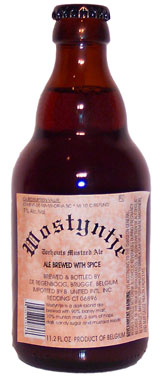
wostyntje-bottle

photo courtesy of B. United International

I tried a mustard beer last night with my dinner at JoeDoe.  It hails from the Regenboog Brewery in Belgium (Brouwerij De Regenboog or Brouwerij ‘t Smisje in Dutch).  Specifically, the brewery’s located in the West Flanders municipality of Assebroek, a suberb of Bruges.  For a native English speaker, there’s a lot of unfortunate sounding words here. 

Regenboog means rainbow in Flemish and they’ve been brewing beer since 1995.  Despite its small production of less than 800 gallons per year (making it Belgium’s smallest craft brewery), Regenboog puts out six beers as part of its regular production as well as many seasonal brews, featuring both traditional Belgian styles as well as some more funky stuff – raisins, honey, vanilla.  I’m happy to report that Wostyntje is part of their regular production. 

Clocking in at 7% abv, it’s a strong, spicy golden ale with munich and pilsner malts, Kent Goldings and Challenger hops, candy sugar and mustard seeds from a nearby village called Tourhout.  This beer undergoes a secondary fermentation in the bottle, adding to its complexity.  The beer is surprisingly versatile – I enjoyed it with fried chickpeas, pickled onion rings, a salad of radish and spring garlic, duck egg and farro, Tasmanian trout and more – hey, there were 2 of us.  It has the full-bodied, citrus-y, spicy and floral qualities often associated with Belgian beer with a unique bitter finish from the crushed mustard seeds.

For a list of bars in NYC that carry it, click here.

Leave a comment

Filed under Beer

Cone-yack

All Cognacs are brandies, but not all brandies are Cognacs.  The best ones are made from low alcohol, high acid grapes.  Sounds a bit like Champagne, don’t you think?  No wonder I like it!

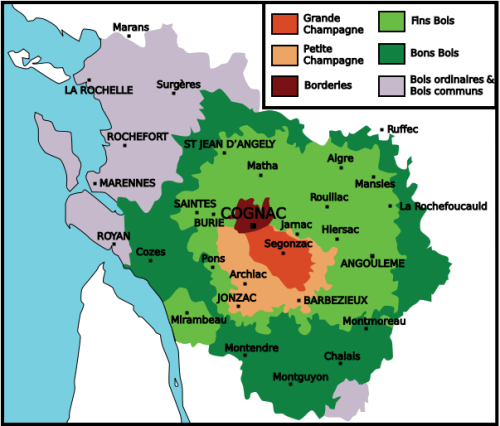
Cognac MapThe Cognac region is just north of Bordeaux in the Charente and Charente-Maritime départments or districts of France.  The ancient city of Cognac, which sits on the Charente River is at the heart of the district.  The region was delimited by law in 1909 (i.e. to call your product a Cognac, it has to be made within the designated geographical area).  There are 6 districts or crus of Cognac: Grande Champagne (best), Petite Champagne (second best), Borderies (yup, 3rd best), Fins Bois, Bons Bois and Bois Ordinaires/Bois Communs.  You might also see Fine (feen) Champagne on a label and that means it’s a blend from the 2 best areas – Grande and Petite Champagnes.  The term Champagne here has nothing to do with the Champagne region, though both areas have very chalky soils. 

Since this region is on a navigable river close to the ocean, its wines have long been popular in England and the Low Countries.  The wines didn’t travel well since they were fairly light, so distilling them became the way to go.  Distillation became pretty common in the 17th century, but really took off in the 18th century when a number of families came to the region to control the trade: the Martells from Jersey, the Hennessys and the Hardys from Ireland, the Hines from Dorset and the Otards from Scotland.

Cognac is the 3rd largest vineyard area in France and up to 8 different grape varieties are permitted.  The two most important are Ugni Blanc – pronounced ooh-knee and also known as Saint-Émilion or Trebbiano (in Italy) and Folle Blanche.  The distillation season begins the November after harvest and runs through the end of March.  The Cognac is double-distilled in a copper pot still and aged in casks of Tronçais or Limousin oak for a minimum of 2 years.  During this process, the spirit mellows and softens, taking on color and flavor from the wood.  Some will evaporate, too and this is called the “angels’ share”. 

Let’s touch on a few other things you might see on the label:

C means Cognac

P means Pale

E means Extra

S means Superior

F means Fine

V means Very

O means Old

X means Extra

You’ve probably noticed that the letters represent English rather than French words, pointing to the traditional importance of the English market.  Usually these letters are used together and since 1955, they’ve had age significance.  For example, VS is at least 2 years old, VSOP is at least 4 years old, XO is at least 6 years old.  The years represent the minimum amount of time the spirit spent in barrel. 

Cognac can improve in wood for up to 55 years, but this is risky – there will be significant loss from evaporation and there’s a risk of over-aging, making the prices exorbitant.  Keep in mind that once the Cognac is bottled, it neither varies nor improves.  The producer has already done the work for you, so once you buy a bottle, just drink it (ideally not in one sitting) and once the bottle’s been opened, consume it within 6 months.

5 Comments

Filed under Lessons, Spirits

“Wine Uncorked” in the press

Wine Uncorked 071409
Caught mid-sentence by Janet

Janet Walker, a freelance writer and the founder of Pulse Point Productions attended last week’s “Wine Uncorked” class.  Her piece was picked up by L.A.’s Splash Magazine.  You can click here to get the full scoop (or to see what you missed).

2 Comments

Filed under Lessons, Wine

Togas aren’t just for frat boys

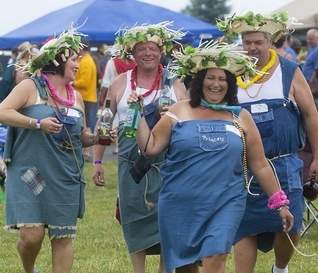
Self-described "redneck togas"

Self-described "redneck togas"

What might not surprise you is that this picture was taken at a stock car race track.  The part that should surprise you is that it was taken during a wine festival that was held there.  Full disclosure: the aforementioned racetrack is 30 minutes from where I grew up and this photo was featured in an article in my hometown paper.

Leave a comment

Filed under Events, Wine

Blueberry Corn Muffin

Glen Thunder

Label for new FLD Corn Whiskey

In honor of the opening weekend of Finger Lakes Distilling and its owner’s birthday today, let me introduce another one of their spirits.

When I tasted the corn whiskey, this is what I came up with:

The aroma of this whiskey is reminiscent of pulling back the husk from an ear of sweet summer corn.  On the palate, it’s crisp yet mellow, with toasty, caramelized notes and a meaty finish – think cornbread with bacon! 

This is what master distiller Thomas had to say about it (I promise he really said this.  You have to meet him):

“Corn whiskey is a true southern favorite; this is an honest, true corn whiskey, made like they do it in the hills and hollers of south Alabama. It smells like Dunkin Hines cake mix comin’ off the still.  Yankees beware, put some south in yo mouth!”

This corn whiskey is unaged and bottled right from the still, but don’t be afraid – it’s surprisingly easy to drink.  The Glen refers to the racetrack at Watkins Glen.  I thought it would pair well with something a little sweet and a little spicy, so I opted for fresh blueberries and ginger ale.  Here’s the recipe:

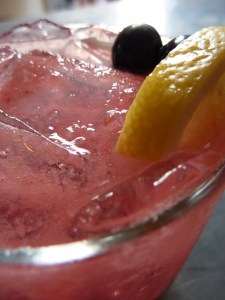
Blueberry Corn Muffin
2 oz. corn whisky
juice of ½ lemon
pinch salt
dash simple syrup
ginger ale
handful blueberries

Muffin 2

Don't be fooled by its innocent pink color

Muddle blueberries (enough to fill a rocks glass, single layer) with juice of ½ lemon, salt and simple syrup.  Add corn whiskey and shake with ice.  Pour back into rocks glass, top with ginger ale and garnish with blueberries and lemon. 

This drink goes down real easy, so watch that you don’t go off to the races.

Leave a comment

Filed under Cocktails