Srirazerac

Noah recently picked up these bitters at Formaggio Essex:

Sriracha (pronounced SIR-rotch-ah) bitters by Brooklyn Hemispherical Bitters. A bit spendy, at $12.95 for 4 oz., the flavor is true to the beloved "rooster sauce".

I opted for the recipe printed on the back label of the bottle: Srirazerac. Step 1 is to coat a rocks glass with Absinthe.

In a stirring glass with ice, I added 2 1/2 oz. rye (I used McKenzie). This is 1 teaspoon of simple syrup going in. Next was 2 dashes Peychaud's, followed by 2 dashes Sriracha Bitters. The dropper in the bottle yields less than a dash would, so that, combined with how spicy you'd like your drink, should dictate how much you add.

The finished cocktail, garnished with a lemon peel and a few additional drops of Sriracha Bitters. It's not terribly complex, but I really like rye, so I'm not the best judge in this instance. The best part is the finish - an intense, yet pleasant heat creeps up on you. These bitters are definitely worth experimenting with. Stay tuned.

1 Comment

Filed under Cocktails

Trenta is not an Italian wine

Trenta is, however, a new cup size at Starbucks that will hold an entire bottle of wine.  31 oz.  Wow.  I’m no scientist, but I think it’s safer to consume this quantity of wine vs. this quantity of Starbucks coffee.  This video will help clarify things for you:

3 Comments

Filed under Videos, Wine

Italian Love Bite

Plenty of Aperol in stock inspired Marcella to create her “Italian Love Bite”.

Marcella working her magic behind the bar. Join us at L'Ecole for a Love Bite starting today.

The recipe:

1.5 oz. Aperol
1 oz. Dolin Blanc
1 oz. Finger Lakes Distilling Pear Brandy
1/2 oz. fresh lemon juice
1 egg white (equivalent to 1 oz.)
dash salt
dash club soda

Combine all ingredients, except for club soda, and dry shake.  Add ice and club soda, shake again, and strain into chilled martini glass.  I asked what the garnish was and was told, “it’s so pretty, it doesn’t need one.”  See for yourself:

Candy-heart pink with notes of ripe pear and herbs, and a beautiful froth on top. Girly, without being sweet.

Leave a comment

Filed under Cocktails

USQ Martini Bowl

From the website of Union Square Wine & Spirits:

Event Date: Saturday, February 05, 2:00pm – 5:00pm
Description of tasting:
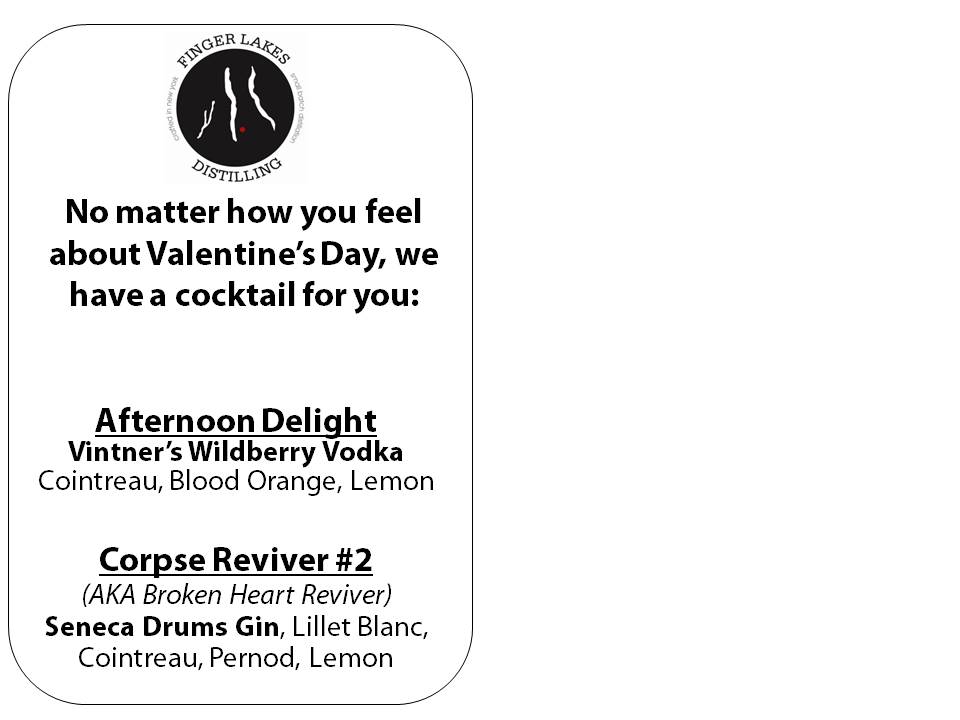
Join USQ to kick off Superbowl weekend with one our most spirited tastings of the year! Martini Bowl 2011 is set to erupt with over one dozen selections offered in classic and seasonal martinis!  Whether you like them dry, extra dry, dirty, or totally twisted, cocktail connoisseurs are encouraged to stop by The Salon for an afternoon of imbibing pleasure!  Attendees may look forward to Swedish stylings from Martini Bowl 2010 champion Karlsson’s Gold Vodka and Heavy Water Vodka, a juniper-fueled UK Invasion from the #1 contender for the 2011 title Bulldog Gin and Hendrick’s Gin, as well as righteous elixirs from Uluvka Vodka, DH Krahn Gin and Double Cross Vodka!  This year’s Bowl features a full roster of New York State spirits as well!  Supporters of local libations will be pleased to sip and savor Finger Lakes Distillery’s Seneca Drums Gin and Vintner’s Wild Berry Vodka, Westchester’s own Comb Vodka and Comb 9 New York Gin, Long Island’s LiV Potato VodkaBreuckelen Gin, and the Hudson Valley’s Core Apple Vodka

Here’s what we’ll be serving:

Come join us for a tipple this weekend!

Leave a comment

Filed under Events, Spirits

Wine grape vines haven’t been getting busy

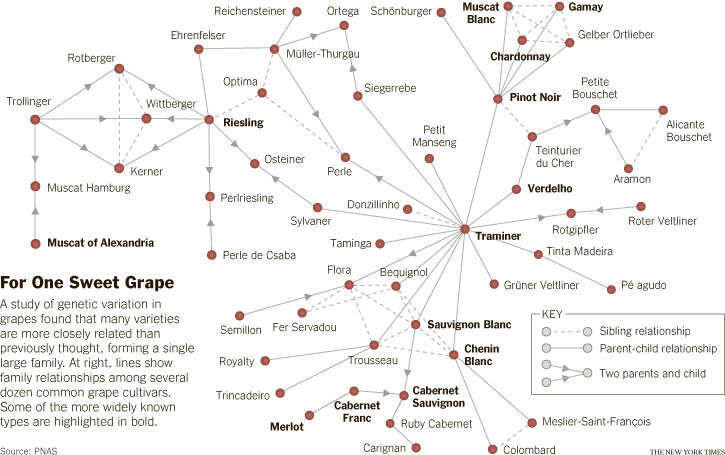
The New York Times reported last week that grape vines weren’t having enough sex.  At first glance, this may not seem like a major problem (insert sex joke here).  Alas, it is a big deal.  Look at the mess of a family tree that has been created as a result:

A geneticist from Cornell determined that 75% of wine grape varieties are as closely related as a parent and child or brother and sister.  This is as simple as the NYT could break it down, and I won’t try to compete:

“Thus merlot is intimately related to cabernet franc, which is a parent of cabernet sauvignon, whose other parent is sauvignon blanc, the daughter of traminer, which is also a progenitor of pinot noir, a parent of chardonnay.”

What happened to cause this?  The ease of propagating vines through grafting, phylloxera, wine laws, and our palates.  As a result of so much genetic similarity, the grapes are more susecptible to a wide range of pests, and vineyard managers have resorted to herbicides, fungicides and other nasty chemicals. 

The Times points out three options: add genes for pest resistance, go organic, breed sturdier varieties. 

Big problems with these three options: folks don’t like genetically modified plants, grape vines can have a hard time surviving in an organic environment, and breeding new varieties takes time, money and we’re not guaranteed a tasty result. 

The article went on to discuss a new plant breeding method, called genomic selection or marker-assisted breeding, which would enable scientisits to explore the grape genome.

Leave a comment

Filed under Alcohol in the News, Wine

Cru Beaujolais

I went to my second tasting group meeting last night.  Thanks to a lack of planning on my part, my camera battery died early in the evening, but here we go:

To keep us hydrated during set-up, we had Beaujolais Blanc from Chateau du Chatelard. Round, with apple, pear and toasty notes, some of the Chardonnay vines are over 95 years old. It was killer with the Montasio (aged cow's milk from Northern Italy) I brought.

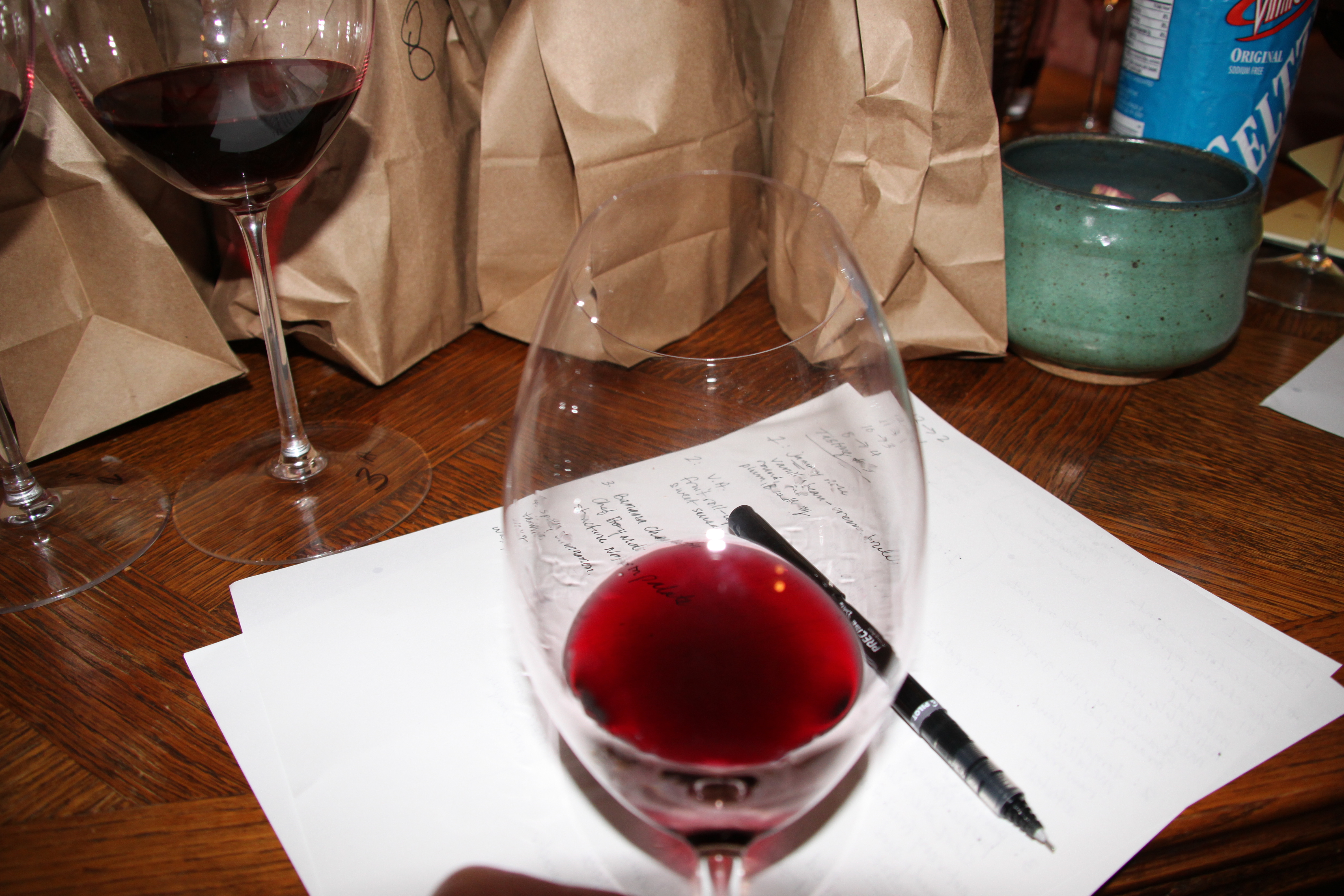
Chris and Tif prepping the bottles. You'll note we have quite a bit more wine this time around. It makes a difference when the average retail price is around $20!

We put all the wine into brown bags and we each opened bottles we had not brought, removing the cork and foil and taping the top of the bag. I picked up the bags on the way over and the bodega owner gave me 12 for $1, wondering why I didn't buy any Chateau Diana to put in them.

We broke our 12 wines into 3 flights of 4. One of our members was stuck in the country because of the snow, so we had 6 out of the 10 Crus represented.

Most of the wines had this electric magenta color. Some other commonalities we found: high acid, minerality, plenty of evidence of carbon maceration. Most of our bottles were current releases - 2009 - though we had a 2006, a 2008 and a 2002.

My favorites of the evening, in no particular order:

1. Domaine de la Chapelle des Bois Fleurie 2009.  Cherry poprocks, ruby grapefruit, orange peel, noticeable oak (in a good way).

2. Jean-Paul Brun Terres Dorées Moulin-a-Vent 2009.  This won’t be a surprise to any Gamay fans out there.  Perfumed, purple flowers, dark cherries, lipstick (strange, but true, and not unpleasant).

3. Clos de la Roilette Fleurie 2009.  We also had the “late harvest” version of this wine, which my companions preferred.  Structured, reminded me of eating prosciutto and figs.

4. Château du Bois de la Salle “Le Vieux Bourg” Moulin-a-Vent 2009.  Spicy cherries with cinnamon.

Interestingly enough, I brought numbers 1 and 4.  We have them on our wine list at L’Ecole.  Guess I know what I like.

I don’t have any food porn shots, but Chris came through, as usual.  Charcuterie course, seared pork tenderloin with roasted potatoes (crisped up in some fat from the pâté), pineapple crêpes with rum.

Overall, we weren’t blown away by any of the wines during the blind tasting section of the evening.  Most of the wines showed better when we brought out the charcuterie.  That said, these are value-priced wines, made with craftsmanship that show off their unique terroir.

1 Comment

Filed under Wine

And you thought they just produced Shiraz

Today I attended the Landmark Australia Master Class, featuring an impressive line-up of Australian Riesling and Pinot Noir.  It was an invite-only tasting and I heard about it through the Sommelier Immersion Program I’m currently enrolled in, through Wine Australia (more about this later).

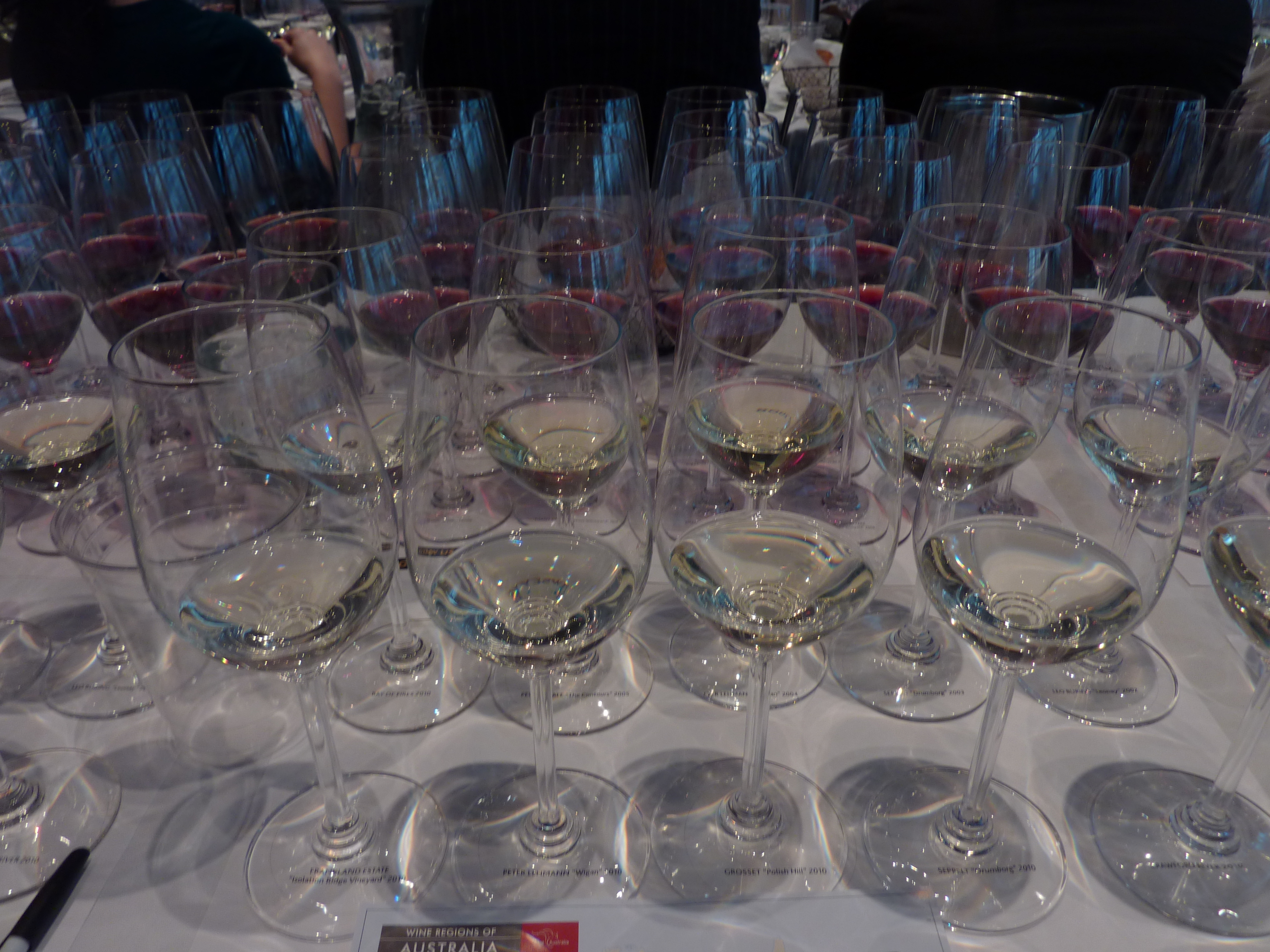
After skiing, the best thing to do on a snowy, wintry day - cuddle up with 25 wines.

Four presenters led the tasting: Tom Carson, chief winemaker at Yabby Lake; Jon Troutman, senior editor of Cork’d; Michael Hill Smith, owner of Shaw and Smith winery and Suzanne Barros, East Coast Market Development Manager for Wine Australia (and our instructor for the Immersion program).

These folks are really smart.  They are putting exciting wines in front of sommeliers, retailers, educators, writers, restauranteurs, importers, and distributors, and it’s working. 

My ideas about Australian wine have completely changed over the last few months, and I’m not alone.  Sure, the country has inexpensive, mass-produced wines on one end of the spectrum and expensive, overly-extracted wines on the other, but they also have cool-climate varietals that deserve a place at the dinner table (and on thoughtful wine lists). 

Some highlights/fun facts:

*The 6 2010 Rieslings we sampled were dry, elegant, sometimes fruity, sometimes floral and had, as Paul Grieco called it, “a bone-crushing acidity”.  Michael said to drink these wines now would be “vinocide” and he’s right.  You can see their potential, but some of them won’t even be released to the marketplace for another 5 years.  My favorite was the 2010 Grosset Polish Hill Riesling from Clare Valley – concentrated, yet delicate with lots of kaffir lime.

*The “spiritual home” of Riesling in Australia is South Australia, particularly in Clare and Eden Valleys.  Eden is slightly cooler than Clare, so the Eden Rieslings tend to be a little tigher, with higher acidity and more rose and floral notes, while the Clare Rieslings have more lime and citrus.

*Several panel members poo-pooed the petrol character that some aged Rieslings develop, attributing these aromas to overexposed fruit or water-stressed vines. 

*An attendee asked whether some residual sugar in the Rieslings would make them more approachable in their youth.  Tom commented that if you have r.s. at the get-go, the wines will get more sweet with age and won’t gain as much complexity as a dry wine.  I bet there are plenty of Germans out there who would disagree.  Michael noted that the grapes can get ripe enough in Australia to be fermented dry, and create a balanced wine.

*The aged Rieslings we sampled – one each from 2002, 2003, 2004 and 2005 – took on toasted honey and fig characteristics.  My favorite was the 2004 Peter Lehman Wigan Riesling from Eden Valley – toasty and honeyed notes, but still had incredible freshness.

*Pinot Noir accounts for about 2% of Australia’s production (Riesling is not much more). 

*MV6 is the most widely-planted clone.  MV stands for “mother vine” and it came from one of James Busby’s cuttings in 1831 from Clos Vougeot.

*The panel indicated that quality Pinot Noir in Burgundy needs the following things: continental climate, limestone-based soils, cold climate, northerly latitude, old vines (>50 years) and selection massale.  Where they may be missing some of these factors in Australia, they do have these: high altitude vineyards, southerly latitude, continental climate (in terms of diurnal temperature shifts), and a maritime influence. 

*Michael remarked that “Pinot Noir needs tension on the palate” and most of the reds we tried were nervy, indeed.  My favorite current vintage was the 2008 Wines by Farr Sangreal Vineyard from Geelong, Victoria – black fruits, red fruits, earthy spice and some carbonic maceration qualities.  The older wine winner for most of the group was the 2000 Yering Station Reserve from Yarra Valley (mine was oxidized).

*Michael likened Pinot Noir in Australia to rock n’roll – it’s exciting, and being embraced and supported by their local market.  It’s probably a welcome relief for folks who are used to drinking jammy, 15%++ alcohol wines.

*Tom closed by reminding us that Australia hasn’t yet hit its Pinot Noir potential, indicating that Burgundy has already made their best wines and that their challenge is to keep it up.  He imagined it was quite a bit of pressure to make a La Tâche every year. 

I look forward to following these producers, as they get closer to finding their stride.

1 Comment

Filed under Wine

Frommer’s visits the Finger Lakes

Brian and Thomas at the distillery. Photo courtesy of Amy Zavatto.

Amy Zavatto, one of the writers for Frommer’s Community Blog, Between Bites, recently wrote a piece titled, “Sipping Whiskey in the Finger Lakes“. 

On assignment for a wine job, she stumbled upon Finger Lakes Distilling on her way out of town. 

She got a tour and did a tasting and reports that her favorites were the Seneca Drums Gin, the Cherry Liqueur and the McKenzie Rye.

Leave a comment

Filed under Alcohol in the News, Spirits

Sommelier Journal

Over the summer, I agreed to help the Sommelier Journal with their ad campaign.  For those of you in the industry who don’t subscribe to it yet, it’s worth checking out.  This just ran in the December 2010 issue:

Leave a comment

Filed under Alcohol in the News, Wine

How to get filthy rich, part 2

As you may know, in addition to being a blog about beverages, A Thirsty Spirit has occasional posts on how to get rich, like this one from last spring, focusing on an ill-conceived plan for the pursuit of tycoon-ship through winery ownership. 
Well, here’s another.  According to a recent study published in Bloomberg today, wealthier Americans are more likely to binge drink than their not-so-wealthy neighbors.  Ergo, binge drinking must make you rich.  The study also shows that (surprisingly) binge drinking is more common with 18-24 year olds. 
Sounds like it keeps you young, too!

1 Comment

Filed under Alcohol in the News