Category Archives: Wine

E is for egg white

Fear not, dear readers, this is not a health food post.

Believe it or not, egg whites play an important role in the wine making process, particularly when it comes to fine red wine production. 

The albumen – from the Latin alba for white – found in egg whites are colloidal in nature and have a positively charged surface that attracts negatively charged tannins.  Egg whites tend to remove fewer phenols and less fruit character than other fining agents, such as gelatin.  Egg whites also tend to favor harsh and bitter tannins, leaving the softer ones behind in the wine. 

Fining is done to improve color and clarity, as well as to enhance flavor and stability.  Five egg whites can do the job for a 225 l/59 gal barrel of young, red wine.  Fining can save money for the producer (and for you) because it saves time – most fine wines held under good conditions for a few months would achieve the same clarity as fining. 

Other fining substances have been derived from milk, fish bladders, and American bentonite clay deposits.  If any of this grosses you out, research conducted at UC Davis found that insignificant traces, at most, of any fining agent remains in the final wine.  Nevertheless, many producers are moving away from animal-based products for the sake of vegetarians and vegans.

Leave a comment

Filed under Alphabet Soup, Wine

How much would you pay for a bottle of wine?

Reuters reported yesterday that a six-liter Methuselah of Romanée-Conti 1976 sold for $42,350 at Sotheby’s New York. 

This guy used to own that bottle. His cellar eventually netted over $1.18 million dollars.

Romanée-Conti is one of the 6 Pinot Noirs from Domaine de la Romanée-Conti, the most prestigious Burgundian wine estate (you’d hope for that price, right?), based in Vosne-Romanée.

The bottle once belonged to Lloyd Flatt, an eye-patch wearing, New Orleans-based wine collector.  Flatt began hunting for world-class wines in the late 1960s and the Wine Spectator quoted him as saying, “Forty years ago, collectors had nothing to go by other than their own palates. Michael Broadbent had yet to write his Great Vintage Wine Book, Marvin Shanken had yet to buy Wine Spectator and Robert Parker was still in law school. My advice to anyone contemplating a wine collection today is to focus. Find something that you enjoy. Don’t try to explore everything all at once…Unlike an art collection, which is permanent, wine ultimately must be consumed. You shouldn’t even contemplate a cellar if you cannot accept that fact.”

For you nerdy folks out there interested in names for various bottles sizes, here is a chart I recreated from my Oxford Companion.

Capacity (liters) Bordeaux Champagne/Burgundy
1.5 (2 bottles) Magnum Magnum
2.25 (3 bottles) Marie-Jeanne Not found
3 (4 bottles) Double-magnum Jéroboam
4.5 (6 bottles) Jéroboam Rehoboam
6 (8 bottles) Impériale Methuselah
9 (12 bottles) Not found Salmanazar
16 bottles Not found Balthazar
20 bottles Not found Nebuchadnezzar

Collectors often favor larger format bottles, as they can lead to slower and more subtle aging of the wine.  As soon as you start your own winery, you’ll be able to begin a collection as impressive as Flatt’s.

2 Comments

Filed under Wine

That bubbly is bitchin’

photo from zinwines.com

I had the pleasure to meet Dan Philips this week and to taste one of his newer products, a sparkling version of the very popular Bitch Grenache. 

Upon the wine’s release last August, Dan put his thoughts down on paper and many of his comments are worth sharing with you.  “Over the years I’ve heard about every possible idea for line extension: Big Bitch (magnums), Skinny Bitch (riesling), White Bitch (chardonnay), Clos de la Bitch, Dom Bitch, Sine Bitch Non, Cloudy Bitch, and on and on…it straddles the line like a delicate tight rope walk between popular culture and fine wine, PT Barnum and RMP, Jr., Meryl Streep and Zsa Zsa Gabor (think Paris Hilton with an accent if you’re too young to remember Green Acres,) Krug and….? Well, something that has not yet been invented.  Until now.  It’s called Bitch Bubbly.  I can try to describe it, but you have to taste it AND see it to get it.  It’s pink.  It’s bubbly.  It’s basically a blanc de blancs with a hint of grenache.  It’s redolent of strawberry mousse.  It is made by Chris Ringland and has his trademark, crisp and vibrant balance.  And, it’s about the sexist thing you’ve ever seen in a bottle.” 

There you have it.  It’s made by a rockstar wine maker, it’s under $10 and it has a crown cap.  What’s not to love?

Leave a comment

Filed under Wine

How to get filthy rich

I think his math is spot on.  Don’t you?

4 Comments

Filed under Videos, Wine

D is for Durif

In the late 1990s DNA profiling determined that Petite Sirah in California was a field blend of Peloursin, some actual Syrah and mainly Durif, which is a crossing of Peloursin and Syrah.

Huh?

Let’s break it down.  Petite Sirah is a darkly-colored, fairly tannic grape grown in warm climates like California, South America and Mexico.  Sometimes it’s bottled as a single varietal – I especially like the ones from Elyse, Judd’s Hill and Neal Family – these wines are bold, with spicy blue and black fruits.  At other times it’s used to beef up red blends.

A field blend, not as common as it once was, is a mixture of different varietals planted in the same vineyard.

Peloursin is an obscure French grape, now found in California and Victoria, Australia.

A crossing is when two varieties within the same species are combined to create a new varietal.  Think Pinotage (Pinot Noir x Cinsault) or Müller-Thurgau (Riesling x Sylvaner).

Durif was spread into southeastern France in the 1880s by Dr. Durif and while it was resistant to diseases such as downy mildew, it didn’t really produce any high quality wine and the French authorities weren’t too keen on having it very widely planted.  You can now find it in North and South America and several areas of Australia; Rutherglen, Riverina and Riverland.

1 Comment

Filed under Alphabet Soup, Wine

Interview, FCI style

We’re in the process of building our team of wine instructors and we want to see potential instructors in action before bringing them onboard. 

So, in the name of education, I had to go drink wine and eat cheese at Murray’s this week.
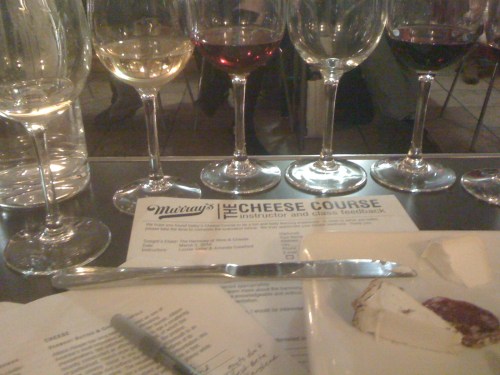
6 wines and 6 cheeses go head to head.

I attended “The Harmony of Wine & Cheese” with instructors Louise Geller (in the cheese corner) and Amanda Crawford (in the wine corner).  Amanda did a great job; she was friendly and approachable, she easily commanded the room, she knew her stuff and most importantly, she picked some delicious, off-the-beaten-path wines.

1. Channing Daughters Scuttlehole Chardonnay 2008.  Unoaked, this Chardonnay had notes of citrus, green melon, fresh herbs and honey.  From the North Fork of Long Island, the high acid style of this wine was a perfect complement to the high acid, lemony goat cheese it was paired with; Vermont Butter & Cheese Coupole.  A classic pairing here would have been Sauvignon Blanc, especially an old world style, such as Sancerre, but the local Chardonnay did the trick.

2. Étoile Chardonnay Domaine de Montbourgeau 2006.  From the Jura region in SE France, this is Chardonnay made in a purposely oxidized style, giving lots of nutty notes (think fino Sherry).  The funk of the wine helped to offset the intense fruitiness of its cow’s milk cheese partner; Jura Erguel.  This pairing illustrated, “what grows together, goes together”.

3. Grignolino “Pogetto” La Casaccia 2008.  gree-nyo-LEAN-oh is native to the Piedmont region of Italy and tends to be pale-colored with lots of red berry notes, some spice, high acid and low tannins.  Tannins and lactose are not friends and when paired together will often yield a metallic finish.  This fresh, fruity and tart wine was a swell partner for the fruity, floral, washed rind cow’s milk called Rubloz, from high in the western, French-speaking part of the Alps. 

4. Lambrusco “Bocciolo” Ermete 2007.  Like raspberry pop rocks, this wine dances on the tongue.  Say what you will about Lambrusco, but a fruity wine with a bit of sparkle and a bit of sweetness is just about the perfect thing when there’s salty meat or cheese involved.  The cheese pairing was Podda Classico, a cow/sheep combo aged for just over a year from the island of Sardinia.  The cheese was crunchy, salty, nutty and intense, but once Lambrusco was added to the mix, both went down easy. 

5. Viña Bosconia Reserva, Lopez de Heredia 2001.  The current release from this very traditional producer had notes of pomegranate, dried cherries, black tea and rose petals.  The dill and coconut from the American oak were evident, along with a bit of musty funk.  It was paired with Mrs. Quicke’s Cheddar from Devon, a traditional, cloth-bound cheese with intense horseradish and damp basement notes (certain bites were reminiscent of corked wine).  The funk of the two proved a pretty partnership.

6. Alvear PX Solera 1927.  From the Montilla region in southern Spain, this is a fortified wine made in the style of Sherry (think solera system).  The grape is PX, Pedro Ximénez, and the wine had notes of prunes, marmalade and toasted hazelnuts.  While super sweet, it still finished very clean.  A classic pairing with a sweet wine is blue cheese.  Louise instead went with Monte Enebro, a salty little devil of a goat cheese from Castilla y León, Spain.  This was hands down the best pairing of the night. 

Leave a comment

Filed under Wine

Wine coach

I recently learned that wine coaches exist.  Life coaches and dating coaches weren’t enough? 

Maybe wine coaches wear track suits bearing their initials, like Steve Bruce, soccer coach for Sunderland. This guy looks serious.

Another option could be short shorts and a wine glass instead of a whistle.

Regardless of the length of the pants, a stop watch, a clip board and tube socks would be required.  I picture a lot of shouting.  Some possible activities: overseeing tasting practice, running swirling drills, speed glass washing exercises, motivating the wine team prior to big drinking events.

p.s. This marks my 200th post – a big thank you to my readers.  Maybe I would’ve hit this number sooner with a wine coach.

1 Comment

Filed under Events, Wine

Sour grapes

The beginning of the grape ripening process is referred to as veraison and in the northern hemisphere, it happens in the summer. 

Red grapes undergoing veraison.

The term comes from the French véraison and it is the time in the vine cycle when the vine’s energies are shifted from growing the berries in size to developing their sweetness and ripe fruit flavor.  Before this process, the grapes’ color is dictated by cholorphyll.  Depending on the variety, anthocyanins will make some berries red-black and carotenoids will make others yellow-green.

Prior to this period of time, the grapes are referred to as green berries and wouldn’t be recognizable to most folks.  They’re hard, starchy, acidic and about half of their final size.   

Alien berries!

Most people wait to harvest their grapes until they are fully ripe.  I came across a video, however, that shows how harvesting some of the grapes early can naturally promote acidity in wine (as opposed to adding tartaric acid later on in the winemaking process).  The clip features my friends Tracey and Jared of A Donkey and Goat Winery, based in Berkeley, CA. 

Vodpod videos no longer available.

more about “Sour grapes“, posted with vodpod


Leave a comment

Filed under Videos, Wine

C is for cap

The cap (chapeau in French) is the layer of grape solids that forms on the surface during red wine fermentation. 

Grape solids forming on the top of fermenting Mourvedre at A Donkey and Goat Winery in CA.

Fermenting Mourvedre at A Donkey and Goat winery in CA.

I got to sample a grape and it was like eating pop rocks, because of the CO2 forming as a by-product of fermentation.  The cap limits the oxygen available to the yeast, encouraging them to eat away at the grape sugar to form alcohol.  

The cap must be broken up and mixed back in with the liquid below, however, in order to extract the phenolics, which add color, flavor and longevity to the wine.  Phenolics can be found throughout the grape, but are particularly rich in the skins, seeds and stems (the solids!).  On a smaller production scale, the winemaker will “punch down” the cap several times per day.

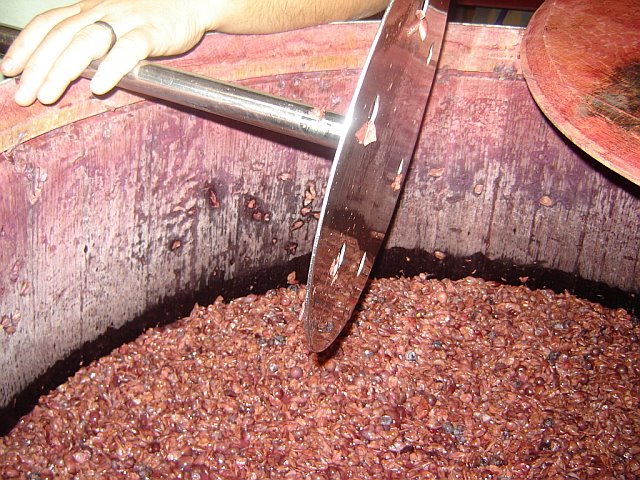
Jared showing off his stainless punch down tool.

The punch down tool breaking through the cap. Notice the bubbles. Jared told me the cap would support his weight and he's not a little guy (he volunteered that information, too).

On a larger production scale, the winery will “pump over” the cap.

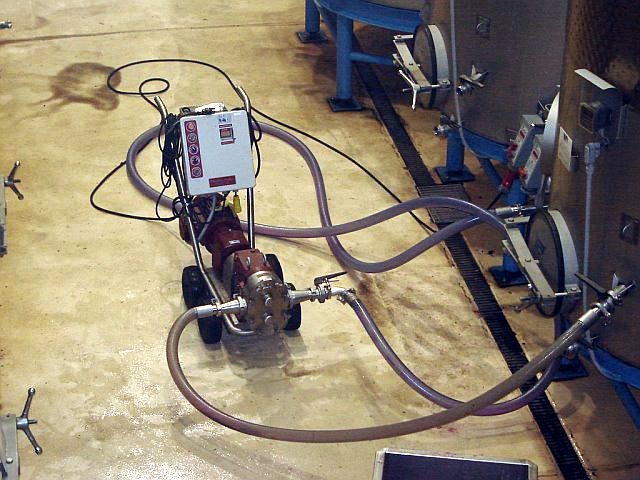
A pump doing its thing at Miner Family in CA.

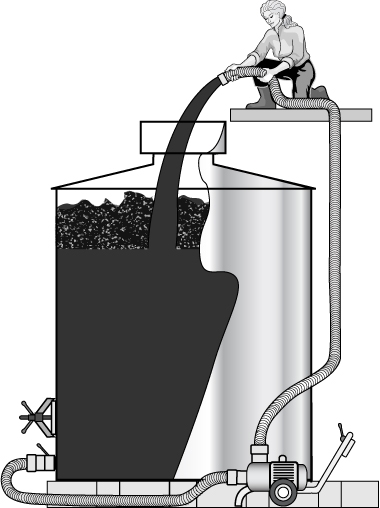
We recently had an illustration created to use in our classes to explain how pumping over works.  Thanks, Laurel.

Flushing the liquid back over the cap to break it up, using a pump. My favorite part of this illustration is the female winemaker.

2 Comments

Filed under Alphabet Soup, Wine

Well-suited pair

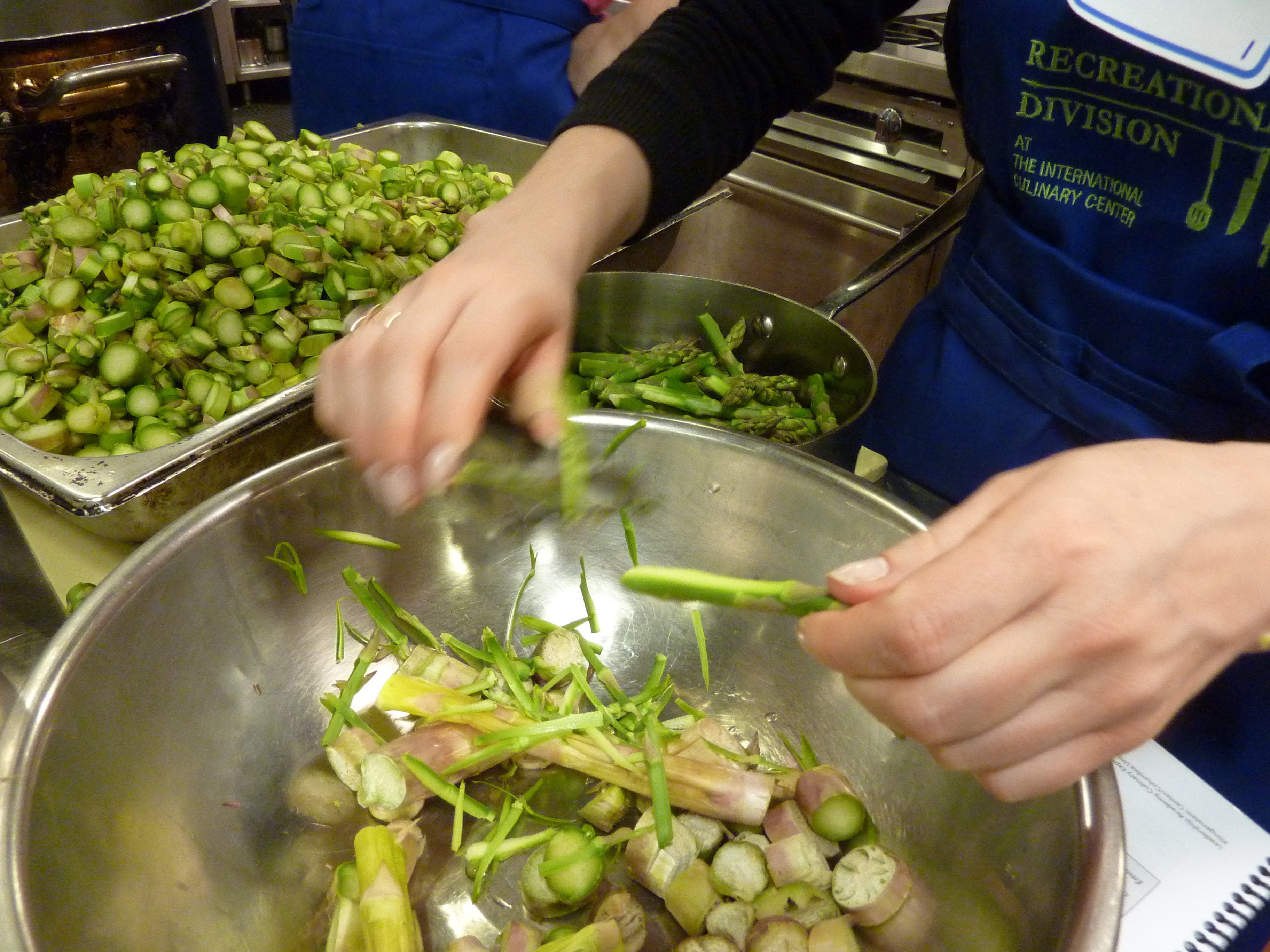
We hosted a team building event at school last night for the Klingenstein Center, part of Columbia University’s Teachers College.  The group made a 3 course meal and then sat down together to enjoy the fruits of their labor. 

I was not excited about the prospect of selecting a wine when I learned the first course was asparagus soup.

Asparagus, along with artichokes, eggs, garlic, cumin, chocolate and several other tasty things, can be tricky to pair with wine.  Certain chemicals in the asparagus can make your wine taste grassy, vegetal, tinny or just plain gross. 

When I saw the finished product, though, I knew I had to come up with something.

Asparagus soup garnished with a chicken lollipop, wild mushrooms and creme fraiche. It was too pretty to go wine-less.

The general rules when selecting a wine to match these dreaded spears are as follows: go with something crisp and refreshing (think Albariño or Pinot Grigio), try a sparkling wine (don’t go too yeasty here, maybe Cava), opt for an aromatic varietal (Grüner Veltliner is a good choice), and avoid tannic or oaky wines.  Ignoring all this, I chose a Chardonnay.

Specifically, I selected the 2006 Kumeu River Village Chardonnay.  Now to be fair, this is a wine from New Zealand, with notes of ripe peaches, flinty minerals and a distinct nuttiness, as opposed to an oak bomb that you might find from California.  While some of this wine (1/3) saw some oak, most was aged in stainless steel. 

The nuttiness was a perfect match to the earthiness in the asparagus and the mushrooms.  The ripe fruit notes worked really well with the sweet chicken.  The acidity worked perfectly, too, thanks to the addition of the crème fraiche. 

Sometimes it pays off when you don’t follow the rules.

Leave a comment

Filed under Wine