Sugar showdown

73408082

Blue agave plant in Jalisco State, Mexico

Agave (ah-GAH-vay) nectar is the new simple syrup at many bars in NYC.  It’s produced from the same blue agave plant used to make tequila – large, spiky and in the succulent family, like aloe vera.  Species of agave abound, but blue agave has a high carbohydrate content which turns into a high fructose content in the nectar, making it the most desirable variety.  The sap or nectar from the plant is called aguamiel or honey water in Mexico and it’s extracted from the piña or core of the 7-10 year old agave plants.  After extraction, it’s filtered and heated, breaking the carbs down into sugars. 

Light and dark varieties are made – both can be made from the same plants; the differences stem from filtering and heating temperatures.  The lighter ones are compared to honey and represent the style you’ll mostly find at the bars, while the darker ones are compared to maple syrup.  You can find it at health food stores, Whole Foods or online.

In a recent conversation with my boss, Nils about my home bar, I mentioned my bottle of agave nectar.  He asked why I bothered, citing that it’s just a more expensive version of simple syrup.  My response was that I didn’t need to use as much because it was sweeter.  He then said, well, it depends on how you make your simple syrup.  Duh. 

Historically, I’ve used a one-to-one ratio of sugar to water when making simple syrup.  Dissolve 1 cup of sugar in 1 cup water on the stovetop – pretty simple, right?  Nils advocates using 2 parts sugar to 1 part water, making the excellent point that he prefers not to dilute his cocktails. 

I was also a sucker for the packaging of the agave nectar – a clean, little squeeze bottle – as opposed to the unwieldy Tupperware I’ve used to store simple syrup in the past.  Getting the sticky liquid from the tub of plastic often yielded more syrup on the inside of the refrigerator/floor/counter than it did into the cocktail-in-the-making. 

What about the difference in taste between simple syrup and agave nectar?  Which is tastier?  In a recent hydrocolloids class, Nils and Dave did a quick experiment and got mixed results – some preferred the simple, some the agave. 

When my current bottle of agave runs out, I’m going to give Nils’ recipe a shot.  He keeps his in the fridge and says it lasts a few weeks.
3 Comments

Filed under Cocktails, How to

Cucumber Cooler

I’ve been playing around with some cocktails using the spirits from Finger Lakes Distilling (FLD).

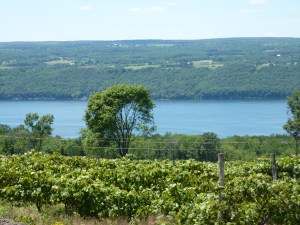
lake view from distillery

view of Seneca Lake from FLD

First up is their Seneca Drums Gin.  A little about the name – Seneca is the name of the lake the distillery overlooks and it’s one of 11 lakes that comprise the Finger Lakes in upstate NY – it’s 38 miles long and at one point, 618 ft deep.  The Seneca Drums refer to the booming sounds that can occaisonally be heard over the lake on warm summer evenings – some attribute the noise to geothermal reactions while the more mystical among us think it’s a message from the Iroquois who used to inhabit the area.  Given the other things I’ve heard them referred to as – “guns of the Seneca” and “lake farts” – I think FLD made the right choice.

The gin is 86 proof with a 75% (local) grape base/25% grain base.  It’s zippy and fresh and will keep you coming back for more.  The signature blend of 11 botanicals gives notes of citrus peel, juniper, cucumber, clove and light anise.

CucumberSince we’re finally starting to feel a little summer, I decided on a very refreshing cocktail.  I started with a cucumber – it’s a great partner with gin and who doesn’t want to be cool as a cucumber?  I removed the skin and the seeds and cut it into small pieces.
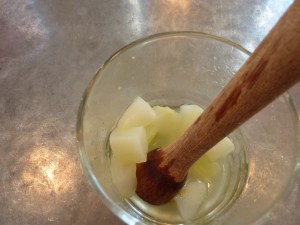
I cut enough to fill the bottom of a rocks glass with a single layer, I added the juice from 1/2 a lime and a pinch of salt and then I muddled.

muddler

After the cucumbers were sufficiently muddled, I added 2 oz. of the Seneca Drums Gin, 1 oz. of Dolin Blanc Vermouth, and enough ice to almost fill the glass.  I chose the Dolin Blanc because it has a touch of sweetness and I wanted to balance the tart citrus from the lime and the herbal qualities of the gin.  Then I transferred everything back and forth between the glass and a shaker a few times to cool everything down as well as to mix the ingredients.  I topped it off with a splash of tonic water and garnished it with a cucumber ribbon (which I made using a vegetable peeler) and a lime segment.  Voila – summer refreshment in a glass.

SDG and cocktailclose up cooler

4 Comments

Filed under Cocktails

The thirsty bird gets the worm

I remember watching Hanna-Barbera cartoons when I was little and seeing the empty bottle of alcohol with the triple X on the label and the worm smiling out from the bottom.  The person who had consumed the spirit inside would be wearing a cowboy hat as well as a dark mustache.  I had no idea what had been in the bottle, but I remember thinking that worm must be one tough cookie.

Turns out those worms were originally used to help test the strength (and safety) of the spirit before hydrometers and other analytical equipment was developed – just like how the sailors used to light their rum on fire to make sure it hadn’t been diluted.  If the worm pickled and was preserved, the spirit was good.  If the worm decayed, the spirit had to be re-distilled.

Contrary to popular belief, the spirit in question is mescal, not tequila.  All tequilas are mescals, but not all mescals are tequilas.  Sure, they’re both Mexican and made from agave (which is NOT in the cactus family), but here are some differences:

  1. Mescal is made from a number of different agave varieties, while tequila only uses the blue variety of agave.
  2. The agave used to make tequila is cooked using ovens or autoclaves, while the agave used to make mescal is cooked in underground ovens using charcoal.  The smokiness imparted from this charcoal accounts for the major taste difference between tequila and mescal.
  3. Traditionally, mescal was distilled once and tequila twice.  Most mescal on the Mexican market today though has been distilled twice, too.
  4. Tequila is originally from the Jalisco state in Mexico and mescal is from the Oaxaca State.

So, where did these worms come from?  The worms are moth larva and live inside the agave plants.  Two types are found – a white one called blanco and a red one called rojo.  The white worm prefers the leaves, while the red one lives closer to the roots.  I guess enough people found the worm as charming as I did because now they’re grown commercially for inclusion in mescal bottling.

6 Comments

Filed under Lessons, Spirits

It’s not just for the birds

LimeLiming has many definitions: “liming the soil” or “liming the lawn” – applying lime (calcium hyrdroxide) to acidic soils to raise the pH, soaking hides for the production of parchment or to remove the hair before tanning, using birdlime (a sticky, plant-based substance) to catch birds and most appropriate for our purposes, a Caribbean expression for hanging out.
In the 18th century, liming came about as a term for relaxing in the islands with friends at the end of the day, sharing stories and drinking rum.  In terms of etymology, was it the British soldiers (limeys) in the colonized Caribbean or the fact that rum is really tasty with lime?  It was a practice of the Royal and Merchant Navies of Britain to supply their sailors with lime juice (limes were more prevalent than lemons) to prevent scurvy. James Lind, a surgeon and pioneer of naval hygiene, was responsible for determining the link between citrus fruits and scurvy.  He was inspired to conduct one of the world’s first clinical trials after noticing that Dutch sailors who ate cabbage had little problems with scurvy.

Can you imagine how it smelled below decks on those Dutch ships?

Leave a comment

Filed under Lessons, Spirits

Rumbullion

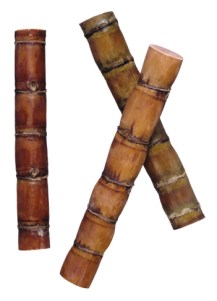
sugarcaneThirsty humans can be a creative lot, making a spirit from a perennial tropical grass.
Rum is produced in over 100 countries today. While many consider the Caribbean to be rum’s home, accounts from the time of Alexander the Great mention the use of sugarcane.

While the exact origin of sugarcane is not known, it was introduced to Europe by the Arabs around 636 A.D. It never took off though, because it needed a longer growing season and warmer temperatures than Europe could offer. Columbus took cane cuttings from the Canary Islands to the West Indies. The early Spanish settlers working in sugar factories in the West Indies realized that the residual molasses from sugar production fermented easily.

The name rum could come from the Spanish ron – chances are good the Spanish were on to distilling before the British decided to use the sugarcane plantations in their colonies as a source of economic growth. It could also be from the Latin saccharum, meaning sugar, or from rombustion, meaning a strong liquid or my favorite, rumbullion, meaning a great tempest.

The two main types of rum depend on which form the sugar cane is in at the time of fermentation. Continue reading

2 Comments

Filed under Lessons, Spirits

New York Spirit Awards

This past Monday, the New York Spirit Awards (NYSA) announced the winners from this year’s inaugural competition.  NYSA was founded by 2 thirsty spirits – Adam Levy, a spirits writer who named his dog after Brooklyn Brewery’s brewmaster (Garrett Oliver) and Dori Bryant, the founder of The Polished Palate who has been given the title “The Rum Queen” by the St. Petersburg Times.

The closed-to-the-public tasting took place on June 14 and 15 at the Javits Center in Manhattan, with 265 brands of spirits (both big and small).  The judges were an impressive mix of buyers, sommeliers, mixologists and other trade folks.  78 awards were given at 3 different levels – “Best of Show” (brand with highest number of points), FDR Awards for “Best in Category” (highest scoring brand in each category, giving props to the President who repealed Prohibition) and Best of Class for “Top Performers” (top scoring 20% of brands in each category).

You may be beginning to wonder why you should care.  Well, turns out that my friends from Finger Lakes Distilling took Best of Class awards for both the brands they entered – Vintner’s Vodka and Seneca Drums Gin!  Right now, they’re available in these markets – Watkins Glen, Ithaca, Elmira, Corning, and Penn Yan – but fear not thirsty friends, I’ll keep you posted as they grow.

1 Comment

Filed under Events, Spirits

Yellow wine, straw wine

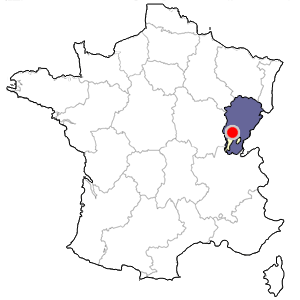
ligier-arbois-map

Map courtesy of Charles Neal Selections

As promised, I want to touch on a few of the unique wine styles found in the Jura region of France.

Vin jaune (yellow wine) is one and it’s made in a purposely oxidized style.  The grapes are picked and fermented as normal, but then the wine is placed in old, 60 gallon casks that are not filled to the top in order to encourage the growth of a film-forming yeast called the voile (veil).  This process is similar to sherry production but there’s no fortification.  The voile is not as thick as the flor (the Spanish voile equivalent) in sherry production because the temperatures are lower here than in southern Spain.   The wine is not bottled until 6 years and 3 months after harvest and it’s full-bodied, mineral-driven and nutty.

The best vin jaune appellation is Château-Chalon, where the wine must be made using the local Savagnin grapes.  You’ll often see it in a distinct clavelin bottle, which is 620 ml, as opposed to the standard 750 ml wine bottle.   The locals claim that 620 ml is the amount left after leaving a liter in cask for 6 years.  Vin jaune from the best vintages will last 50 or more years.  A compound called sotolan forms during the bottle aging process and can give the wine spicy, curry flavors.  Try it with poultry dishes or a cheese course.  Here are some producers to look for: Jean Macle, Berthet-Bondet, Baud Père et Fils and Philippe Butin.

Another unique style in the region is vin de paille (straw wine), a long-lived sweet white wine made from grapes that have been dried on straw mats.  This style is called strohwein in Germany.  These wines are rare and only produced in very ripe vintages.  Once the grapes have raisinated, the yield is pretty small, so you’ll usually find these wines in half-bottles.

The Jura producers use Savagnin, Poulsard or Chardonnay to make this style and they often will place the grapes in boxes, rather than on mats, to dry them.  The grapes are pressed in January and are aged in cask for at least three years.  The resulting wine is rich and honeyed, with notes of dried apricots.  Try it with fruity or nutty desserts, with pungent cheeses or as a dessert on its own.

4 Comments

Filed under Lessons, Wine

Thirsty strikes again on corksavvy.com

Here’s a 4 minute clip on food and wine pairing.  Very attractive freeze frame don’t you think?

1 Comment

Filed under Lessons, Videos, Wine

My flame burns blue for you

I’m currently studying for a spirits exam and during the next few weeks I’m going to be sharing some fun facts that I’ve discovered in the process.

You’ve probably noticed in my postings that I’ll often give the percent alcohol by volume (ABV) of the beverage in question.  In the U.S., the “proof” measurement is used as well.  The proof is twice the percentage of ABV at 60°F – i.e. 80 proof=40% ABV.

Alcohol content is easy for distillers to measure these days with hydrometers and other modern equipment, but back in the old days, gunpowder was the analytical tool of choice.  Equal parts spirit and gunpowder were mixed and set alight.  If the gunpowder didn’t burn or just sparked, the spirit was too weak and if it burned too brightly, the spirit was too strong.  If the mixture burned evenly, and with a blue flame, it was considered to be “100% pure” or “100 proof”.  Turns out that a blue flame will appear at a 50/50  ratio.

In Britain, the proof to ABV ratio is 4:7.  In the 18th century payment to British sailors included a ration of rum.  These sailors also used the gunpowder trick, making sure the liquid would ignite and that it hadn’t been watered down – these thirsty fellows didn’t want any spirits that were “under proof”.   Rum that passed a sailor’s test was later found to contain 57.15% ABV, which is quite close to a 4:7 ratio of alcohol to total liquid.  The definition then became (4÷7) × 175 = 100 degrees proof spirit.  100% alcohol had (7÷7) × 175 = 175 degrees proof spirit, while alcohol with 50% ABV had (3.5÷7) × 175 = 87.5 degrees proof spirit.  To convert percentage of alcohol to degrees proof, multiply the percentage by 1.75 (and watch out for scurvy).

1 Comment

Filed under Lessons, Spirits

Pull back on the reins

82840004Phenols are a class of chemical compounds commonly found in wine (and chili peppers, cannabis, raspberries and wintergreen to name just a few).  In wine they can bestow pleasant aromas like vanilla, wood, cloves, carnations or animal smells such as horse. 

Now you may enjoy a little horse leather in your glass, but probably not horse manure.  4-ethyl-phenol is the compound responsible for this horseplay and there’s 4 times more it found in red wines than in white.  It shows up more often if the grapes have been macerated without any oxygen before the fermentation process.  Continue reading

1 Comment

Filed under Lessons, Wine