Category Archives: Wine

Sémillon you say?

An amusing article came out this week in the Telegraph.  The title, “Sémillon is the most mispronounced wine”, belies what seems to be an opportunity to make fun of British folks – not something you’d expect from a British publication:

*Ten per cent of people have complained that the waiter hasn’t poured them enough wine, when the intention was for them to taste it.

*One in twenty Britains have asked for a slice of lemon in their wine glass according to the poll of 3000 adults.

*One in twenty have “moaned” to a waiter that the wine is corked, not realizing it came from a screw-top bottle.

*Five per cent of the nation vigorously swirls the wine around in the glass to allow it to breathe but then embarrassingly spills it on themselves.

*16% of people who completed the poll said they often just order a bottle of expensive wine just so it looks like they know their wine, when they haven’t a clue what they’re actually drinking.

1 Comment

Filed under Wine

Alan Richman’s rules for ordering wine

In the current issue of GQ you’ll find Alan Richman’s 14 Tips for Ordering Wine in a Restaurant

Some highlights:

“I don’t care if the restaurant is pouring Chateau Latour into Minnie Mouse mugs, don’t walk into a restaurant carrying your own wine glasses. It’s more pretentious than wearing a monocle and spats.”

“Here’s what you do with a cork when it’s presented to you: Nothing. No sniffing, please.”

“Don’t be a big shot. Nobody can get everything right when it comes to detecting problems in wine. Can you identify sulphur, volative acidity, brettanomyces, and/or T.C.A.? That’s why sommeliers exist. If you hate the wine you’ve ordered and can’t articulate why, don’t be afraid to ask for help.”

If you’d like to learn my tips, join me for class here or here.  If you like Alan’s style, join him for class here.

Leave a comment

Filed under Lessons, Wine

Class with Karen MacNeil

Karen nosing a Sauvignon Blanc at the Rudd Center for Professional Wine Studies at the CIA in Napa.

I was excited that Karen was part of my Napa Valley adventure, as her book, The Wine Bible, was the first wine book I ever read.  We also use it here at The FCI in some of our wine classes.  She led us through a tasting our first day and administered our quiz on the last day. 

At one point she asked the question, “What makes great wine great?”  Her answer was “distinctiveness”, quickly adding that that doesn’t always translate to likability. 

She noted that when a wine is really good, as a teacher, it makes you a little nervous because there’s not much to say.  She elaborated on the idea and mentioned that when she finds she has few words it’s either because she’s not paying attention, the wine doesn’t have a lot to say, or the wine is so beautiful. 

She did just fine finding words for our class and it was fun to see the personality I recognized from her book standing at the front of our classroom.

Leave a comment

Filed under Wine

Going greener in Champagne

In today’s NYT’s Business Day section, Liz Alderman wrote a piece describing how some Champagne producers have changed their bottles in an attempt to reduce their carbon footprint.

I was pleasantly surprised by this news.  We think of Champagne as a region steeped in tradition, with an image of luxury that it must work hard to protect.  If they are willing to change their bottle by slimming its shoulders to reduce its weight, perhaps other regions will follow suit.

2 Comments

Filed under Wine

Grape sampling in Napa Valley

I spent the majority of this week in the Napa Valley thanks to the Napa Valley Vintners and my sponsor, Herta Peju of Peju Vineyards.

I have a few stories to post, but one of the best parts was dubbed, “Down & Dirty in the Vineyard”.  At 7:15 am this past Tuesday, 29 of us lined up in the hotel lobby, waiting for a vintner to pull our name out of a hat.  I was selected by Kristin, of Honig Vineyard & Winery.
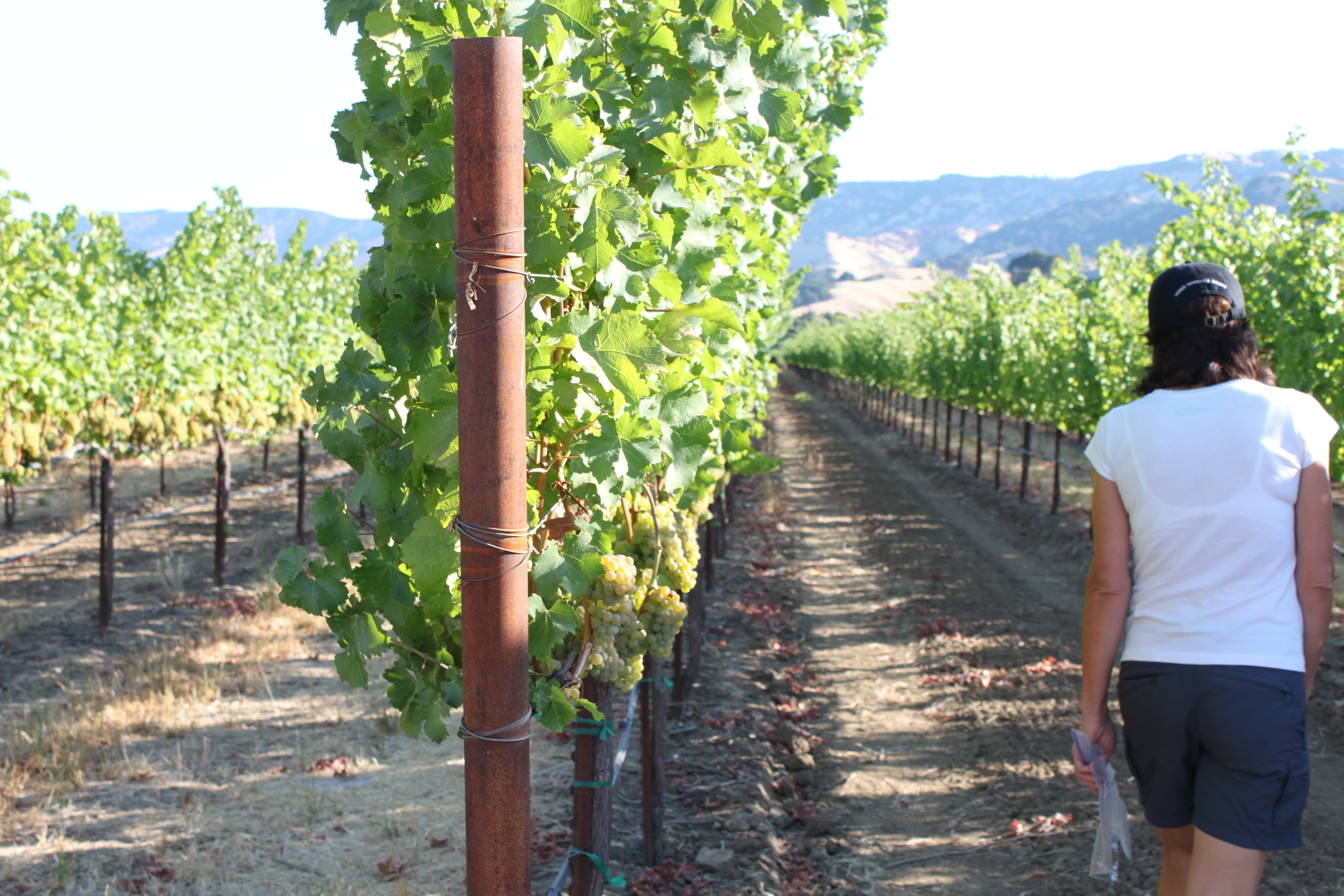
Following Kristin through one of Honig's Sauvignon Blanc vineyards. She wanted to test the sugar level, or Brix, in both her newer (approx. 6 yrs. old) and older (15-20 year old) vines in the Gordon Vineyard.

We traipsed down a few rows and selected berries from each vine, from the back, alternating between the top, middle and bottom of the cluster. We collected our spoils in baggies.

Grape porn. Napa's had a cool summer (jealous, New Yorkers?) and they're about 2 weeks behind where they usually would be, in terms of ripeness. Of course, our down and dirty day got up to 113.

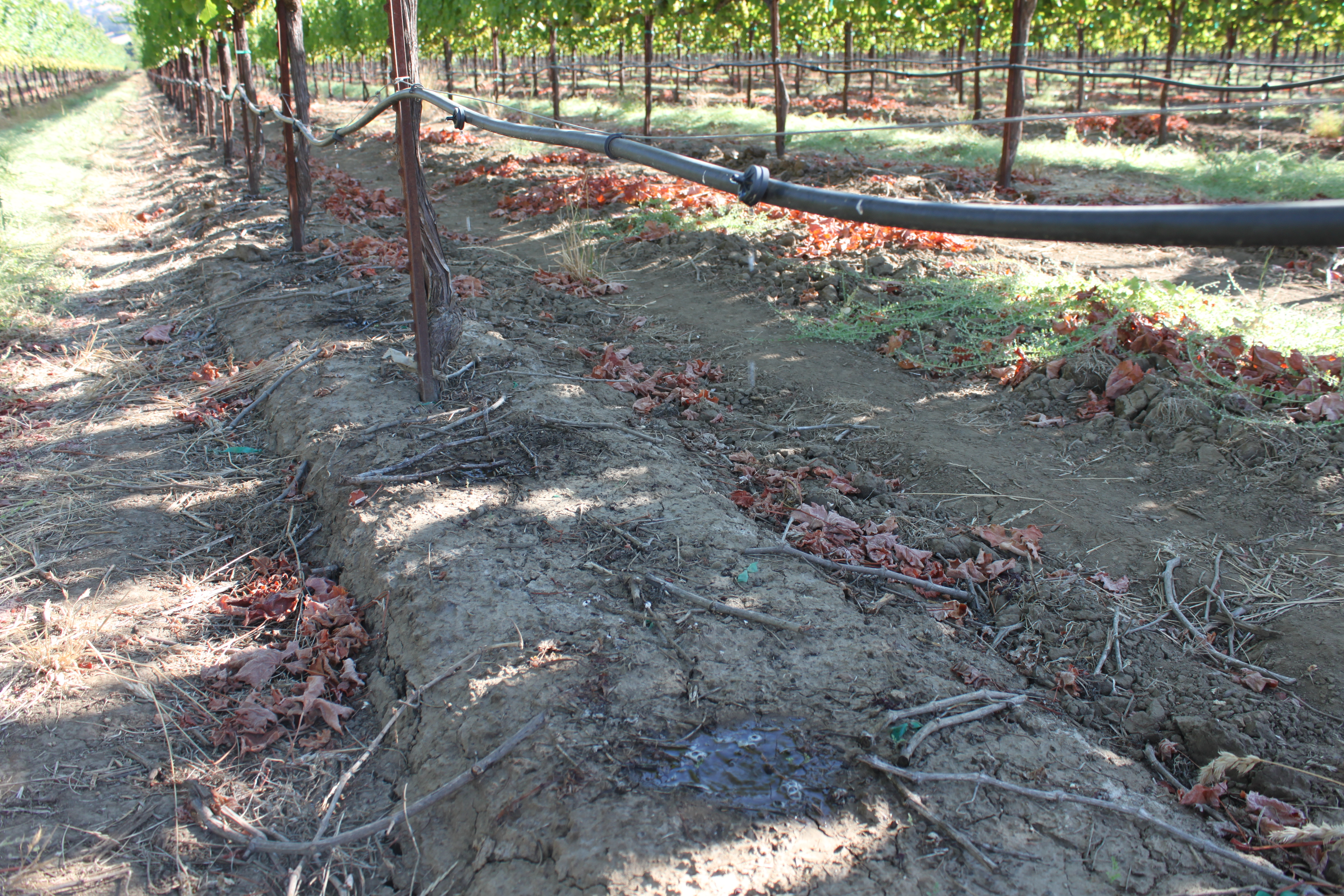
Since at least another day of the heat wave was expected, Kristin had her vineyard manager turn on the water. If you look carefully, you can see the drops beginning to emerge from the drip irrigation system.

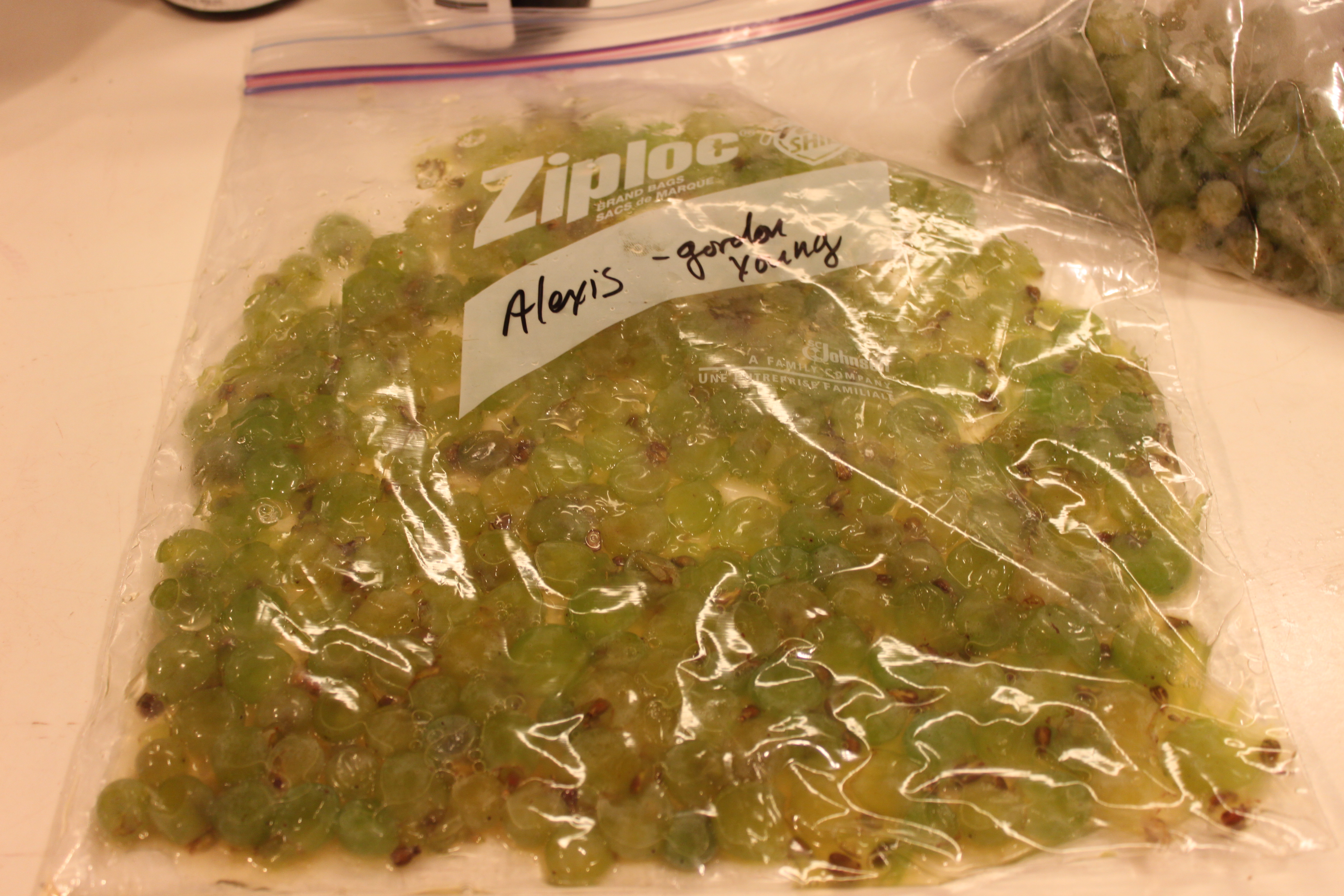
Back at the lab, we squished our grapes to relase the juice. Notice how the seeds are starting to ripen, going from green to brown.

Pouring a small amount of grape juice onto the refractometer. I hadn't seen this style before and Kristin guessed it was a couple hundred bucks.

The older vines were almost a brix ahead of the younger vines. We had noticed their sweetness through snacking in the vineyard. Kristin thought she'd probably harvest at the end of this week, or early next. The final alcohol in the wine can be measured as around 0.6 * the Brix at harvest.
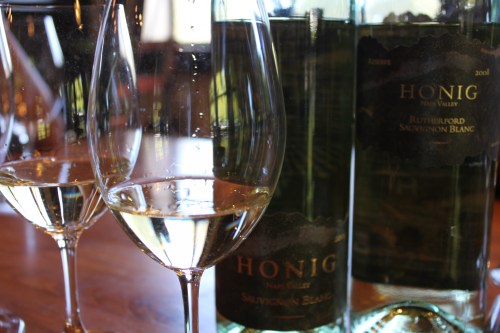
Rewarding our hard work with last year's wines. My favorite was the Honig Napa Sauvignon Blanc - clean, crisp, lively and full of grapefruit notes, it's also a great bargain at $16. Thanks, Kristin, for a great experience!

2 Comments

Filed under Wine

Sommelier smackdown

I just learned I’ll be competing at the 1st annual Sommelier Smackdown at the 5th annual International Chefs Congress, sponsored by StarChefs.  A multi-day, “on-the-fly” food and wine pairing contest with the chance to win a trip to Italy.  Oh.  Heck.  Yes.

3 Comments

Filed under Events, Wine

“Are they giving you wine back there or are you just listening to my bullshit speech?”

At last week’s conference, I attended a 3+ hour seminar on dry Riesling given by Terry Theise.   Terry’s often off-color comments and his selection of incredible wines made the time fly by.

Terry "I put the heed in hedonism" Thiese. During the seminar he also described himself as a "grey beard" and a "silverback".

We sampled 20 German and Austrian Rieslings that Terry imports, attempting to help him answer two questions, “First, what is the nature of the market for dry Rieslings?  And, second, what can educators do to make it grow?”  We did significantly more tasting than question answering, but I can understand why consumers have hang-ups about Riesling:

  • The labels are confusing.  I’m not even referring to the fact that they may be in a different language.  It can be impossible to tell if you’re going to get a sweet or dry wine, even if you’re familiar with the country’s wine laws or the particular producer’s style, as it may vary depending on the vintage.
  • They don’t come cheap.  Out of the 20 we tasted, one retailed for $19 and another for $25, but even these “good values” aren’t in the average consumer’s price range for even a semi-regular purchase.  When you add a restaurant mark-up to the equation, forget it.
  • Consumers still think of Riesling as sweet.  This, of course, is not always the case, but for some reason, many folks associate dry wines with sophistication.  As Terry noted, “the singular genius of Riesling is its ability to be delicious and useful in almost every variation of dryness and sweetness”.  Can your Chardonnay or your Sauvignon Blanc do that?

Hopefully, with more time, education, and passionate folks like Terry or Paul Grieco, more consumers will get on the Riesling train.

Some highlights from the tasting, with average retail price:

  1. 2009 Selbach-Oster Schmitt (Mosel, Germany) $34.  Floral, peach, slight petrol, pronounced minerality and crazy acidity.
  2. 2009 Gysler Weinheimer Kapellenberg “S” (Rheinhessen, Germany) $28.  Apple blossom, bacon smoke, certified biodynamic.
  3. 2009 Nigl Pellingen “Privat” Erste Lage (Kremstal, Austria) $66.  Meyer lemon, boxwood, licorice, minerals and an incredibly creamy mouthfeel.
  4. 2009 Spreitzer Lenchen Erstes Gewächs (Rheingau, Germany) $39.  Apple, nectarine, peach, or as Terry noted, “an 11 out of 10 on the suck it down scale”.
  5. 2009 Eugen Müller Forster Freundstück Spätlese (Pfalz, Germany) $31.  Lime jello, white flowers, or “a cheerful puppy that licks your face”.
  6. 2008 Schloss Gobelsburg “Tradition” (Kamptal, Austria) $54.  The tradition here refers to old-school methods: fermenting in oak, racking instead of filtering.  Rounder, gentler style, or “everything that great white wine can be”.
  7. 2008 Wagner-Stempel Heerkretz Grosses Gewächs (Rheinhessen, Germany) $82.  Electric, with lime and underripe peach.  Terry exclaimed, “Ok, baby, we’re takin’ a ride! I like to use technical terms.”
  8. 2009 Leitz Rüdesheimer Berg Kaisersteinfels Alte Reben (Rheingau, Germany) $42. Incredible complexity – the citrus fruits, the stone fruits and the minerality all ran together.  Terry called it the “perfection of dry Riesling”. 

Leave a comment

Filed under Wine

Styles of NV Champagne

Mary Ewing-Mulligan and Ed McCarthy were back at the SWE Conference this year and unfortunately their seminar occurred over lunch.  Last year, with about 50 attendees at their seminar, they covered Prestige Cuvées, but with several hundred of us at lunch, we were relegated to sipping NV Champagne.

Late for lunch=obstructed view seat.

These two love Champagne, and it shows.  They went through some things I knew:

  • Non-Vintage Champagne is a misnomer; the wine is a blend from several vintages
  • Since the climate is so marginal, the producers historically haven’t had suitable weather to produce Vintage Champagnes each year
  • Each year, the Champagne houses must keep reserve wines in their cellars to blend into future Non-Vintage Champagnes (otherwise they wouldn’t be able to make Champagne in years with crappy weather)
  • Non-Vintage Champagnes are the heart of the bubbly business, accounting for 85-90% of all Champagne produced
  • Most retail for $30-$50
  • You won’t see “Non-Vintage” on the label; you just won’t find a vintage year.  You may also see terms like Brut Imperial, Brut Réserve, Cordon Rouge, Brut Premier, Brut Classic and so on
  • 3 other types of Non-Vintage Champagne include: Blanc de Blancs (100% Chardonnay), Rosé (usually a blend of 2 or 3 varieties), and Blanc de Noirs (1 or 2 black varieties – Pinot Noir/Pinot Meunier).  You’ll also find these 3 styles made as Vintage Champagnes

Some things I didn’t:

  • Non-Vintage Champagnes were the only style available for the first 150 years of Champagne’s history
  • Vintage Champagne did not become commercially available until the late 19th century
  • While it’s difficult to tell how long a Non-Vintage Champagne has been out in the marketplace, one trick is to check out the cork.  A more compressed cork = older Champagne
  • The quantity of residual sugar allowed in Brut Champagne has changed from 6-15 g to 6-12 g.  Extra dry used to start at 12 g, so there was some overlap

At one point, they covered 6 differentiating factors between house styles.

  1. Terroir.  Yes, it really does make a difference.
  2. Grapes.  Chardonnay, Pinot Noir and Pinot Meunier each bring unique qualities to the blend.
  3. Reserve wines.  These are what really creates the house style.  The questions then become what are the age of the reserve wines and how many are there?  This will vary from house to house.  2 or 3 wines, minimum will be added to the base, while the average is 5 or 6.  Krug uses 10-13.  Reserve wines can make up 12-40% of the blend.
  4. Amount of time prior to disgorging.  The minimum is now 18 months (it used to be 15 months).  Most houses age the wines for 2-3 years, while some will go even longer. 
  5. Dosage.  This will determine the sweetness of the Champagne.
  6. Quality of the base vintage.  This is not a stylistic issue, but rather what Mother Nature doles out.

They also shared with us how they categorize different styles of Champagne.

  1. Light-bodied, elegant style.  These are best as an aperitif.  Examples include: Ruinart, Jacquesson, Pommery, Billecart-Salmon, Nicolas Feuillate, Laurent-Perrier.
  2. Light to medium style.  These are a bit richer and would pair nicely with a first course.  Examples include: Deutz, Mumm, Taittinger, Guy Charlemagne, Moet & Chandon.
  3. Medium to full style.  These often have more Pinot Noir in the mix.  Examples include: Pol Roger, Philiponnat.
  4. Full to powerful.  These will have more reserve wines blended in.  Examples include: Gosset, Egly-Ouriet, H. Billiot, Pierre Peters.

Now, for what we tasted, with average retail price listed.

  1. Ayala Brut Majeur NV ($36-$39).  Lighter style, with bracing acidity.  45% Pinot Noir, 35% Chardonnay, 20% Pinot Meunier.  80% from 2004, with 20% reserve wines.  Aged 2 1/2 years on the lees.  Dosage is 8.5 g.
  2. Henriot Blanc Souverain NV ($49).  This was a Blanc de Blancs.  It spent 3 years on the lees and had a dosage of 10 g.
  3. G.H. Mumm Cordon Rouge NV ($30-$34).  45% Pinot Noir, 30% Chardonnay, 25% Pinot Meunier.  2 1/2 years on the lees.  This was one of the tastiest “big house” Champagnes I’ve had in some time, with a great price.
  4. Charles Heidsieck Brut Réserve NV ($35-$40).  40% Chardonnay, 40% Pinot Noir, 20% Pinot Meunier.  60% from 2005, 40% reserve wines.  Richer, “dinner” style.
  5. Louis Roederer Brut Premier NV ($37-$38).  2/3 Pinots and 1/3 Chardonnay.  3 years aging on the lees.  
  6. Gosset Grande Reserve NV ($60-$65).  Only Pinot Noir and Chardonnay from Premier and Grand Cru vineyards.  Aged 5 years on the lees, with 8 g. dosage.  Some perceptible oak.  My favorite of the tasting.   

Leave a comment

Filed under Wine

Breathalyzer before buying

I never anticipated that buying wine would have anything to do with homeland security technology. 

Pennsylvania is testing out vending machines for wine.  The bottle of Korbel I spied in the video doesn’t instill much confidence, though I’m all for making it more convenient for folks to buy and enjoy wine.

1 Comment

Filed under Alcohol in the News, Videos, Wine

How lieblich

In preparation for an upcoming nerd conference (this year’s is in DC), I’m nerding out.  Here’s something I’m sure you’re all desperate for – an Austrian residual sugar chart!

Austrian Term English Translation Amount of Residual Sugar
Trocken Dry Up to .9%…provided that the total acidity is no more than .2% less than the residual sugar content
Extra Trocken Extra Dry Up to .4%
Halbtrocken Semi Dry Up to 1.2%
Lieblich “Charming” Up to 4.5%
Süss Sweet Over 4.5%

Leave a comment

Filed under Wine