Category Archives: Wine

Wine-sicles

popsicle

I’ve never had frozen wine, but I’ve definitely left a rosé in the freezer too long when speed-chilling it. Come to think of it, a Riesling slushy doesn’t sound half bad.

As you may have guessed, this post is about serving temperatures. People can be quite particular about the temperature of the wine in their glass. Different wine books, websites and organizations will all offer advice on this topic and exceptions seem to be the rule. Click here for 6 tips

2 Comments

Filed under Lessons, Wine

Virtual cellar

How many times have you enjoyed a great bottle of wine and then instantly forgotten the name of it?  I have an easy and free solution for you. 

1. Take a picture of the wine bottle you’d like to remember using the camera on your cell phone.

2. Email the picture to mycellar@corksavvy.com.  If you choose to add a subject, that will become the title of your entry –  “Lucien Albrecht Cremant d’Alsace” or “last night’s dinner at L’Ecole”.  If you choose to add any text in the body of the email, that will become your description – “sparkling, pink and delicious” or “great with oysters”.

3. Log-in to corksavvy.com.  If you don’t have an account with them yet, you can still sign in:

User Name: your email

Password: your email

Your email will be recognized and a virtual cellar will be started for you.  Your photos will show up in “The Wine Diary”.  Don’t stress about what you write in step #2 because you can add more details to any of your entries whenever you choose.  You can also change your password once you log-in to your account. 

No label savers, scrapbooks or iPhone apps required.  How cool is that?

2 Comments

Filed under Wine

Haunting in Himrod

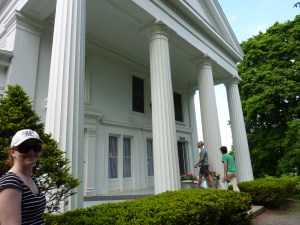
P1000052

The tasting room for Miles Wine Cellars is in a Greek revival style mansion built in 1802. 

The current owners learned their house was a stop on the Underground Railroad when they discovered Civil War-era pennnies in the cistern.  A local historical society confirmed that the pennies had been minted by banks in the South and that they were most likely left behind by former slaves grateful to be escaping. 

The family has also had many paranormal encounters since living and working there – mist in the kitchen, slamming doors, flying comforters.  Most of the activity has been more inconvenient than frightening, but the owners have admitted to taking great care in cleaning and maintaining the cemetery that’s on the property. 

They’ve also created a wine in honor of the newlyweds who lived there in the mid-19th century – a light and fruity blend of Chardonnay and Cayuga White labeled “Ghost”.  It’s believed that the groom met an untimely end by falling off a ladder while changing an oil lamp on the front porch and his new bride died soon after of a broken heart.  They’ve been spotted throughout the house, but most frequently on the front porch and usually in classic Victorian garb.  Click here to see what we tasted

1 Comment

Filed under Wine

Hermann the German

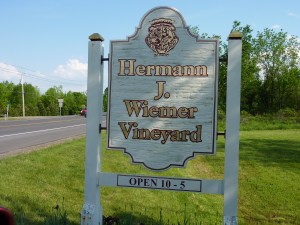
Yesterday, I visited:

P1000050

Hermann J. Wiemer purchased 140 acres on the west side of Seneca Lake (Finger Lakes, upstate NY) in 1973 and released his first vintage in 1979.  He’s originally from Bernkastel, in the Mosel region of Germany and his family has a winemaking history of over 3oo years. 

He’s considered one of the pioneers in this region and was one of the first to focus on planting vitis vinifera grapes – this is the species of all the wine grapes you’ve heard of before; Chardonnay, Sauvignon Blanc, Cabernet Sauvignon, etc.  Previously, most plantings in this area had been vitis labrusca – think concord grapes and Welch’s grape juice. 

The cool climate and gravelly soils in the Finger Lakes reminded Wiemer of his family’s vineyards in the Mosel.  His dedication to old-world style winemaking and the quality of the wines he’s produced have not gone unnoticed – just this past week was a great mention in the New York Times where Eric Asimov focused on Complex American Wine at an Easy Price to Pay. Click here to see what I sampled

Leave a comment

Filed under Wine

Tiny bubbles take two

56803872

Last week I explained how Champagne is made, but not all producers of bubbly follow the traditional method.  There are a few other ways to go.

1. Transversage: a twist on the traditional method.  Think about all those different sized bottles that Champagne comes in – half-bottles, the adorable splits (187 ml) and the big boys with fun names like Methuselah (8 bottles) or Balthazar (16 bottles) – going through the strict tradtional method with all of these would get out of hand.  Instead, immediately after disgorgement, the sparkling wine is put into a pressurized tank where it receives its dosage and then gets transferred to different sized bottles.

2. Transfer Method: a combination of individual bottle fermentation and bulk clarification.  This process follows every single step of the traditional method up to and including the liqueur de tirage, individual bottle fermentation and bottle aging.  There is a period of lees aging, too.  Instead of riddling, however, the bottles are chilled and their contents are transferred (get it?) to a bulk pressure tank where sediment is removed.  The bottles are washed and refilled with the newly filtered sparkling wine.  It may say “fermented in the bottle” on the label, but the kicker is that it wasn’t necessarily that bottle.  Producers will save some time and money by nixing the riddling process.

3. Continuous Method: was developed in the USSR and is now used in Germany and Portugal.  A network of (usually) five tanks are under five atmospheres of pressure – the same level of fizz in most sparklers.  At one end, the base wine together with sugar and yeast is pumped in and the second fermentation begins.  As you know, this second fermentation will create additional pressure (from released carbon dioxide) in the tank, but the yeast cannot thrive under this pressure, so additional yeast has to be added continuously.  The second and third tanks are partly filled with something like wood shavings to provide some surface area for the dead yeast cells to accumulate.  This is where autolysis (the breakdown of the yeast cells) occurs, giving us that toasty, nutty bouquet.  The fourth and fifth tanks don’t contain any yeast cells.  The wine comes out pretty clear, having spent an average of 3-4 weeks in the system.

4. Charmat process or tank method: If two names weren’t enough, you may hear it referred to as cuve close (French for sealed tank) or bulk method.  Eugene Charmat developed it in the early 20th century in Bordeaux.  It’s cheaper, faster and less labor-intensive than anything we’ve discussed so far.  It’s best suited for wines not intended for aging.  The base wine is held in a pressurized tank where yeast and sugar are added to provoke the second fermentation.  There’s no lees aging here; instead the emphasis is on the youthful, floral and primary fruit aromas – think Prosecco. 

5. Carbonation: yup, just like Coca-cola.  Also carries the charming names injection and bicycle pump method.  Carbon dioxide is pumped from cylinders into a tank of wine which is then bottled under pressure.  Since the carbon dioxide is not created within the liquid, it never really integrates – the bubbles are bigger and dissipate quickly.  This is the cheapest method of all, but fear not, it only accounts for about 10 percent of sparkling production.

1 Comment

Filed under Lessons, Wine

One stop shopping

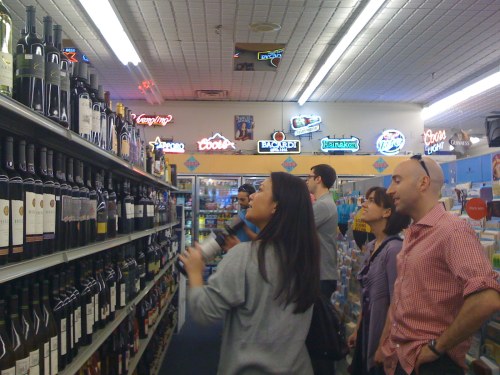
New Jersey. Home of Bon Jovi, the Boss and some pretty insane liquor laws. Take a look at this picture:

IMG_0282

If you look closely, you’ll notice greeting cards along the right hand side of the aisle. Sympathy cards as well as some birthday cards are probably best accompanied by booze, but this is not a thoughtful liquor store, this is a Rite Aid. As my friends and I were gearing up for a night of wiffleball and fajitas in the ‘burbs, we had to leave the grocery store in order to buy beer from the pharmacy.

I’ve shopped for a decent amount of alcohol beverages in my time, but I can’t say I’ve ever browsed for it under harsh fluorescent lighting while others in the same store were filling prescriptions or buying toilet paper.

Here’s another curiosity I encountered:

IMG_0283

The curiosity I’m referring to is not the idea of buying a 2003 Haut-Médoc from Rite Aid, but rather the security device affixed to the top of the bottle. I doubt the concern here is about counterfeit wine (similar looking devices can be hooked up using a USB cable to a computer to detect if the wine has been opened or altered).

Residents of New Jersey are not allowed to purchase any alcoholic beverages over the phone, via a mail-order catalog or from the internet if the producer or retailer is in another state. Perhaps the thinking is that these restrictions make swiping a bottle from the corner drug store more tempting? Or maybe it’s that the fancy razors and the addictive cold medicines are taking up too much room behind the counters.

Leave a comment

Filed under Beer, Wine

Thirsty alert

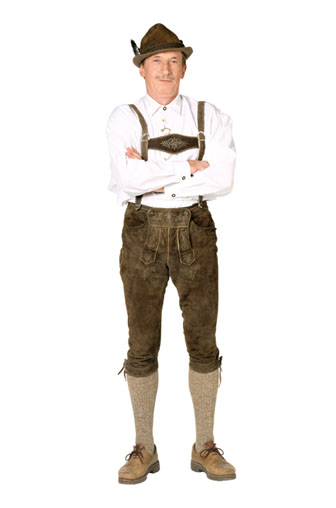
Lederhosen 2It’s almost time for Riesling Week!

Wines of Germany and the European Union are sponsoring the 5th annual Riesling Week 5/18-5/24 in New York, San Francisco, Chicago, Las Vegas and Miami.  Over 80 restaurants and retailers are participating, offering treats like multiple Rieslings by the glass, flights of Riesling, tasting menus with Riesling pairings, discounts on bottles of Riesling and special in-store tastings.  For the full list of the goings-on, click here or if you’re in NYC, Tasting Table did it up by specifying what the restaurant or retail spot is offering.

I touched on Riesling in the post “sweetness is my weakness“, mentioning that it’s sadly underappreciated.  So, next week will be your chance to give it a try (or try more if you’re already in-the-know).  And here’s why you should:

1. Riesling is a sommelier’s secret weapon – it’s incredibly versatile with food:  hors d’oeuvres like cold meats, light cheeses, smoked fish (try with lighter styles); main courses like most seafoods, pork, poultry and veal (for heavier preparations, go for a full-bodied, dry style); desserts with a slight tartness to them or that contain fruit (many sweeter styles of Riesling are desserts themselves); cheese – harder ones with fruity, low-alcohol Rieslings and blue-veined ones with richer, sweeter styles; Asian dishes – many have a touch of sweetness which works well with wines that do, too – and the sweetness can help cut any spiciness.

2. Riesling is the fastest growing grape varietal in the United States (35.6% by volume, according to Destination Riesling), so you’ll probably start to see more of it when you’re out and about.  Germany’s the top producer, providing 60% of the world’s supply and in Austria, Riesling is the second leading white grape varietal (after Grüner Veltliner).  It has a special place in my heart because it’s one of the few grapes we can grow successfully where I’m from (the Finger Lakes).  New Zealand, Australia and the Pacific Northwest are also doing a lot with it. 

3. Few other grapes can produce such a range of wine styles – bone dry to syrup-y sweet, with everything in between.  That being said, I want to briefly explain some things you might see on a German bottle of Riesling.  The overwhelming majority of German Rieslings are sold as Qualitätswein (quality wine), meaning they’ve passed analytical and taste tests.  There are two divisions of this Qualitätswein category: Qualitätswein bestimmter Anbaugebiete (don’t worry, you can just remember this as QbA) and Qualitätswein mit Prädikat (QmP). 

QbA wines must come from one of the 13 approved wine making regions in Germany (think Mosel or Rheingau) and reflect the style of its region (think terroir).  QmP wines meet all of the requirements of QbA wines, but are made from riper or overripe grapes, giving them a special attribute (Prädikat in German).  Generally speaking, riper grapes yield more concentrated wines.   So, when someone says Prädikat level, this is what it means:

Kabinett (KAH-bee-net): light to medium bodied wines and can be finished dry, medium-dry or sweet.  They average 7-10% alcohol.

Spätlese (SHPATE-lay-zuh): means “late harvest”, but don’t be fooled – these wines can be vinified dry, medium-dry or sweet, just like the Kabinetts, though they tend to be more concentrated with more intense flavors.

Auslese (OWSS-lay-zuh): means “select picking” – hand picked very ripe bunches of grapes – intense in bouquet and taste – often sweet, but can be finished dry or medium-sweet.  Dry Auslese can have over 14% alcohol.

Beerenauslese (BARON-owss-lay-zuh, a mouthfull that’s usually shortened to BA): means “berries select picking” – individually selected, overripe berries – here begins your rich, dessert wines.

Eiswein (ice-vine): yup, you guessed it, ice wine.  these babies can stay on the vine as late as December (most harvesting in the Northern Hemisphere is Aug/Sept/Oct) – they’re pressed while frozen and excess water is discarded, leaving lots of sugar – sometimes they have the honeyed influence of botrytis.

Trockenbeerenauslese (TROCK-en-BARON-owss-lay-zuh, also known as TBA): “dry berries select picking” – these things have shriveled to raisins by the time they’re harvested and have definitely experienced noble rot – incredibly rare and considered among the world’s best dessert wines (their prices usually match this sentiment).

So, slap on your lederhosen, practice your pronunciation and go drink up.

Comments Off on Thirsty alert

Filed under Wine

Tiny bubbles

If I could only drink one type of beverage for the rest of my life, it would be sparkling wine (sorry, bourbon).  If money were not an issue, it would be Champagne.  Most of you probably know this, but please only call it Champagne if it’s from the Champagne region of France. 

Prosecco, cava, crémant, spumante, sekt and your Korbel do not count – don’t be fooled because they put California Champagne on the bottle – that simply does not exist.  Besides the allowed grape varietals (Chardonnay, Pinot Noir and Pinot Meunier – say MOON-yay), the aging requirements and the terrior, the most unique thing about Champagne is the process that traps those tantalzing bubbles in there; méthode Champenoise (Champagne method) or méthode traditionnelle (traditional method). 

I’m going to break it down for you.

1. The first key is to have grapes with high acidity and moderate sugar levels.  Here is the basic fermentation equation:

sugar+yeast = alcohol+carbon dioxide (+heat)

Low sugar in the grapes=low alcohol in the wine. This is important because two fermentations happen in the production of sparkling wine and high levels of alcohol are toxic to most yeast.  So, the base wine can’t have too high a level of alcohol or the second fermentation won’t take place.  Champagne is very far north in France and has a very cool climate, so this part is easy for them.

2. Now that we have our grapes, we have to press them.  The traditional press is a wide, shallow basket.  These are still used today in addition to the more modern bladder press, which has a gross name, but is very gentle on the grapes.  The juice is extracted in phases, called tailles (TIES), which translates to cuts.   The cuvée is the first press and contains the juice that is rich with sugars and acids (the good stuff from near the center of the grape pulp).  The second cut is called the taille (same word, new meaning here), which is richer in minerals and lower in sugar and acids.  This often goes into demi-sec Champagne because the additional sweetness will cover any coarseness.  The last press is the rebêche, which is sent to the distillery for spirits or vinegar. 

3. After pressing, we have to let the juice settle, called débourbage in French.  Sugar may have to be added at this point (chaptalization) because we want the must to reach an alcohol level of 10-11% in the base wine. 

4. Fermentation happens now; mostly in stainless steel tanks, some in oak.  The process is relatively warm – 60-70°F and quick – 7-10 days.  Malolactic fermentation may happen here if the producer so chooses.  This process converts malic acid (think citrus fruit) to lactic acid (think milk) and should be called a conversion since it’s not a true fermentation, but let’s not get too technical.  It makes the wine rounder, creamier and can add additional flavor and complexity.  Once fermentation is complete, the wine is racked, or separated from its sediment and moved to another cask or vat. 

5. Assemblage (if you want to be fancy, say ah-SEM-blahge).  Separate lots of wine are systematically tasted and blended to achieve and maintain the house style; house=producer= Krug, Bollinger, Billecart-Salmon, etc.  Assemblage is a vertical and horizontal blend, meaning it’s a blend of: vintages, grapes, crus – think Premier (prem-E-ā) or Grand – officially recognized as being of superior quality) and vineyard sites.

6. This is followed by fining – removal of matter, racking – moving to another container and cold stabilization – to counter physical, chemical and microbial changes. 

7. Now we have to “create the sparkle” or “set the foam” or as the French say, “prise de mousse“.  This step represents the second fermentation and traditionally, this takes place in the same bottle from which it is later served.   This is what sets Champagne or other sparklers made in the traditional method apart.  So, how do we get the wine to undergo a second fermentation?  Well, as the wine is being bottled, liquer de tirage (yeast, sugar and usually a fining agent) is added.  The yeast will start feeding on the sugar and thus spark a second fermentation in the bottle which will take place over the next 20-45 days.  Additional alcohol – about 1.5% – and pressure – from the carbon dioxide will be produced as well.  At this stage in the game, the bottle is sealed with a crown cap (think beer). 

8. Aging takes place sur lie, or on top of the dead yeast cells.  They’re trapped in the bottle, remember?  As the yeast cells break down, they break open, releasing amino acids and this is what gives Champagne that toasty, nutty bouquet.  Concurrently, the carbon dioxide is dissolving more and more into the wine, creating smaller and smaller bubbles.

Here is a picture of sediment in a bottle:

Sediment in Champagne bottle

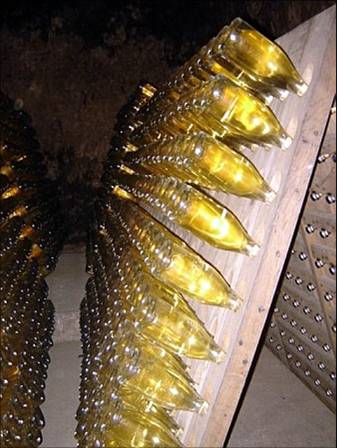
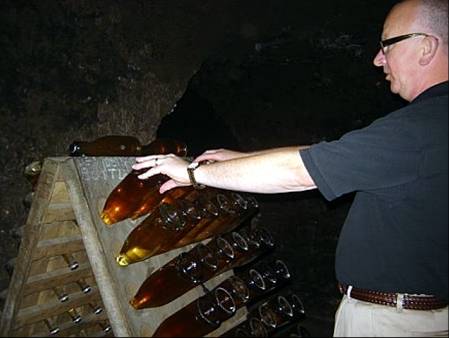
9.  Next, we have the riddler.  Not the enemy of Batman, but the person or machine (not called a riddler, but called a gyropalette) that rotates the bottles while they’re aging.  In French, this process is called remuage.  By hand, it takes three months; with a machine, it takes about a week.  The idea is to gradually move the bottle from a horizontal position to a vertical one in order to collect the dead yeast cells in the neck of the bottle. 

Here is the rack that houses the bottles in a manual system:
Sur Point Aging

Here is someone demonstrating riddling by hand:
Sample Riddling

10.  Now, we’ll remove the sediment and this is called disgorgement (dégorgement).  The bottles will be chilled to reduce the pressure, the neck will be dipped into an icy brine solution to freeze the sediment into a plug of slush, the bottle is turned upright, the crown cap is removed and the internal pressure shoots the ice plug out of the neck of the bottle. 

Here is a picture of a frozen plug:
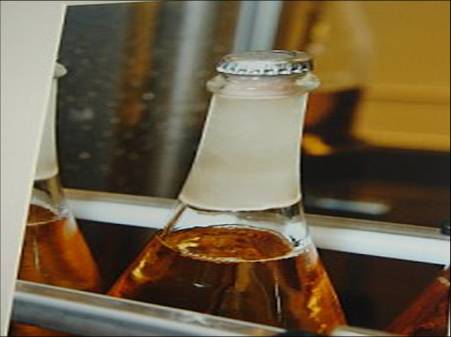
Ice Plug 2

11.  Some wine is lost during this slightly violent process, so we’ll replace it with the same or a similar cuvée and this is called the dosage.  The amount of sugar here will determine the final sweetness of the Champagne – Brut, Sec, Doux, etc.

12. Final aging – for non-vintage (NV) Champagne, it’s 15 months and for vintage, it’s 3 years. 

There, now you understand how Champagne is made.  To celebrate, sing along with Don Ho.

12 Comments

Filed under Lessons, Wine

What a treat

Jerome Quiot

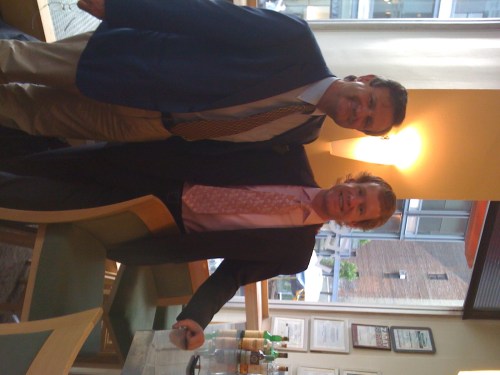
Unless you’re a wine nerd, you probably won’t recognize the gentlemen in this photograph.  On the left is Jérôme R. Quiot, the owner of several estates in France, including Domaine du Vieux Lazaret, Domaine Houchart and Château du Trignon.  On the right is Josh Miles, my friend and wine rep from Martin Scott Wines.

Yesterday my staff and I had the pleasure of welcoming Jérôme to L’Ecole to speak about his wines.  I spend a good deal of time around French folks because of my job and Jérôme is one of the more charming ones I’ve encountered, saying things like, “You can probably tell from my accent that I’m not from around here.”   Now this might not sound terribly charming to you, but I’m the type of person who enjoys popsicle stick jokes.  The important thing here is that he makes some darn good wine. 

The Quiot family has been making wine since 1748 (they’re now on the 11th generation) and Jérôme works closely with his wife Genevieve, his daughter Florence and his son Jean-Baptiste.  Jérôme explained to me that he honors his family’s working relationship by putting out the Domaine du Vieux Lazaret Cuvée Exceptional Red.  It’s not made in every vintage and it’s based on certain barrel selections in the cellar, but what makes it exceptional is that his whole family has to sit down and agree on it.  His wife doesn’t care much for barrel aging, his daughter likes floral, expressive wines, his son wants robust wines and he said his own vote doesn’t count for much.

Here are some highlights from the tasting:

From Domaine Houchart:

1. Blanc 2008.  Mainly Clairette with some Rolle (this is the same as the Italian Vermentino).  Vibrant, lively and persistant with notes of citrus, white peach, cantaloupe and minerals.

2. Rosé 2008.  Mostly Cinsault, Grenache and Syrah with a touch of Cabernet Sauvignon.  A perfect example of why dry rosé is so good.  If you don’t drink it, you should – it’s food and wallet friendly and goes down easy (especially when consumed outdoors).  This one was salmon colored with notes of strawberries, raspberries and orange peel with a crisp, but round mouthfeel. 

3. Rouge 2006.  Grenache, Carignan, Syrah and Cabernet Sauvignon.  A great summer red.  It was structured, but not too tanic with cherries and a healthy dose of spice.

The label design on the Domaine Houchart bottles was inspired by a dress that Jérôme’s grandmother wore.  It was crinoline (usually a combination of horse-hair and cotton or linen) with a corset-style top.  He told me to picture Gone with the Wind

From Château du Trignon:

1. Rasteau 2005.  Mostly Grenache with a touch of Mourvèdre.  Fresh and lively with ripe berries.  Undertones of herbs, spices and wood.  With Rhône wines, you’ll often hear people talking about herbes de Provence – things like basil, fennel, lavender, marjoram, rosemary, sage, savory and thyme.  This may seem obnoxious to you, but it really is possible to smell and/or taste these things in wine.  Take a whiff through your spice cabinet and file a little smell memory for yourself and the next time you have a wine from southern France, see if you detect any spice.

2. Gigondas 2005.  Grenache, Syrah, Mourvèdre and Cinsault.  Stewed fruits, cloves and coffee notes.  Fresh, yet powerful (think tannin structure).

The Quiot family began farming the Trignon property in 1986 and have refined and expanded the property as well as installed a wine cellar that operates primarily by letting gravity do the work.

From Domaine du Vieux Lazaret:

1. Châteauneuf-du-Pape (CDP) Blanc 2007.  Grenache Blanc, Bourboulenc (Josh thinks this would make a fine name for a dog; I agree), Roussanne and Clairette.  My favorite from the day.  Round, full, slightly nutty with peaches, white flowers and lemon.  Only a touch of barrel aging, so the fruit really comes through.

2. CDP Rouge 2006.  The 13 varietals allowed by law, with a majority of Syrah, Grenache, Mourvèdre and Cinsault.  Only 15% was aged in barrel, so you get a lot of deep red and black fruits as well as some sweet baking spices. 

CDP (shat-toe-NOOF-duh-pop) means the “Pope’s new castle”.  In the 14th century, the papal court moved from Rome to Avignon.  Domaine du Vieux Lazaret is here and it’s the family’s oldest holdings.  The name refers to a former hospital that was used to quarantine and treat patients during the major epidemics of the 17th and 18th centuries.  The plagues killed 30% of the population (and we were worried about swine flu).  People had to spend 40 days in seclusion before entering the village. 

Jérôme explained this was a good way to deal with the situation because after 40 days you were either fine or dead. 

Quiot Wines

1 Comment

Filed under Wine

Ruby blossom

Elderflower Cocktail

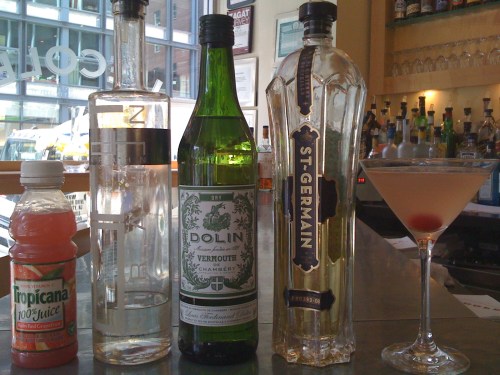
The Dolin Dry has been nagging me, especially since I did the vermouth posting a few days ago.  I knew I wanted to get it in a cocktail and on the list, but I hadn’t come up with anything special to do with it.   The inspiration came in the form of ruby red grapefruit juice, which we had leftover from an event. 

I got behind the bar and unlike every other time I’ve tried to make a cocktail, I got this one on the first try.  I chose DH Krahn gin because a)they’re really nice guys and b) it’s very tasty – sweet citrus, coriander and ginger – just the spicy hint that I thought would balance out the ruby red. 

Next, I wanted a floral component, so I chose St-Germain Elderflower Liqueur.  The elderflower blossoms are handpicked in the foothills of the Alps in a 2-3 week period in the spring and delivered via a specially rigged bicycle to the distillery.  They claim to have a secret method of extracting the essence from these flowers without producing any bitterness. Pretty romantic, huh? 

I use the Dolin Rouge all the time, especially for Manhattans, but I thought the lighter, more crisp Dry would add the perfect amount of herbaceousness to the concoction.  I was on the fence as to whether the cocktail needed a touch of sweetness (I hate sweet cocktails), so I compromised by tossing a cherry into the bottom of the martini glass.

Come by and enjoy this with us starting tonight.

Ruby Blossom
2 oz. DH Krahn Gin
1 oz. Dolin Dry
1 oz. St-Germain
1 oz. ruby red grapefruit juice

Combine all ingredients over ice in a shaker, shake like you mean it, strain into chilled martini glass, garnish with a cherry and fantasize about frolicking in the French countryside in Spring.

2 Comments

Filed under Cocktails, Spirits, Wine