Category Archives: Wine

More bubbly

Ed McCarthy and Mary Ewing-Mulligan

Ed McCarthy and Mary Ewing-Mulligan

JetBlue, you’re currently 0 for 2; 3 hours on the tarmac at JFK on the way out and straight up cancelled on the way back – Northeast weather advisory or was it simply an undersold flight?

Luckily, I had Ed McCarthy, Mary Ewing-Mulligan (of Wine for Dummies fame among a myriad of other wine-related accomplishments) and 8 Tête de Cuvée Champagnes to take my mind off air travel.

Tête de Cuvée is also referred to as Prestige Cuvée and in layman’s terms, it’s the pride and joy of the Champagne house that made it.  The best grapes from the best vineyard sites (almost always Grand and Premier Cru) spend more time on their lees (dead yeast cells – recall the magic of the second fermentation) and while no minimum aging laws exist, most have spent at least 5 years in the bottle prior to release.

All of this yields a complex Champagne, with a fine mousse (bubbles) and developed aromas (think mushrooms in a good way), with an ability to age that most other Champagnes on the market lack.  What’s not to love?  I can think of two things – they’re difficult to come by and they don’t come cheap.  I’ve listed the average retail price after each bottle, as given by the instructors.

This was by far the most impressive line-up I’ve tasted and shame on the organizers for making this a morning session because it was terribly difficult to spit.

  1. Taittinger, Comtes de Champagne, 2002 $210-250.  The third oldest house in Champagne, these guys have been at it since 1834.  This was a blanc de blanc (100% Chardonnay) with very crisp acidity, a lemony nose and a palate with peach, coffee and mocha notes.
  2. Perrier-Jouet, Fleur de Champagne Rosé 2002 $300.  According to Ed, rosés don’t last as long as other vintage Champagnes (this was news to me) and can also seem sweeter because they often have more Pinot Noir (more fruit-forward).  Just so you know, the “t” is pronounced and pair-e-yay-jew-et is a pretty Champange with stewed strawberry and mushroom notes.
  3. Pommery Cuvée Louis, 1998 $190-200.  This was earthy, yeasty, yet delicate and ready to drink.
  4. Gosset, Celebris, 1998 $130-150.  Pronounced “go-say”, this is produced by another branch of the Cointreau Family.  It was rich and concentrated with floral, honey and butter notes.
  5. Mumm, Rene Lalou, 1998 $140-150.  This is the first vintage released by this house since the 1980s (they faced various difficulties, including being purchased by Seagram’s).  This Champagne was elegant and harmonious, not showing much age, even though it was over 10 years old.
  6. Deutz, Cuvée William Deutz, 1998 $145-150.  Believe it or not, the company pronounces it “duhtz”.  Lots of dulce de leche notes, this Champagne was ready to drink.
  7. Charles Heidsieck, Blanc de Millenaires, 1995 $115.  Notes of truffles and brioche, this was the best value of the line up.
  8. Henriot, Cuvée des Enchanteleurs, 1995 $145-165.  Believe it or not, this is their current release and it tastes young.   It’s mouth-watering and dry, with notes of almonds on the nose.

Needless to say, this was a good day.

5 Comments

Filed under Wine

Think Wine Spectator will cover it?

More plausible than keeping hearts young or preventing extensive brain damage following a stroke, red wine may increase women’s libido!

Doctors at the University of Florence studied 800 women, aged 18-50, and split them into 3 groups; those who regularly consumed 1 or 2 glasses of red wine per day, those who consumed less than 1 glass per day of any type of wine or alcohol and those who didn’t consume any alcohol at all.

They chose to exclude women who drank more than 2 glasses per day, removing inebriation as an obvious study flaw.

All participants filled out a questionnaire titled “Female Sexual Function Index”, which is apparently used by doctors to assess women and their sexual health. It’s 19 questions long and the final scores can range from 2-36, with higher scores equating better function. Sounds like something you’d find in Cosmo or Seventeen, don’t you think?

The red wine drinkers averaged 27.3, while those who consumed less frequently averaged 25.9 and those who abstained clocked in around 24.4. These results have been published in the Journal of Sexual Medicine.

The exact correlation between the red wine and better sexual function is unclear (shocker), but one of the current theories is that antioxidants in the red wine widen the blood vessels, therefore increasing blood flow to key areas of the female body.

The study doesn’t clarify whether the red wine is actually doing something to women’s libidos or whether women who have healthy sexual appetites also have a healthy thirst for wine, but regardless, viva red wine!  I’d buy into this before I’d be convinced that chocolate is good for my health.

2 Comments

Filed under Alcohol in the News, Wine

If Homer Simpson drank wine

Toh Friulano

Toh! or is it Doh!

Tocai or Tocai Friulano is an old Friulian name for Sauvignonasse, a widely planted white varietal in northeastern Italy. It’s a productive, late-budding varietal that produces a light-bodied wine with floral and almond notes best consumed in its youth. In addition to the Friuli region in Italy, this varietal is also planted in California, in the Hudson Valley in New York State as well as a touch in Argentina.

This varietal is not related to Tokay d’Alsace, an Alsatian synonym for the Pinot Grigio, which can be found alongside the Tocai in Friulano. It also has nothing to do with Hungary’s great wine, Tokaji, which is probably why the Hungarians succeeded in convincing the EU to ban Italy’s use of the term in 2007.

Tocai is the most popular and widely planted white grape region of the Friuli region and old names can die hard. di Lenardo has honored the varietal’s original name by giving his wine the proprietary name, “Toh!”. Massimo’s family has been making wine in the area since the late 1800s. All of their grapes are picked by hand and the Toh! is their most popular wine. Greenish-yellow in color, the wine had a delicate nose of white flowers and bitter almonds. It had great acidity, but was round and delicate rather than angular on the palate. Homer might opt for a burger or a donut, but I think you’d find a better match with shellfish.

More good news – it retails for around $14.

3 Comments

Filed under Wine

“Wine Uncorked” in the press

Wine Uncorked 071409
Caught mid-sentence by Janet

Janet Walker, a freelance writer and the founder of Pulse Point Productions attended last week’s “Wine Uncorked” class.  Her piece was picked up by L.A.’s Splash Magazine.  You can click here to get the full scoop (or to see what you missed).

2 Comments

Filed under Lessons, Wine

Togas aren’t just for frat boys

Self-described "redneck togas"

Self-described "redneck togas"

What might not surprise you is that this picture was taken at a stock car race track.  The part that should surprise you is that it was taken during a wine festival that was held there.  Full disclosure: the aforementioned racetrack is 30 minutes from where I grew up and this photo was featured in an article in my hometown paper.

Leave a comment

Filed under Events, Wine

Nerd Conference

SWE LogoThe Society of Wine Educators is holding this year’s annual conference in Sacramento, CA from July 27 – Aug 1 and yours truly will be in attendance.  I’m calling it a nerd conference because each day is jammed packed with seminar after seminar and also because one of my wine-nerd heroes, Jancis Robinson, is giving the keynote address.  I’ll be taking a spirits exam and attending classes on everything from sustainability in winemaking to “the truth about wine and cheese” to “can absinthe cause insanity?” to a 3 hour class on sake.  Keep reading and I’ll fill you in on all the good stuff I learn out there.

You don’t have to be a member of SWE to attend, but you might have to be a nerd.

1 Comment

Filed under Events, Wine

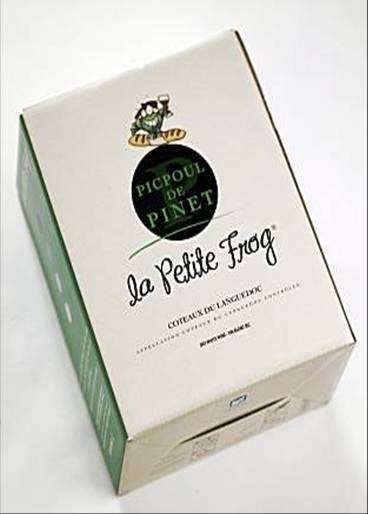
I bought a wine featuring a cartoon animal

PicpoulYes, it’s a frog – a petite one, who seems to be riding a baguette.  I was so excited to see this varietal come in a box, I put my cute-sy label prejudices aside. 
Picpoul (pick-pool) is also known as Folle Blanche (Loire Valley) and is sometimes spelled Piquepoul, which means “lip-stinger”, a reference to the wine’s high acidity.  It comes in Blanc, Noir (one of the varietals allowed in Châteauneuf-du-Pape) and Gris versions, but the most famous is the Blanc from the Languedoc area of southwestern France. 

Picpoul de Pinet is one of the named crus of Coteaux du Languedoc.  Cru in this case refers to a recognized region of superior quality and Picpoul de Pinet is a designation that may be used in the Languedoc if it’s a white wine made exclusively from Picpoul Blanc.  The wines tend to be greenish-gold in color and round, with lemony-citrus notes. 

This particular Picpoul de Pinet (say that three times fast) is the 2008 La Petite Frog by the Cave de Pomerol cooperative.  I found it at Astor Wines and it’s clean, bright and zippy.  Lemon, grapefruit and a pronounced minerality dominate the palate.   It paired beautifully with a pasta dish with fava beans and an herb salad.  It’s an interesting, refreshing wine at a reasonable price – 3 liters for $30.  Add it to your list of wines to drink this summer. 

1 Comment

Filed under Wine

Fun guy? Hardly!

Last but not least in the series on stink – odors in the fungi family. 

First up is moldy-earthy smell (2-ethyl-fenchol and geosmine).  The molecules responsible for making your wine smell like dirty beets are usually produced by microorganisms.  The pungent smell is often caused by the lack of proper hygiene in winemaking equipment, especially vats or barrels.  Empty barrels are tricky to keep clean and free of mold because the temperature and humidity inside are often just what these microorganisms are looking for.  Once the pesky spores make their way into the pores of a wooden vessel, it’s almost impossible to remove them completely.  Sure, some earthy qualities in a wine can be enjoyable, but to prevent a moldy-smelling mess, the winemaking team needs to keep it (those barrels) clean; prewash, clean, rinse, disinfect, re-rinse – you get the idea. 

Speaking of moldy, another fault you’re probably more familiar with is cork taint.  Since the 17th century, oak cork has been the bottle sealer of choice – it’s elastic, compressible and impermeable to liquids and gases.  Its taste, similar to that of wood, also varies a bit depending on how it’s processed – stripping, seasoning, washing, etc.  A slight taste of cork or pieces of cork floating in your wine glass should not be confused with cork taint.  The former is considered pleasant by some and the latter is a problem with wine service.  Here are some scenarios, though, where the wine’s corked:

1.  A foul, putrid smell caused by yellow stains on cork harvested at the base of the trunk.  Don’t worry, though, the chances of this one are about 1 in 100,000.

2.  A taste of stagnant water caused by poor hygiene during the cork production process – the cork strips were not fully dried.

3. The smell of solvent or smoke caused by a narrow cork that created bottle leakage.  Mold or bacteria might be present and visible on the cork when you open the bottle.

4. The smell and taste of mold and must (yum!) caused by 2,4,6, tricholoro-anisole or TCA – this potent compound is responsible for 90% of cork tainted wines.  The formation of TCA  happens when chlorine reacts with organic phenols (highly prevelant compounds in the winery; in grapes, in corks, in barrels, in wooden pallets and in structural wooden beams) to form chlorophenols.  These in turn react with mold in the presence of moisture to form TCA.  Our threshold for detection of TCA is very low (less than 1 billionth of a gram per liter), so a little taint goes a long way to spoiling your glass of wine. 

What are your chances of running into a corked wine?  I’ve seen figures ranging from 2-8% of all bottles on the market – yikes.  We’ll tackle alternative packaging and closures another day.

1 Comment

Filed under Lessons, Wine

Wines of summer, Part I

I got a request for my recommended wines for summer (honest!).  I’ll introduce some off-the-beaten path varietals that will still appeal to all of you Pinot Grigio drinkers out there.  Summer’s certainly about drinking wines that are light, crisp and refreshing, but that doesn’t mean they have to be boring.  Today, we’ll start with the letter V. 

First up is Verdejo (vehr-DAY-ho); aromatic and herbaceous, it’s Spain’s Sauvignon Blanc.   Rueda is the spot in Spain to find Verdejo.  It’s northwest of Madrid in Castilla y León.  Wine has been made in this region since the Middle Ages, but found its stride in the 1970s, when Bodegas Marqués de Riscal of Rioja recognized the area’s potential for dry, white wines.  They began selling fresh Rueda alongside their Rioja reds and in 1980 Rueda was awarded its DO status (Denominación de Origen; controlled appellation, think France’s AC). 

Verdejo is sometimes blended with Viura (also known as Macabeo), the white grape of the Rioja region or with Sauvignon Blanc – in both cases, Verdejo must account for at least 50% of the blend.  If the label says Rueda Superior, the wine must contain at least 85% Verdejo.  Verdejos are fragrant, often with notes of apple, mint and fresh-cut grass.  In warmer years, they can take on aromas and flavors of tropical fruits.  When they’re well done, they have both juicy citrus as well as an underlying minerality.  Here’s more good news – they’re usually inexpensive – you should have no trouble finding some in the $9-$15 range.  Here are some producers to look for: Cuevas de Castilla “Con Class”, Martínsancho and Bodegas Hermanos del Villar “Oro de Castilla”. 

Next up is Vermentino (ver-mehn-TEE-noh), which is also called Rolle in Provence.  It’s grown primarily in Sardinia, Liguria and Corsica, with increasing amounts in Languedoc and Roussillon and a touch in California and Australia.    Some think the grape has Spanish origins, while others think it’s related to the Malvasia grape and to a grape called Favorita grown in Piedmont (who wouldn’t want to drink that?).  Vermentino produces a lively wine, with lots of citrus and great acidity.  Acidity=refreshment during the heat of the summer.  It’s a great partner with seafood or grilled vegetables.   Styles from Liguria tend to be a bit lighter than those from Sardinia.  Check these out: Cantina Santadi “Villa Solais”, Santa Maria la Palma “Aragosta” and Bibi Graetz “Bianca de Casamatta”. 

Last but not least for your summer sipping I present Vinho Verde DOC (VEE-nyoh VEHR-deh) (Denominação de Origem Controlada; again, controlled appellation).  I’ve switched gears now from varietal to region and I’m taking you to northwest Portugal.  Vinho verde means green wine, but not like green beer for St. Patrick’s Day – the green here refers to the youth and vivacity of the wines from this region.  These wines are slightly effervescent too, and you know how I feel about wines with bubbles.  Whites from this region are crisp, fresh and quite zippy.  They’re made from these grapes: Alvarinho (yup, Spain’s Albariño), Loureiro, Trajadura and Avesso.  Look for these in the store: Sogrape “Gazela” (I’ve seen it for $4.99!) and Auratus – a mix of Alvarinho and Trajadura and a bit more complex than most on the market. 

Leave a comment

Filed under Lessons, Wine

Yellow wine, straw wine

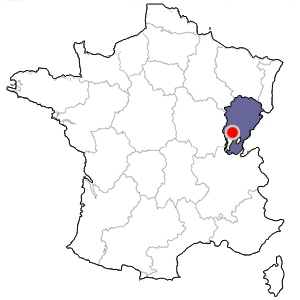
ligier-arbois-map

Map courtesy of Charles Neal Selections

As promised, I want to touch on a few of the unique wine styles found in the Jura region of France.

Vin jaune (yellow wine) is one and it’s made in a purposely oxidized style.  The grapes are picked and fermented as normal, but then the wine is placed in old, 60 gallon casks that are not filled to the top in order to encourage the growth of a film-forming yeast called the voile (veil).  This process is similar to sherry production but there’s no fortification.  The voile is not as thick as the flor (the Spanish voile equivalent) in sherry production because the temperatures are lower here than in southern Spain.   The wine is not bottled until 6 years and 3 months after harvest and it’s full-bodied, mineral-driven and nutty.

The best vin jaune appellation is Château-Chalon, where the wine must be made using the local Savagnin grapes.  You’ll often see it in a distinct clavelin bottle, which is 620 ml, as opposed to the standard 750 ml wine bottle.   The locals claim that 620 ml is the amount left after leaving a liter in cask for 6 years.  Vin jaune from the best vintages will last 50 or more years.  A compound called sotolan forms during the bottle aging process and can give the wine spicy, curry flavors.  Try it with poultry dishes or a cheese course.  Here are some producers to look for: Jean Macle, Berthet-Bondet, Baud Père et Fils and Philippe Butin.

Another unique style in the region is vin de paille (straw wine), a long-lived sweet white wine made from grapes that have been dried on straw mats.  This style is called strohwein in Germany.  These wines are rare and only produced in very ripe vintages.  Once the grapes have raisinated, the yield is pretty small, so you’ll usually find these wines in half-bottles.

The Jura producers use Savagnin, Poulsard or Chardonnay to make this style and they often will place the grapes in boxes, rather than on mats, to dry them.  The grapes are pressed in January and are aged in cask for at least three years.  The resulting wine is rich and honeyed, with notes of dried apricots.  Try it with fruity or nutty desserts, with pungent cheeses or as a dessert on its own.

4 Comments

Filed under Lessons, Wine