Category Archives: Wine

If only it were so easy

Doing some house cleaning today (don’t make fun), I found an apron that I hadn’t seen in a while.

apron

Instead of suggesting that you kiss the cook or that too many brews spoil that cook, this apron offered something even sillier – a six-step recipe for fine wine – not that it’s necessarily wrong.  In coming weeks I’ll write more about wine-making.  I can’t make it this easy, but I’ll do my best.  Stay tuned.

wine recipe

2 Comments

Filed under Wine

The Hollywood of Germany

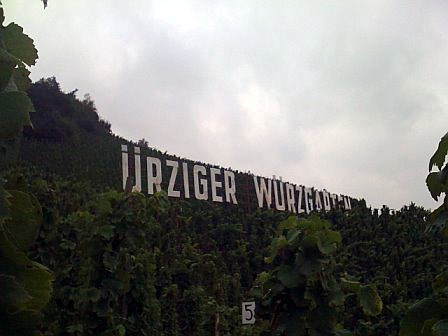
urziger wurzgarten background

far from California

One of the highlights of the trip was when the winemaker from Schmitges took us on a stroll up through the Ürziger Würzgarten vineyards in the Mosel. 

Despite the ominous clouds and the steep incline of the trail, it was a wine nerd’s dream. 

I’ve seen the name “Ürziger Würzgarten” on bottles of Riesling for years and being able to see it in person helped shed some light on why these bottles are so expensive.

First, check out the terroir:

yes, they're referring to rocks as soil - the famous slate of the Mosel

yes, they're referring to rocks as soil - the famous slate of the Mosel

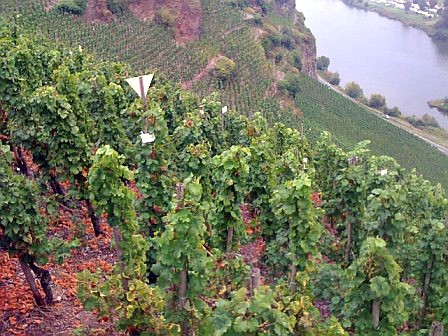
Next, check out how steep the vineyards are:
some sections have slopes up to 70 degrees

some sections have slopes up to 70 degrees

Here’s a typical sign you’d find in the vineyard:
the signs mark who owns the vines

the signs mark who owns the vines

If you’re lucky, you’ll own more than one row.
Here we’re getting closer:
urz wurz no people
Here’s a view from the top:
the Mosel River is in the background

the Mosel River is in the background

Yes, we were so spoiled that the winemaker’s wife drove up and presented us glasses of wine once we got to the top:
not a good photo op for those afraid of heights

not a good photo op for those afraid of heights

Oh, and it was single vineyard Spätlese:
sweet success!

sweet success!

Leave a comment

Filed under Wine

Bright young stars

This week we visited with Prinz Salm. Here’s a quick video showing the estate:


The estate has been around since 1200, but the average age of the current team in charge is 25! We tasted and toured with Felix, who’s 27 and the current wine maker (he started 2 years ago). He’s the 32nd generation, but the first one to focus only on wine making – historically, the family has also been involved in politics, construction and finance.

Felix told us a story about when his grandparents were living near Cologne prior to WWII. When his grandmother received word the Americans were coming, she acted quickly to preserve the family’s wine cellar. She took all the bottles from the cellar, tied rocks to them and tossed them into the nearby lake. The wines were protected and the family did get them back, but there was one serious shortcoming to her idea – the day after she sunk the bottles, all of their labels floated to the surface of the lake.

After we toured the estate, Felix took us to some of his family’s vineyards. Here’s a video where’s discussing one of his current projects, replanting Riesling vines.

(This video has useful information, but it appears as though it was shot by a child.  I didn’t realize you can’t get a “portrait” shot in video mode – only “landscape”.  I’ll get the hang of it)

Leave a comment

Filed under Videos, Wine

Beneath the market

I hope the sound works in this video. I’m traveling with a computer that doesn’t like to play audio, so I’m hoping for the best.

This medieval, 500 year-old cave that lies below the market in Westhofen has belonged to Weingut K.F. Groebe since 1763. All of Fritz’s wines are treated in oak – no stainless steel (if the sound is working in the video you’ll learn the barrels are 20-100 years old, so they don’t impart flavor – it’s more about texture and tradition).

I asked if the cellar required any maintenance and the answer was “not really”. It maintains a year-round temperature of right around 14 degrees Celsius and just the humidity level that the wines seem to like. From time to time, they may have to clean a little fungus from the outside of the barrels just to make sure it doesn’t end up in the wine.

Turns out this fungus (the black stuff you can see on the ceiling if you’re paying attention) is “good fungus” and survives on humidity and alcohol alone – doesn’t sound like such a bad existence.

2 Comments

Filed under Videos, Wine

Thank you, Wines of Germany

header_landscapeTonight I’m headed to Germany to visit the Rheinhessen, Nahe and Mosel regions.  Please stay tuned and I’ll keep you posted on my adventures.

Prost!

Leave a comment

Filed under Wine

Don’t call it Champaña

Today’s Cava was called Champaña until the 1970s when the Spanish agreed to stop using the potentially misleading (i.e. too close to sounding like Champagne) term.

Cava is the Cataluñian word for cellar and this bubbly delight does share some similarities with Champagne. For instance, most Cavas are made using the traditional method and Chardonnay has been an approved varietal in the blend since 1986. Champagne was the inspiration behind Cava’s creation, too – Jóse Raventós, head of Codorníu (now one of the largest sparkling wine producers in the world), made a trip to France in 1872 and upon his return home, made the first bottles of sparkling wine in Spain. In 1889, Pedro Ferrer joined the Raventós family and later went on to found Freixenet (one of the other largest sparkling houses today).

While 95% of Cava is made in Cataluñia, grapes can also be sourced from Valencia, Aragón, Navarra, Rioja and the Basque country. Here t are the indigenous varietals used in the blend:

Macabeo (called Viura in Rioja): usually makes up about 1/2 the blend, fairly neutral, popular because its buds break late – this is important in areas prone to spring frost.

Xarel-lo (pronounced cha-rel-low): 2nd most important, gives the nice earthiness found in many Cavas.

Parellada (pair-eh-yah-duh): produces light-bodied, fine wines.

Cava was hands-down one of the highlights of my trip to Spain. By simply asking for a “copa de Cava” at any bar or restaurant, we’d be rewarded with a bubbly, refreshing, citrus-y, yeasty glass of wine that was less expensive than most draft beer in New York City (even with the exchange rate!).

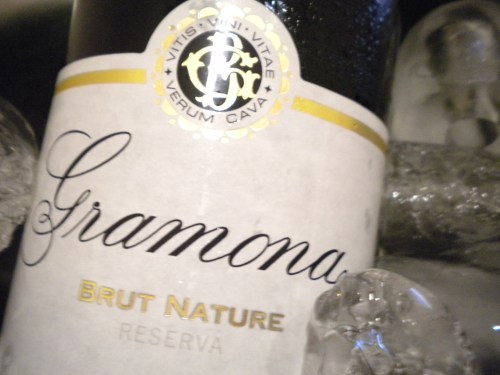
Here’s a photo of one of my favorites – it was the house Cava at our hotel in Barcelona:

DSCN0379

ahh, Cava on ice

Gramona’s a family winery in the heart of Penedès – more specifically, at the foot of the very impressive Montserrat mountain range and they’ve been making Cavas over 125 years.

The family coat of arms is “Vitis, Vini, Vitae”, or the vine, wine, life – you can see it on the label if you look closely.  Verum cava refers to their certain idea of what Cava should be – essentially that vines cultivated in good soil by capable hands will yield a tasty product.

Based on my tastings (yes, I went back for more), I think they’ve done their job well.  This Cava had it all – fine bubbles, notes of citrus, apples, and toasty bread, great acidity and a creamy finish.

Leave a comment

Filed under Wine

Bebidas divertidas

I wanted to share some of the amusing beverages I encountered during the last 2 weeks.

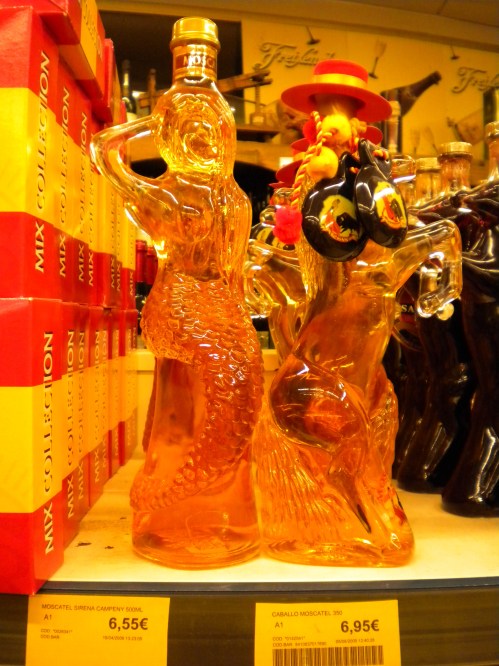
Moscatel mermaid and horse

Do you like your Moscatel from a mermaid? Or perhaps from a horse? Those free castanets are pretty tempting.

sangria bull

Olé! Again, please note the castanets.

sangria guitars

Maybe sangria is at its best when poured from hat-wearing guitars.

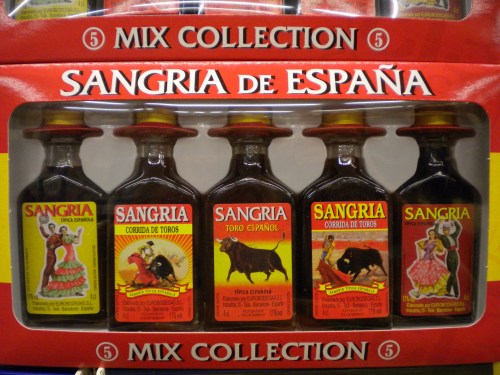
sangria collection

Sangria sampler pack. Has yours ever looked this brown when you've made it at home?

Leave a comment

Filed under Spirits, Wine

About.com came to class

Alison Wellner attended last month’s Wine Uncorked class and wrote a review for About.com: Culinary Travel.  Here’s my favorite part of her description, “This is a great class for people who pretend that they know more about wine than they actually do, and are able to get away with it.” 

Tsk, tsk if this describes you.  We have more classes starting in September and October if you’d like to back up your swagger with some facts.

Leave a comment

Filed under Lessons, Wine

Wines of Summer, Part II

Last time we focused on wines that started with the letter V.  This time, we’ll explore a few summer-sipping gems from Spain.

Instead of reaching for the old stand-by Sauvignon Blanc, try an Albariño (ahl-bah-REEN-yoh).  This varietal predominately hails from Rías Baixas (Ree-as buy-shus), Galician for low estuaries or low inlets (though you can find some grown in California, Oregon and Australia).  The region’s proximity to the Atlantic yields a cool, rainy and windy climate. 

See Rías Baixas in the upper left corner?

The vines of Albariño are trained high off the ground to ensure enough wind passes through to prevent rot or mildew or other fungal diseases from developing.  Thirsty yet? 

Luckily, the thick skins of the grapes also help protect them from all this as well as contribute to the alcohol, acidity and flavor in the resulting wine. 

These grapes tend to produce highly aromatic wine – look for almonds, apples, peaches, citrus, flowers and grass.  

The razor sharp acidity of Albariño makes it refreshing in the heat of the summer as well as a natural partner to seafood (don’t forget its coastal home!).   
 
I like the 2007 by Pedralonga (Rías Baixas) – it’s full-bodied with lots of grapefruit, honeysuckle and minerality.  This winery has been practicing biodynamic farming practices since 1991 and attritubes their tasty wine to the quality of their soil.
Next up is Godello (go-day-oh), which can be found in Valdeorras, just east of Rías Baixas.  Also planted in Portugal (called Gouveio there), this varietal is a food-friendly alternative to Chardonnay. 

It’s fuller-bodied than Albariño and often has a touch of oak or some aging over the lees (dead yeast cells), which can also contribute to a creamy mouthfeel. Look for apples, peaches, some tropical fruits and with some bottle aging, anise notes. 

I like the 2006 Bodega Ladera Sagrada, Castelo do Papa (Valdeorras)- herbal and expressive, this wine’s also a bargain – most stores carry it for around $12.  Another to try is the 2006 Rafael Palacios, As Sortes (Valdeorras) – more expensive, but more Burgundian in style. 

Last but not least is a varietal called Hondarribi Zuri, which accounts for 85% of the production of Txakoli (Chacolí in Castilian).  We’ve now moved to Basque country and this wine shares some similarities with Portugal’s Vinho Verde – it’s usually sold young, it often has a touch of frizzante and it tends to be low in alcohol. 

Look for freshness, citrus and minerality.  Here are two producers to try – Txomin Etxaniz from the Getariako region of Txakoli and Itsas Mendi from the Bizkaiko appellation. 

They tend to be pricier than Vinho Verde – usually in the $20 range – but worth the few extra bucks to get you out of your wine-drinking rut.

Leave a comment

Filed under Wine

Blending Cabernet across vintages?

I did make it to one winery while out in California – Porter Family Vineyards.

Vineyard 1

The vines (mostly Cab, some Syrah, Merlot, Malbec and Cab Franc) range in age from 3-20 years

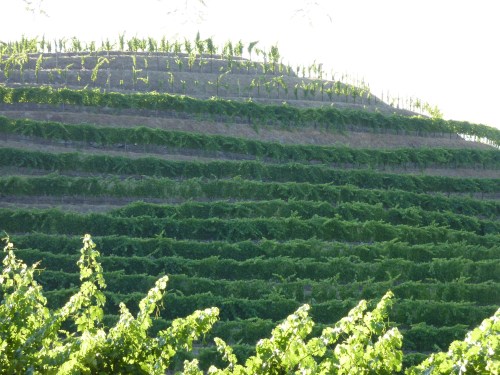
Terraced Vineyard

The property is 20 acres, with 13 under vine - check out those terraced plantings

The Porter Family vineyards are at 600 ft.

The Porter Family vineyards are at 600 ft.

Specifically, the winery is in Coombsville region of Napa Valley and the Porter Family is among those lobbying for the area to receive its own AVA – American Viticultural Area – designation.  The soils are old and volcanic. 

While digging their cave, the Porter Family came across a piece of sandstone covered in volcanic ash with fossilized sandpiper prints that is over 20 million years old (they had it tested).  It made sense, then, that we were greeted with their 2008 “Sandpiper” Rosé – 100% Syrah with lots of red fruits and bright acidity. 

The creation of their cave was covered in a 2006 episode of "Dirty Jobs"

The creation of their cave was covered in a 2006 episode of "Dirty Jobs"

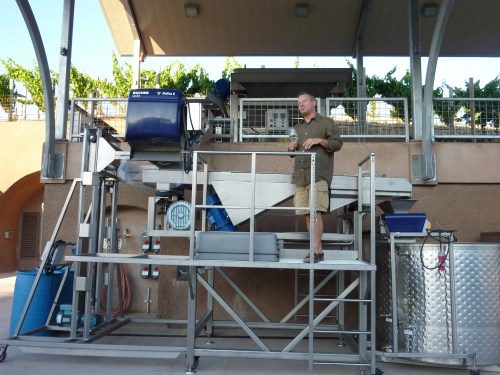
Ken Burns, consulting winemaker, describing the winemaking equipment

Ken Burns, consulting winemaker, describing the winemaking equipment

Throughout the evening, we also tried their 2006 Sandpiper red – a 50/50 blend of Cabernet Sauvignon and Merlot that had distinct elements of both varietals – the currant and cedar from the Cab and the plummy softness from the Merlot, their 2006 Syrah, which was also varietally classic – white pepper, violets and berries and their 2005 Cabernet Sauvignon – full and chewy with vanilla and coffee on top of the berries.  The two special treats were a barrel sample of the 2008 Syrah (similar notes to the 2006, just not as integrated yet) and the Cabernet Sauvignon Blend across 3 vintages – 2005, 2006 and 2007. 

In theory, it’s an interesting idea – the bold, bright fruit of a young Cab and the more developed flavors of a Cab that’s had some time to age in the barrel.  It’s like getting the best of both worlds in one bottle of wine. 

They don’t yet have a scheduled release date nor would they tell us the name they plan on using (proprietary and not yet registered), but I hope they give the wine more time, as the flavors didn’t seem pulled together quite yet. 

Champagne and Sherry notwithstanding, most vintage-dated wines are superior to non-vintage wines, but perhaps the Porter Family’s looking to change that.  If you know of anyone else doing similar experiments, please leave a comment.

Leave a comment

Filed under Wine