Monthly Archives: July 2009

Cone-yack

All Cognacs are brandies, but not all brandies are Cognacs.  The best ones are made from low alcohol, high acid grapes.  Sounds a bit like Champagne, don’t you think?  No wonder I like it!
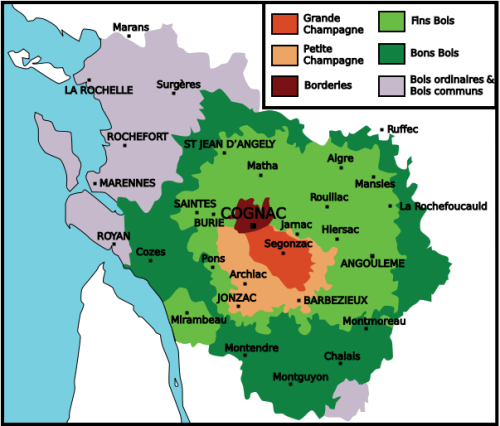
Cognac MapThe Cognac region is just north of Bordeaux in the Charente and Charente-Maritime départments or districts of France.  The ancient city of Cognac, which sits on the Charente River is at the heart of the district.  The region was delimited by law in 1909 (i.e. to call your product a Cognac, it has to be made within the designated geographical area).  There are 6 districts or crus of Cognac: Grande Champagne (best), Petite Champagne (second best), Borderies (yup, 3rd best), Fins Bois, Bons Bois and Bois Ordinaires/Bois Communs.  You might also see Fine (feen) Champagne on a label and that means it’s a blend from the 2 best areas – Grande and Petite Champagnes.  The term Champagne here has nothing to do with the Champagne region, though both areas have very chalky soils. 

Since this region is on a navigable river close to the ocean, its wines have long been popular in England and the Low Countries.  The wines didn’t travel well since they were fairly light, so distilling them became the way to go.  Distillation became pretty common in the 17th century, but really took off in the 18th century when a number of families came to the region to control the trade: the Martells from Jersey, the Hennessys and the Hardys from Ireland, the Hines from Dorset and the Otards from Scotland.

Cognac is the 3rd largest vineyard area in France and up to 8 different grape varieties are permitted.  The two most important are Ugni Blanc – pronounced ooh-knee and also known as Saint-Émilion or Trebbiano (in Italy) and Folle Blanche.  The distillation season begins the November after harvest and runs through the end of March.  The Cognac is double-distilled in a copper pot still and aged in casks of Tronçais or Limousin oak for a minimum of 2 years.  During this process, the spirit mellows and softens, taking on color and flavor from the wood.  Some will evaporate, too and this is called the “angels’ share”. 

Let’s touch on a few other things you might see on the label:

C means Cognac

P means Pale

E means Extra

S means Superior

F means Fine

V means Very

O means Old

X means Extra

You’ve probably noticed that the letters represent English rather than French words, pointing to the traditional importance of the English market.  Usually these letters are used together and since 1955, they’ve had age significance.  For example, VS is at least 2 years old, VSOP is at least 4 years old, XO is at least 6 years old.  The years represent the minimum amount of time the spirit spent in barrel. 

Cognac can improve in wood for up to 55 years, but this is risky – there will be significant loss from evaporation and there’s a risk of over-aging, making the prices exorbitant.  Keep in mind that once the Cognac is bottled, it neither varies nor improves.  The producer has already done the work for you, so once you buy a bottle, just drink it (ideally not in one sitting) and once the bottle’s been opened, consume it within 6 months.

5 Comments

Filed under Lessons, Spirits

“Wine Uncorked” in the press

Wine Uncorked 071409
Caught mid-sentence by Janet

Janet Walker, a freelance writer and the founder of Pulse Point Productions attended last week’s “Wine Uncorked” class.  Her piece was picked up by L.A.’s Splash Magazine.  You can click here to get the full scoop (or to see what you missed).

2 Comments

Filed under Lessons, Wine

Togas aren’t just for frat boys

Self-described "redneck togas"

Self-described "redneck togas"

What might not surprise you is that this picture was taken at a stock car race track.  The part that should surprise you is that it was taken during a wine festival that was held there.  Full disclosure: the aforementioned racetrack is 30 minutes from where I grew up and this photo was featured in an article in my hometown paper.

Leave a comment

Filed under Events, Wine

Blueberry Corn Muffin

Glen Thunder

Label for new FLD Corn Whiskey

In honor of the opening weekend of Finger Lakes Distilling and its owner’s birthday today, let me introduce another one of their spirits.

When I tasted the corn whiskey, this is what I came up with:

The aroma of this whiskey is reminiscent of pulling back the husk from an ear of sweet summer corn.  On the palate, it’s crisp yet mellow, with toasty, caramelized notes and a meaty finish – think cornbread with bacon! 

This is what master distiller Thomas had to say about it (I promise he really said this.  You have to meet him):

“Corn whiskey is a true southern favorite; this is an honest, true corn whiskey, made like they do it in the hills and hollers of south Alabama. It smells like Dunkin Hines cake mix comin’ off the still.  Yankees beware, put some south in yo mouth!”

This corn whiskey is unaged and bottled right from the still, but don’t be afraid – it’s surprisingly easy to drink.  The Glen refers to the racetrack at Watkins Glen.  I thought it would pair well with something a little sweet and a little spicy, so I opted for fresh blueberries and ginger ale.  Here’s the recipe:

Blueberry Corn Muffin
2 oz. corn whisky
juice of ½ lemon
pinch salt
dash simple syrup
ginger ale
handful blueberries

Muffin 2

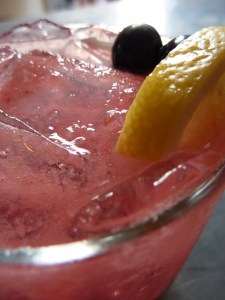
Don't be fooled by its innocent pink color

Muddle blueberries (enough to fill a rocks glass, single layer) with juice of ½ lemon, salt and simple syrup.  Add corn whiskey and shake with ice.  Pour back into rocks glass, top with ginger ale and garnish with blueberries and lemon. 

This drink goes down real easy, so watch that you don’t go off to the races.

Leave a comment

Filed under Cocktails

Finger Lakes Bramble

My friend Scott stopped by L’Ecole this week so I could taste him on some Finger Lakes Distilling Products.   He’s got plenty of experience, as he’s behind DH Krahn gin (the website is under construction, but for more info in the meantime, click here).  When we got to the Crème de Cassis, he exclaimed, “This would make a delicious bramble!”

Thanks for the tip, buddy and here goes:

see the cassis trickling down the inside of the glass?

See the cassis trickling down the inside of the glass?

Is your mouth watering yet?

Is your mouth watering yet?

The cassis will have a pretty label soon instead of my post-it note

The cassis will have a pretty label soon instead of my post-it note

Brambles are thorny plants in the rose family and the bramble fruits that come from those plants are raspberries and blackberries.  The bramble cocktail was created by Dick Bradsell in the 1980s at a club in London.  The original calls for blackberry liqueur, but I opted for blackcurrant with FLD’s Cassis. 

With the help of a Chef-Instructor and a robot coupe, I got some crushed ice.  If you don’t have either of those at home, I suggest a blender or a mallet.  The crushed ice really is an important part of the cocktail and you’ll see why in a moment.  Here’s the recipe:

2 oz. Seneca Drums gin
1 oz. fresh squeezed lemon juice
1 oz. simple syrup
dash salt

Combine the above ingredients with ice and shake vigorously.  Strain over crushed ice in a rocks glass.  Top with 1 oz. Crème de Cassis – the crushed ice slows the dissipation of the cassis, making quite a pretty show.  The trickle would have been more obvious in the first photo above, but I was a one-woman cocktail-making, photo-taking show.  Garnish with lemon slice and blackberries. 

This is an easy cocktail that’s got everything you want – a little sweet, a little tart, a little herbaceous and a little bite.

1 Comment

Filed under Cocktails

Nerd Conference

SWE LogoThe Society of Wine Educators is holding this year’s annual conference in Sacramento, CA from July 27 – Aug 1 and yours truly will be in attendance.  I’m calling it a nerd conference because each day is jammed packed with seminar after seminar and also because one of my wine-nerd heroes, Jancis Robinson, is giving the keynote address.  I’ll be taking a spirits exam and attending classes on everything from sustainability in winemaking to “the truth about wine and cheese” to “can absinthe cause insanity?” to a 3 hour class on sake.  Keep reading and I’ll fill you in on all the good stuff I learn out there.

You don’t have to be a member of SWE to attend, but you might have to be a nerd.

1 Comment

Filed under Events, Wine

Ooh la la

My niece is traveling through Europe this summer (I’m not jealous) and has been sending the family amusing updates on her adventures.  Her last email concluded like this:

“One more thing I would like to share with you.  It is absolutely NOT a stereotype, and I am absolutely NOT exaggerating when I tell you that French people really do often use the expression “ooh la la”.  Sometimes they don’t stop at two “la” ‘s – they continue on with four more “la”s, but there is never an odd number of “la”s, as the “la”‘ s are always accompanied in twos.”

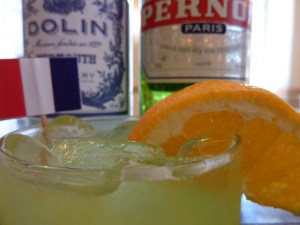
In celebration of Bastille Day, we created a cocktail yesterday and called it Ooh La La.
Ooh la la

Do you like the house made French flag?

2 oz Dolin Blanc
1 oz Pernod
dash salt
juice of 2 orange wedges

Combine all ingredients in mixer and shake with ice. Strain over fresh ice in a rocks glass. Garnish with orange and optional “French flag on a toothpick”.

By definition, ooh la la is an expression of pleasant surprise and that was my reaction upon sampling this seemingly simple cocktail.  The bright citrus, the spicy star anise and the sweet herbaceousness combined seamlessly and sang.

Speaking of singing, turns out that Ooh la la is also a song from the band, Faces.  The catchy refrain goes like this:

I wish that I knew what I know now
when I was younger
I wish that I knew what I know now
when I was stronger

I bet Rod Stewart wishes he knew about this drink.

1 Comment

Filed under Cocktails

I bought a wine featuring a cartoon animal

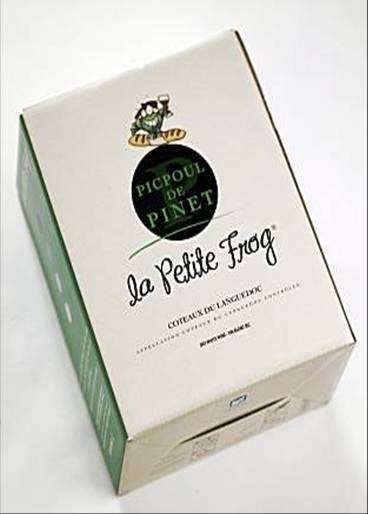
PicpoulYes, it’s a frog – a petite one, who seems to be riding a baguette.  I was so excited to see this varietal come in a box, I put my cute-sy label prejudices aside. 
Picpoul (pick-pool) is also known as Folle Blanche (Loire Valley) and is sometimes spelled Piquepoul, which means “lip-stinger”, a reference to the wine’s high acidity.  It comes in Blanc, Noir (one of the varietals allowed in Châteauneuf-du-Pape) and Gris versions, but the most famous is the Blanc from the Languedoc area of southwestern France. 

Picpoul de Pinet is one of the named crus of Coteaux du Languedoc.  Cru in this case refers to a recognized region of superior quality and Picpoul de Pinet is a designation that may be used in the Languedoc if it’s a white wine made exclusively from Picpoul Blanc.  The wines tend to be greenish-gold in color and round, with lemony-citrus notes. 

This particular Picpoul de Pinet (say that three times fast) is the 2008 La Petite Frog by the Cave de Pomerol cooperative.  I found it at Astor Wines and it’s clean, bright and zippy.  Lemon, grapefruit and a pronounced minerality dominate the palate.   It paired beautifully with a pasta dish with fava beans and an herb salad.  It’s an interesting, refreshing wine at a reasonable price – 3 liters for $30.  Add it to your list of wines to drink this summer. 

1 Comment

Filed under Wine

Fun guy? Hardly!

Last but not least in the series on stink – odors in the fungi family. 

First up is moldy-earthy smell (2-ethyl-fenchol and geosmine).  The molecules responsible for making your wine smell like dirty beets are usually produced by microorganisms.  The pungent smell is often caused by the lack of proper hygiene in winemaking equipment, especially vats or barrels.  Empty barrels are tricky to keep clean and free of mold because the temperature and humidity inside are often just what these microorganisms are looking for.  Once the pesky spores make their way into the pores of a wooden vessel, it’s almost impossible to remove them completely.  Sure, some earthy qualities in a wine can be enjoyable, but to prevent a moldy-smelling mess, the winemaking team needs to keep it (those barrels) clean; prewash, clean, rinse, disinfect, re-rinse – you get the idea. 

Speaking of moldy, another fault you’re probably more familiar with is cork taint.  Since the 17th century, oak cork has been the bottle sealer of choice – it’s elastic, compressible and impermeable to liquids and gases.  Its taste, similar to that of wood, also varies a bit depending on how it’s processed – stripping, seasoning, washing, etc.  A slight taste of cork or pieces of cork floating in your wine glass should not be confused with cork taint.  The former is considered pleasant by some and the latter is a problem with wine service.  Here are some scenarios, though, where the wine’s corked:

1.  A foul, putrid smell caused by yellow stains on cork harvested at the base of the trunk.  Don’t worry, though, the chances of this one are about 1 in 100,000.

2.  A taste of stagnant water caused by poor hygiene during the cork production process – the cork strips were not fully dried.

3. The smell of solvent or smoke caused by a narrow cork that created bottle leakage.  Mold or bacteria might be present and visible on the cork when you open the bottle.

4. The smell and taste of mold and must (yum!) caused by 2,4,6, tricholoro-anisole or TCA – this potent compound is responsible for 90% of cork tainted wines.  The formation of TCA  happens when chlorine reacts with organic phenols (highly prevelant compounds in the winery; in grapes, in corks, in barrels, in wooden pallets and in structural wooden beams) to form chlorophenols.  These in turn react with mold in the presence of moisture to form TCA.  Our threshold for detection of TCA is very low (less than 1 billionth of a gram per liter), so a little taint goes a long way to spoiling your glass of wine. 

What are your chances of running into a corked wine?  I’ve seen figures ranging from 2-8% of all bottles on the market – yikes.  We’ll tackle alternative packaging and closures another day.

1 Comment

Filed under Lessons, Wine

Cucumber Coolest

Maybe you’ve tried the cucumber cooler.  If you haven’t had a chance, try this one first.  Similar idea and ingredients, but even tastier:

Seneca Drums Gin

Seneca Drums Gin

This time around, however, I subbed St. Germain for the Dolin Blanc.  The recipe now looks like this:

2 oz. Seneca Drums gin
1 oz. St. Germain
juice of 1/2 lime
2 oz. cucumber chunks
dash salt
splash club soda

Muddle cucumber with lime juice, add gin, St. Germain, dash salt and ice, shake and pour into rocks glass over ice.  Top with club soda and garnish with cucumber wheel.

The flavors were incredibly well integrated.  Was it the greenmarket cucumber (I didn’t skin or de-seed this time)?  Was it the St. Germain?  The sweet, floral quality was a great match with the herbaceous gin.  Regardless, this cocktail did a nice job of extending the weekend.

Cucumber Coolest

Cucumber Coolest

2 Comments

Filed under Cocktails, Spirits