The last South American titanosaur

Aeolosaurus

I thought titanosaur was a made-up dinosaur name, but turns out it’s not. 

Titanosaurs are in the sauropod family, known for their “lizard-hips”, small heads but large overall size – some reaching 60 feet in height – and herbivorous ways.  Of particular interest for the purposes of this post is the aeolosaurus.  The last one on record was found during the construction of the Familia Schroeder winery in San Patricio del Chañar, a fairly new winemaking region in the Patagonia area of Argentina.  The fossils are still on exhibit at the winery today.  

Since I’m more interested in enology than paleontology, I’ll get on with it. Click here for the wine I tried

2 Comments

Filed under Wine

Wine-sicles

popsicle

I’ve never had frozen wine, but I’ve definitely left a rosé in the freezer too long when speed-chilling it. Come to think of it, a Riesling slushy doesn’t sound half bad.

As you may have guessed, this post is about serving temperatures. People can be quite particular about the temperature of the wine in their glass. Different wine books, websites and organizations will all offer advice on this topic and exceptions seem to be the rule. Click here for 6 tips

2 Comments

Filed under Lessons, Wine

Virtual cellar

How many times have you enjoyed a great bottle of wine and then instantly forgotten the name of it?  I have an easy and free solution for you. 

1. Take a picture of the wine bottle you’d like to remember using the camera on your cell phone.

2. Email the picture to mycellar@corksavvy.com.  If you choose to add a subject, that will become the title of your entry –  “Lucien Albrecht Cremant d’Alsace” or “last night’s dinner at L’Ecole”.  If you choose to add any text in the body of the email, that will become your description – “sparkling, pink and delicious” or “great with oysters”.

3. Log-in to corksavvy.com.  If you don’t have an account with them yet, you can still sign in:

User Name: your email

Password: your email

Your email will be recognized and a virtual cellar will be started for you.  Your photos will show up in “The Wine Diary”.  Don’t stress about what you write in step #2 because you can add more details to any of your entries whenever you choose.  You can also change your password once you log-in to your account. 

No label savers, scrapbooks or iPhone apps required.  How cool is that?

2 Comments

Filed under Wine

Haunting in Himrod

P1000052

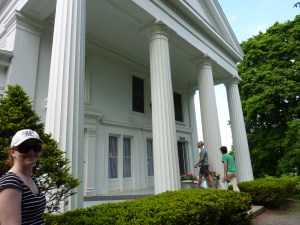
The tasting room for Miles Wine Cellars is in a Greek revival style mansion built in 1802. 

The current owners learned their house was a stop on the Underground Railroad when they discovered Civil War-era pennnies in the cistern.  A local historical society confirmed that the pennies had been minted by banks in the South and that they were most likely left behind by former slaves grateful to be escaping. 

The family has also had many paranormal encounters since living and working there – mist in the kitchen, slamming doors, flying comforters.  Most of the activity has been more inconvenient than frightening, but the owners have admitted to taking great care in cleaning and maintaining the cemetery that’s on the property. 

They’ve also created a wine in honor of the newlyweds who lived there in the mid-19th century – a light and fruity blend of Chardonnay and Cayuga White labeled “Ghost”.  It’s believed that the groom met an untimely end by falling off a ladder while changing an oil lamp on the front porch and his new bride died soon after of a broken heart.  They’ve been spotted throughout the house, but most frequently on the front porch and usually in classic Victorian garb.  Click here to see what we tasted

1 Comment

Filed under Wine

Hermann the German

Yesterday, I visited:

P1000050

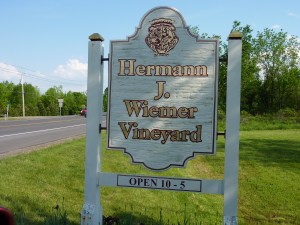
Hermann J. Wiemer purchased 140 acres on the west side of Seneca Lake (Finger Lakes, upstate NY) in 1973 and released his first vintage in 1979.  He’s originally from Bernkastel, in the Mosel region of Germany and his family has a winemaking history of over 3oo years. 

He’s considered one of the pioneers in this region and was one of the first to focus on planting vitis vinifera grapes – this is the species of all the wine grapes you’ve heard of before; Chardonnay, Sauvignon Blanc, Cabernet Sauvignon, etc.  Previously, most plantings in this area had been vitis labrusca – think concord grapes and Welch’s grape juice. 

The cool climate and gravelly soils in the Finger Lakes reminded Wiemer of his family’s vineyards in the Mosel.  His dedication to old-world style winemaking and the quality of the wines he’s produced have not gone unnoticed – just this past week was a great mention in the New York Times where Eric Asimov focused on Complex American Wine at an Easy Price to Pay. Click here to see what I sampled

Leave a comment

Filed under Wine

What a gal

Dorothy Parker (1893-1967) was an author, poet, screenwriter, humorist, critic and defender of human and civil rights.  In her time, she was published in Vanity Fair, Vogue and The New Yorker.  Not bad considering her formal education ended at the age of 13.  She was also a thirsty spirit.  Here’s what she had to say about martinis:

I like to have a martini,

Two at the very most.

After three I’m under the table,

after four I’m under my host.

6 Comments

Filed under Lessons

Go go jasmine ginger

I was introduced to a new beverage this week – sparkling white jasmine tea. 

P1000014

The Golden Star Tea Company takes jasmine silver needle tea, a rare white tea from the Fujian province in China, and puts it through a controlled fermentation with Champagne yeast – controlled to produce only trace amounts of alcohol (less than 0.5% abv) but to still capture the brioche, tropical fruit and floral notes created by the action of the yeast. 

Some of the bubbles are from the fermentation process and some have been supplemented.  There’s a touch of caffeine as well as a touch of sweetness from raw sugarcane juice. 

They recommend serving it well-chilled and straight up, in a Champagne flute. But, as is usually the case when I’m introduced to a new beverage, I decided to make a cocktail out of it.

P1000023

The tea had lots of stone fruit and honeysuckle notes, which I thought would pair nicely with the fiery earthiness of an unaged tequila.  I wanted to add a little spice to the mix, so I chose Domaine de Canton, a ginger-infused Cognac. 

Go Go Ginger Jasmine
1.5 oz. white tequila (I used Sauza Blanco)
.5 oz. Domaine de Canton
1 oz. Golden Star Sparkling Jasmine Tea
splash of simple syrup
juice of 1/2 lime, 1/4 lime to finish
pinch of salt

Combine tequila, Domaine de Canton, simple syrup, lime juice and salt in a shaker with ice, shake vigorously, strain into chilled martini glass, top with sparkling tea and squeeze the juice of an additional 1/4 lime on top.  Candied ginger or an edible flower would make a nice garnish.

5 Comments

Filed under Cocktails, Other Beverage, Spirits

Booze of the nation

Last night was Share our Strength’s Taste of the Nation NYC 2009 event, a walk-around tasting to fight childhood hunger.  It was held in the cavernous Roseland Ballroom and featured over 50 top restaurants as well as plenty of alcohol. 

Lots of heavy hitters from the city bar scene were there hawking specialty cocktails.  My favorite was the Talbott Leaf, which was personally served to me by Jim Meehan of PDT.

The name comes from the Talbott Tavern, an 18th century public house in Bardstown, KY.

2 oz. Woodford Reserve Bourbon
.75 oz. fresh lemon juice
.5 oz. green Chartreuse (French liqueur)
.5 oz. strawberry preserves
.25 oz. Cynar (Italian bitter)
4 mint leaves

Add mint and lemon juice to a mixing glass.  Muddle, then add the rest of the ingredients.  Add ice, shake, strain into chilled serving vessel and garnish with mint.

Granted, I love bourbon, but this cocktail was really well-balanced; a touch of sweetness from the strawberries, nice smokiness from the bourbon and some herbal undertones from the liqueur and the bitters.  I’m also a nerd who reads Jim’s monthly column in the Sommelier Journal, so I was tickled to see him do his thing.

1 Comment

Filed under Cocktails, Spirits

Tiny bubbles take two

56803872

Last week I explained how Champagne is made, but not all producers of bubbly follow the traditional method.  There are a few other ways to go.

1. Transversage: a twist on the traditional method.  Think about all those different sized bottles that Champagne comes in – half-bottles, the adorable splits (187 ml) and the big boys with fun names like Methuselah (8 bottles) or Balthazar (16 bottles) – going through the strict tradtional method with all of these would get out of hand.  Instead, immediately after disgorgement, the sparkling wine is put into a pressurized tank where it receives its dosage and then gets transferred to different sized bottles.

2. Transfer Method: a combination of individual bottle fermentation and bulk clarification.  This process follows every single step of the traditional method up to and including the liqueur de tirage, individual bottle fermentation and bottle aging.  There is a period of lees aging, too.  Instead of riddling, however, the bottles are chilled and their contents are transferred (get it?) to a bulk pressure tank where sediment is removed.  The bottles are washed and refilled with the newly filtered sparkling wine.  It may say “fermented in the bottle” on the label, but the kicker is that it wasn’t necessarily that bottle.  Producers will save some time and money by nixing the riddling process.

3. Continuous Method: was developed in the USSR and is now used in Germany and Portugal.  A network of (usually) five tanks are under five atmospheres of pressure – the same level of fizz in most sparklers.  At one end, the base wine together with sugar and yeast is pumped in and the second fermentation begins.  As you know, this second fermentation will create additional pressure (from released carbon dioxide) in the tank, but the yeast cannot thrive under this pressure, so additional yeast has to be added continuously.  The second and third tanks are partly filled with something like wood shavings to provide some surface area for the dead yeast cells to accumulate.  This is where autolysis (the breakdown of the yeast cells) occurs, giving us that toasty, nutty bouquet.  The fourth and fifth tanks don’t contain any yeast cells.  The wine comes out pretty clear, having spent an average of 3-4 weeks in the system.

4. Charmat process or tank method: If two names weren’t enough, you may hear it referred to as cuve close (French for sealed tank) or bulk method.  Eugene Charmat developed it in the early 20th century in Bordeaux.  It’s cheaper, faster and less labor-intensive than anything we’ve discussed so far.  It’s best suited for wines not intended for aging.  The base wine is held in a pressurized tank where yeast and sugar are added to provoke the second fermentation.  There’s no lees aging here; instead the emphasis is on the youthful, floral and primary fruit aromas – think Prosecco. 

5. Carbonation: yup, just like Coca-cola.  Also carries the charming names injection and bicycle pump method.  Carbon dioxide is pumped from cylinders into a tank of wine which is then bottled under pressure.  Since the carbon dioxide is not created within the liquid, it never really integrates – the bubbles are bigger and dissipate quickly.  This is the cheapest method of all, but fear not, it only accounts for about 10 percent of sparkling production.

1 Comment

Filed under Lessons, Wine

Calling all coffee freaks

Want to serve better coffee at your restaurant or café?  Wish you could enjoy a better cup at home?  I’ve got the class for you! 

The International Culinary Center has partnered with illycaffè to offer their renowned coffee “sommelier” training program.  Ten years ago illy began Università del Caffè at their headquarters in Trieste, Italy as a way to train their employees, purveyors, distributors, retailers and consumers and now we’re launching the first one in NYC.  

Join us starting June 1 for an intensive two-day course where we’ll cover everything from the history of coffee and its cultural significance to how it goes from being fruit on a tree to part of your morning routine.  We’ll also feature several tastings and interactive discussions and you’ll get hands-on training on the Ferraris of the espresso machine world. 

You’ll pick up some pretty nerdy trivia, too.  Like, did you know there are 50 beans in a single espresso and that if just one is not perfect, the flavor in your cup will be off?  I’ll be there leading some tastings and I’ll be joined by some very charming Italians.   For more details and to sign up, go here.

84589563

2 Comments

Filed under Coffee, Lessons