A perfect finish

Underberg

the signature 20 ml bottle, dubbed the "portion of well-being"

I couldn’t believe my luck when I noticed the Underberg behind the bar at the hotel in Mühlheim. We heard stories from multiple winemakers in Germany about “wild porks” running through the vineyards and I had just finished a braised leg of one with a side of sauerkraut that contained potatoes, cheese and more pork.

this much food calls for a digestive

this much food calls for a digestive

I discovered Underberg 4 or 5 years ago and would purchase it regularly from Amazon. Sadly, they stopped carrying it and it fell off my radar. The company was founded in 1846 and the founder’s grandson developed the “portion-sized” bottle in the 1940s. The family, now on their 5th generation, safeguards the secret recipe which contains over 40 aromatic herbs.

I think of it as a less-sweet and tastier version of Fernet-Branca. It’s perfectly balanced and will make you feel like maybe you weren’t such a pig at dinner.

The bartender at the hotel also shared a cool party trick with me regarding the bottles. He claimed that the Underberg bottle was carefully shaped so that only Underberg would pour successfully from it. I was skeptical, so after stocking up at the Frankfurt airport, I tested his theory upon my return home. Sure enough, I drank the Underberg, re-filled the bottle with water, turned it upside down over the sink and not a drop escaped.

1 Comment

Filed under Spirits

Bright young stars

This week we visited with Prinz Salm. Here’s a quick video showing the estate:


The estate has been around since 1200, but the average age of the current team in charge is 25! We tasted and toured with Felix, who’s 27 and the current wine maker (he started 2 years ago). He’s the 32nd generation, but the first one to focus only on wine making – historically, the family has also been involved in politics, construction and finance.

Felix told us a story about when his grandparents were living near Cologne prior to WWII. When his grandmother received word the Americans were coming, she acted quickly to preserve the family’s wine cellar. She took all the bottles from the cellar, tied rocks to them and tossed them into the nearby lake. The wines were protected and the family did get them back, but there was one serious shortcoming to her idea – the day after she sunk the bottles, all of their labels floated to the surface of the lake.

After we toured the estate, Felix took us to some of his family’s vineyards. Here’s a video where’s discussing one of his current projects, replanting Riesling vines.

(This video has useful information, but it appears as though it was shot by a child.  I didn’t realize you can’t get a “portrait” shot in video mode – only “landscape”.  I’ll get the hang of it)

Leave a comment

Filed under Videos, Wine

Beneath the market

I hope the sound works in this video. I’m traveling with a computer that doesn’t like to play audio, so I’m hoping for the best.

This medieval, 500 year-old cave that lies below the market in Westhofen has belonged to Weingut K.F. Groebe since 1763. All of Fritz’s wines are treated in oak – no stainless steel (if the sound is working in the video you’ll learn the barrels are 20-100 years old, so they don’t impart flavor – it’s more about texture and tradition).

I asked if the cellar required any maintenance and the answer was “not really”. It maintains a year-round temperature of right around 14 degrees Celsius and just the humidity level that the wines seem to like. From time to time, they may have to clean a little fungus from the outside of the barrels just to make sure it doesn’t end up in the wine.

Turns out this fungus (the black stuff you can see on the ceiling if you’re paying attention) is “good fungus” and survives on humidity and alcohol alone – doesn’t sound like such a bad existence.

2 Comments

Filed under Videos, Wine

First taste of Germany

Lufthansa beerMy first taste of Germany was on Lufthansa airlines last night.  I know this is a wine trip, but they were serving wines from Australia, so I thought a German beer would be the proper way to kick things off.

The Warsteiner Premium Verum is a crisp, clean, refreshing pilsner-style beer – the perfect thing when you’re packed like a sardine into a stuffy plane.

What I love about this shot though is the bag of crackers with a picture of a German vineyard on the front.  These folks are going to be serious.

The flight attendants mistakenly equated my blond hair and blue eyes with an understanding of German, but sadly at this point in time I’m not much past guten tag.

2 Comments

Filed under Beer

Thank you, Wines of Germany

header_landscapeTonight I’m headed to Germany to visit the Rheinhessen, Nahe and Mosel regions.  Please stay tuned and I’ll keep you posted on my adventures.
Prost!

Leave a comment

Filed under Wine

Don’t call it Champaña

Today’s Cava was called Champaña until the 1970s when the Spanish agreed to stop using the potentially misleading (i.e. too close to sounding like Champagne) term.

Cava is the Cataluñian word for cellar and this bubbly delight does share some similarities with Champagne. For instance, most Cavas are made using the traditional method and Chardonnay has been an approved varietal in the blend since 1986. Champagne was the inspiration behind Cava’s creation, too – Jóse Raventós, head of Codorníu (now one of the largest sparkling wine producers in the world), made a trip to France in 1872 and upon his return home, made the first bottles of sparkling wine in Spain. In 1889, Pedro Ferrer joined the Raventós family and later went on to found Freixenet (one of the other largest sparkling houses today).

While 95% of Cava is made in Cataluñia, grapes can also be sourced from Valencia, Aragón, Navarra, Rioja and the Basque country. Here t are the indigenous varietals used in the blend:

Macabeo (called Viura in Rioja): usually makes up about 1/2 the blend, fairly neutral, popular because its buds break late – this is important in areas prone to spring frost.

Xarel-lo (pronounced cha-rel-low): 2nd most important, gives the nice earthiness found in many Cavas.

Parellada (pair-eh-yah-duh): produces light-bodied, fine wines.

Cava was hands-down one of the highlights of my trip to Spain. By simply asking for a “copa de Cava” at any bar or restaurant, we’d be rewarded with a bubbly, refreshing, citrus-y, yeasty glass of wine that was less expensive than most draft beer in New York City (even with the exchange rate!).

Here’s a photo of one of my favorites – it was the house Cava at our hotel in Barcelona:

DSCN0379

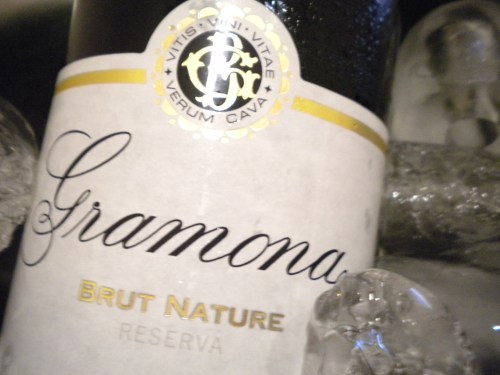
ahh, Cava on ice

Gramona’s a family winery in the heart of Penedès – more specifically, at the foot of the very impressive Montserrat mountain range and they’ve been making Cavas over 125 years.

The family coat of arms is “Vitis, Vini, Vitae”, or the vine, wine, life – you can see it on the label if you look closely.  Verum cava refers to their certain idea of what Cava should be – essentially that vines cultivated in good soil by capable hands will yield a tasty product.

Based on my tastings (yes, I went back for more), I think they’ve done their job well.  This Cava had it all – fine bubbles, notes of citrus, apples, and toasty bread, great acidity and a creamy finish.

Leave a comment

Filed under Wine

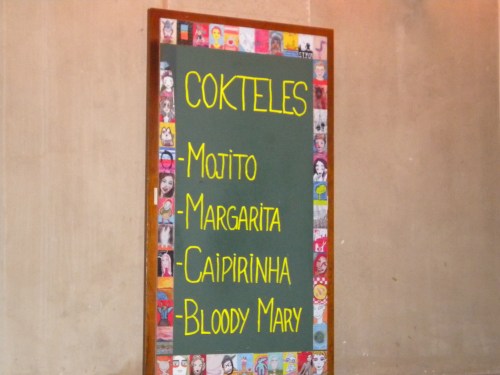
Cokteles

DSCN0253

a sign outside a bar in Spain. what's your favorite coktele?

Cokteles, yes, actual cocktails, not so much.  ESL issues aside, I do feel ok saying that cocktails are not what comes to mind when I think about Spain.  Inexpensive cava and wine drawn from barrels into plastic soda or water bottles – heck, yeah.   At one bar, I ordered a Dark and Stormy and got what tasted like a Manhattan.  This may have just been bad luck, but the wine was good enough that it just didn’t matter.

Leave a comment

Filed under Cocktails

Please don’t go (summer)

I don’t like the new nip in the night air.  I also don’t like that it’s already dark just after 8 pm.  To help stave off the end-of-summer and the end-of-the-long-weekend blues, I looked to the cantaloupe on my counter for inspiration and this is what happened:

please don't go ingredients

musky cantaloupe is a good match with herbaceous gin

Please don’t go (summer):
2 oz. G’vine gin
1 oz. St. Germain
5 1-inch pieces of cantaloupe
pinch salt
juice of 1/2 lime
club soda

Muddle melon with lime juice and salt, add ice, gin and St. Germain.  Shake and strain into rocks glass with ice and top with club soda. 

please don't go

isn't it a great color?

This drink was crying for fresh mint, but I was out.  I think it could’ve used a touch more sweetness, too.  That being said, there was a refreshing brightness – dare I say hopefulness – to this drink – maybe an Indian Summer?

1 Comment

Filed under Cocktails

Dusty because it’s old

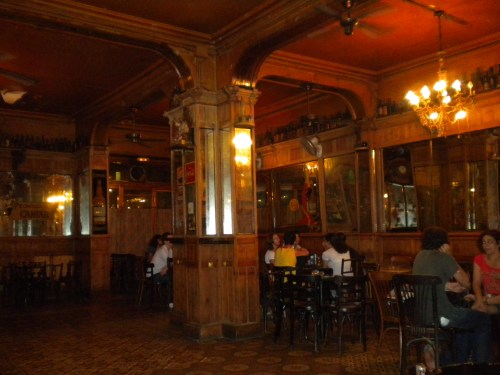
The dust bunnies on the ceiling and the crusty bottles lining the shelves were not there to add to the kitsch factor. Marsella, a bar in the El Raval section of Barcelona, has been around since 1820.

DSCN0330

Picasso, Hemingway and Dali are said to have been regulars here

I had heard this was the place to have an absinthe and there was little need to twist my arm.

DSCN0328

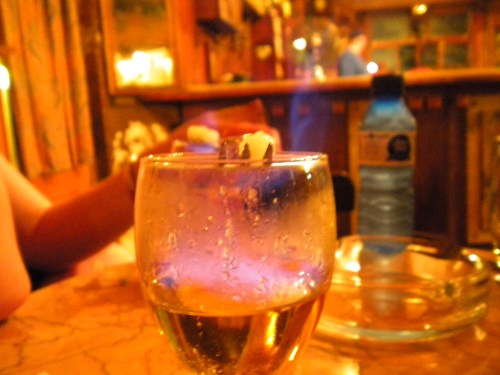
lighting our absinthe on fire

I couldn’t tell you what kind of absinthe we tried. The service was unceremonious at best and the glasses were already filled when they were brought over to our table. That all said, it didn’t matter – it was great to partake in a drinking tradition that has gone on there for almost 200 years. The closest parallel I can draw in the U.S. is McSorely’s bar in the East Village, which opened in 1854. Of course, as a woman I wouldn’t have been able to get in until 1970!

Leave a comment

Filed under Bar Reviews

4th annual Salud!

wines-of-chile-vinos-de-chileSeptember 18-30th, 2009 marks the 4th annual Salud! Chilean Wine Fest.  Restaurants in NYC and D.C. will be pouring Chilean wines by the glass or doing special tasting menus and retail stores will be offering free tastings.  For a full list of the goings-on, click here.
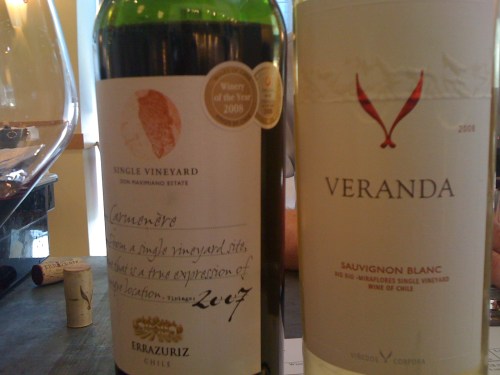
We’re going to feature a Sauvignon Blanc and a Carmenère:

Chilean wines

tasted today and approved

A little on each:

The Sauvignon Blanc is from Veranda, a project overseen by Pascal Marchand, who has an impressive background, including time at Comte Armand and Domaine de la Vougeraie.  It hails from a single vineyard, Miraflores, in the Bío Bío region of Chile.  In addition to being fun to say, Bío Bío is one of Chile’s southernmost winemaking regions.  We’ll be featuring the 2008 vintage and it’s a perfect Sauvignon Blanc for fall because it’s got some meat on its bones.  Sure, the citrus and herbaceous qualities are there, but floral, honey and some anise notes are, too.  Another bonus: the winemaker is working biodynamically. 

The Carmenère is produced by Errazuriz and is also a single vineyard, this time from the Don Maximiano Estate in the Aconcagua Valley.  Carmenère is to Chile what Malbec is to Argentina.  Thousands of acres of vines in Chile thought to be Merlot turned out to be Carmenère instead.  Jancis Robinson has described it as combining the charm of Merlot and the structure of Cabernet Sauvignon.  Many I’ve had have been too herbaceous, but the 2007 from Errazuriz had black fruits, sweet spice and some tobacco notes.  Errazuriz has an impressive winemaking history in Chile – they’re on their 6th generation right now.  I’ll leave you with a quote from their founder, Don Maximiano:

“Grapevines should be carefully tended and treated like a work of art, since their life span runs parallel to that of humans. A vine should be educated, cared for, and trained like a man; it should not be allowed to grow unoriented, because to bear proper fruits, it must not extend its branches in vain.”

Leave a comment

Filed under Events