Vintner’s Wildberry Harvest

While I was still sleeping this morning, an email arrived from a friend living upstate requesting a cocktail idea featuring Finger Lakes Distilling’s Wildberry Vodka.   She’s involved with a benefit this weekend and wanted to get some more exposure for a local product.  She needed the cocktail to be easy; something she could pre-batch and pour.

Coincidentally, I’ve been searching for a good fall cocktail using the Wildberry, too.  Over the summer it contributed to a killer lavender lemonade, but sadly, it’s time to move on.  Fall and berries don’t really go hand in hand the way apples or pumpkins do.  My first thought was cranberries and I did make a tasty Cosmopolitan, but I thought I could do better. 

My next thought was harvest time, which led me to grapes, which then led me to white grape juice – Welch’s white grape juice made from Niagra grapes to be exact.  Interestingly enough, some of the grapes used to make FLD’s Wildberry vodka are Niagra.  I was very tempted to call my new concoction “The Chicken and the Egg”, but it would involve quite a lengthy explanation and not everyone shares my goofy sense of humor. 

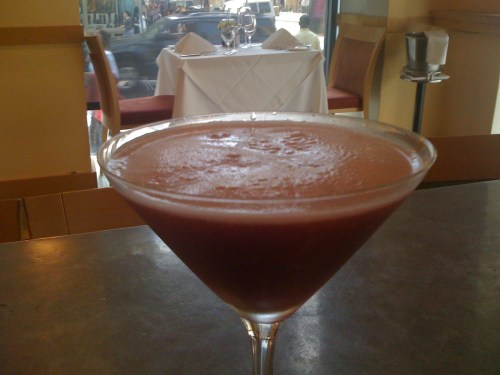
IMG_0439

8 oz. of white grape juice is the equivalent of 2 servings of fruit

Vintner’s Wildberry Harvest
2 oz. Wildberry vodka
4 oz. Welch’s white grape juice
0.5 oz. Cointreau (could sub triple sec if you’d like)
0.25 oz. orange juice (makes the flavors pop, gives the needed acidity)
0.5 oz. simple syrup

Combine all ingredients in a shaker with ice, shake, strain and serve up in chilled vessel.  Garnish with grapes – my first choice would have been white (or green), but red was all that was on hand. 

This grape juice is sweet and intensely grape-y, but the drink is well-balanced.  It reminds me of being a little kid, playing in the fallen leaves and coming back inside for a glass of grape juice.  Funny how what we consider refreshing changes as we get older.

3 Comments

Filed under Cocktails

Malbec, Carmenere, Torrontes, oh my!

The Recreational Division at The International Culinary Center is hosting “Discover the Wines of South America” on Wednesday, October 28 from 7-9:30 pm. 

You’ll learn about terruño (Spanish for terroir), sip some Argentine sparkling wine, dabble in a little blind tasting and impress your friends with your new-found knowledge about “hot” new grapes, regions and producers from South America. 

Best of all, your instructor, Liz Caskey, has lived in Santiago since 2001, so you’ll get the scoop from an insider.  She started her own boutique travel firm and in addition to running her business, she’s worked in many kitchens, vineyards and cellars and is a food/wine/travel writer for international publications as well as her Eat Wine Blog.

Leave a comment

Filed under Events, Wine

Fermentation, take two

You may have heard malolactic fermentation described as a secondary fermentation.  While it never precedes the primary, alcoholic fermentation (sugar+yeast=alcohol+CO2+heat), it’s not a true fermentation.  The process is carried out by bacteria (lactic acid bacteria), not yeast.  It is sometimes shortened to MLF or to the French la malo, and it is the conversion of malic acid to lactic acid. 

Malic comes from malum, Latin for apple and this type of acidity is found in nearly all fruits and berries.  It’s used commercially to acidify food and beverage in industrial processes.  Lactic acid is named after lactis, Latin for milk and is one of the milder acids found in wine. 

Is it a good thing?  Well, that depends.  If you have a wine with excess acidity, like a red wine from a cool climate, then yes.  It can also add additional flavor and complexity to both red and white wines as well as prevent the process from happening later on once these wines are bottled.  If, however, you have a wine from a warmer climate or a hotter vintage and you want to preserve its zip, then no. 

Some grapes, especially Chardonnay, take better to it than others.  Producers of Riesling or Chenin Blanc usually avoid it (through maintaining cooler temperatures and using sulfur dioxide), even though these grapes are naturally high in acidity. 

So, what can you expect if a wine’s undergone the process?  A rounder, fuller mouthfeel – some would say buttery.  The buttery-ness is from diacetyl, which is a by-product of the process.  If the diacetyl is not kept in check, it can be overpowering in the wine, even coming across as rancid butter.  Some winemakers think that if the malolactic fermentation happens while the wine is in the barrel, the fruit and oak flavors will be better integrated.

Leave a comment

Filed under Wine

New sommelier competition announced

Top SommThe Guild of Sommeliers just announced a new U.S. Wine Championship.  Master Sommeliers will be the judges and the competition will follow the service standards outlined by the Court of Master Sommeliers. 
It’s $25 and you have to be 21, an American citizen and some sort of wine professional.  There’s an online testing component as well as regional competitions before the grand finale. 

Here are the dates to know:

10/6/09 registration opens
11/15/09 entry deadline
1/23/10 online testing begins
March-June 2010 regional competitions
August 2010 championship

For more info and to sign up, click here.

Leave a comment

Filed under Events, Wine

Tickled pink

Sounds more exciting than “vinified pink”, don’t you think?  As promised, it’s time to talk about winemaking and I thought rosé would be a fun place to start. 

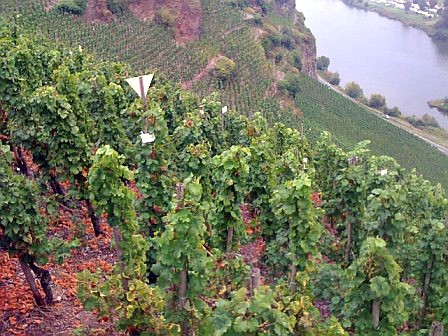
Let’s back up for a moment, though.  Whether you start with grapes that look like this:

Riesling

Riesling

Or like this:

Spatburgunder

Spätburgunder aka Pinot Noir in Germany

The juice and pulp of all grapes are clear, meaning the color in wine comes from the skins of the grapes. 

If this is a new concept to you, it might be helpful to think about Champagne.  The pink stuff aside, most of the Champagne we see on the market is white.  Two of the three permitted grapes for Champagne production, however, are red (Pinot Noir and Pinot Meunier).  The winemakers are careful to quickly separate the liquid from the grape skins, preventing any color from being imparted into the juice.

So, what to do when you want wine whose color falls somewhere between a white and a red?  Here are a few options:

1. A short maceration of the juice with the skins.  For our purposes, you can think of maceration as skin contact.  Technically speaking, it’s the extraction of phenolics (think tannins and flavoring compounds) from the grape skins, seeds and stem fragments into the juice and it’s affected by temperature, agitation and time.  The soak usually lasts 2-3 days, depending on the style the winemaker is going for – the longer the skin contact, the more darkly colored the rosé will be.  The skins are then discarded and fermentation proceeds as for a white wine.

2. The Saignée method – French for bled or bleeding the vats.  In this process the winemaker will collect free-run juice from just-pressed dark-skinned grapes after a short, prefermenation maceration.  Coincidentally, this concentrates the remaining red wine, imparting more tannin and color because the ratio of liquid to grape solids has been reduced through bleeding the vats.

3. Blending.  This is just as it sounds – blending finished red wine into finished white wine.  You’ll get a pink wine, but you won’t get the nuances achieved through maceration.  Believe it or not, Champagne is one of the few controlled appellations where this is allowed.  I guess the thought is that the second fermentation and resulting carbonation will provide enough interesting character to the rosé. 

I’ve also read that pink wines can be made by using charcoal treatments to remove the color from red wine.  This makes me a little suspicious – if the winery doesn’t want to sell it as red wine, why would I want to drink it pink?

3 Comments

Filed under Wine

More vineyard adventures

While the Ürziger Würzgarten vineyard was probably my favorite, I wanted to share two more with you.

DSC00562

The winemaker from Emrich Schönleber walking us through the Goldtröpfchen vineyard

Whenever we were let out into the vineyards, we were like kids at recess.  Here’s a short video of my fellow wine nerds traipsing through the Goldtröpfchen vineyard.  I was hoping to hit the America’s Funniest Home Video jackpot, but no dice.

This was the next stop:

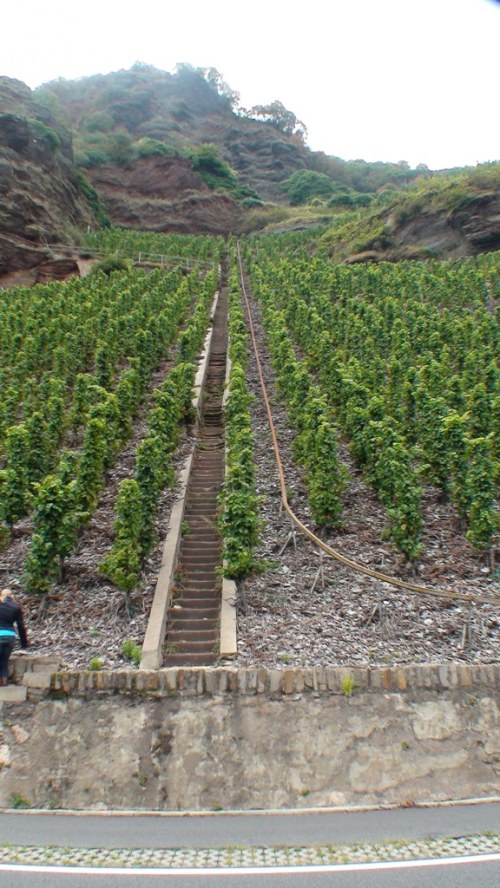
DSC00619

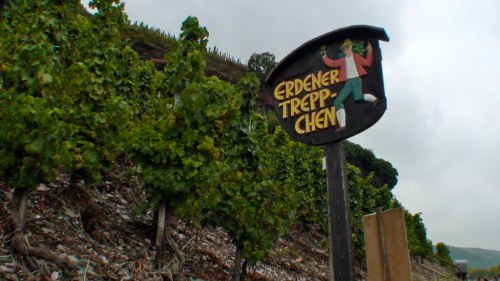
Still in the Mosel, on to the Erdener Treppchen vineyard

you can see me making my way up the stairs at the bottom left - helps give some scale to the shot

you can see me making my way up the stairs at the bottom left - helps give some scale to the shot

I made a quick video of this vineyard because I was impressed by the “soil” (aka big slabs of slate).  I did turn the camera at one point, but it still worth checking out.

1 Comment

Filed under Videos, Wine

My teeth hurt

4 days + over 200 of the world’s most high-acid wine = sensitive teeth

tooth10 days of ProEnamel by Sensodyne and an emergency visit to the dentist have almost restored my teeth to their pre-Germany sensitivity level. 

I doubt I will receive sympathy from any of my dear readers, but take it from me – if you plan to go on a wine trip, don’t forget to pack the enamel building toothpaste!

2 Comments

Filed under Lessons, Wine

If only it were so easy

Doing some house cleaning today (don’t make fun), I found an apron that I hadn’t seen in a while.

apron

Instead of suggesting that you kiss the cook or that too many brews spoil that cook, this apron offered something even sillier – a six-step recipe for fine wine – not that it’s necessarily wrong.  In coming weeks I’ll write more about wine-making.  I can’t make it this easy, but I’ll do my best.  Stay tuned.

wine recipe

2 Comments

Filed under Wine

Jamaican me thirsty

I’m not sure if this name will fly once we actually put this cocktail on the list, but for now I’ve found it quite entertaining.

I recently got in a cool product called St. Elizabeth Allspice Dram from my friend Scott who distributes products from Alpenz.  Essentially, it’s a rum-based liqueur flavored with allspice berries.  These are no ordinary allspice berries, however.  They’re from Jamaica and they give the spirit a rich smell of baking spices – clove, cinnamon and nutmeg (“all” spices in one – get it?), along with a spicy, pepper finish.  It will make great fall and winter cocktails – mulled ciders, warm punches, etc. 

In some recipes this liqueur is listed as Pimento Dram.  The pimento refers to the berry from which the allspice is derived and is not to be confused with that flavorless red thing jammed into your olive.  I found a few definitions for dram, the most likely being an informal expression of a small amount of liquid (often in reference to Scotch).  The fact that dram can also be used as a measure of the powder charge in a shotgun shell was also quite compelling. 

The label claims it’s a tradition of the West Indies, yet it’s bottled in Austria.  Go figure.

Shortly after getting the product in house, Scott emailed over a recipe for me to try.  With a few tweaks, here it is:

guests in the background wondering why I'd want to photograph bottles of booze

guests in the background wondering why I'd want to photograph bottles of booze

1.5 oz. bourbon
1 oz. Finger Lakes Distilling Cassis Liqueur
just under 0.5 oz. St. Elizabeth Allspice Dram
1 oz. fresh lemon juice
1 egg white (gives great body and texture to the drink – don’t be scared!)
healthy pinch salt
club soda


Combine all ingredients in a shaker and do a pre-shake without ice – this helps to incorporate the egg white.  Add ice, shake again, strain into a chilled up glass and top with club soda.  It was so pretty on its own, I didn’t garnish it.  Maybe a lemon twist?

my bartender Gene doing the egg honors

my bartender Gene doing the egg honors

pink, frothy, spicy, refreshing - what more do you need?

pink, frothy, spicy, refreshing - what more do you need?

3 Comments

Filed under Cocktails

The Hollywood of Germany

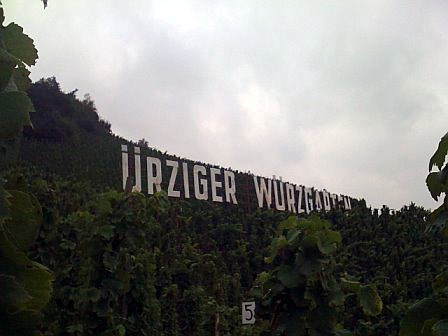
urziger wurzgarten background

far from California

One of the highlights of the trip was when the winemaker from Schmitges took us on a stroll up through the Ürziger Würzgarten vineyards in the Mosel. 

Despite the ominous clouds and the steep incline of the trail, it was a wine nerd’s dream. 

I’ve seen the name “Ürziger Würzgarten” on bottles of Riesling for years and being able to see it in person helped shed some light on why these bottles are so expensive.

First, check out the terroir:

yes, they're referring to rocks as soil - the famous slate of the Mosel

yes, they're referring to rocks as soil - the famous slate of the Mosel

Next, check out how steep the vineyards are:
some sections have slopes up to 70 degrees

some sections have slopes up to 70 degrees

Here’s a typical sign you’d find in the vineyard:
the signs mark who owns the vines

the signs mark who owns the vines

If you’re lucky, you’ll own more than one row.
Here we’re getting closer:
urz wurz no people
Here’s a view from the top:
the Mosel River is in the background

the Mosel River is in the background

Yes, we were so spoiled that the winemaker’s wife drove up and presented us glasses of wine once we got to the top:
not a good photo op for those afraid of heights

not a good photo op for those afraid of heights

Oh, and it was single vineyard Spätlese:
sweet success!

sweet success!

Leave a comment

Filed under Wine