Barbara West

On Tuesday afternoons, I’ll often go down to the bar and mix cocktails with Gene.  Today, I taped him making a Barbara West cocktail. 

I realize now that I should have given more commentary as he’s making the drink.  It seemed very loud in the restaurant at the time, but I come through loud and clear.

We sourced the recipe from Ted Haigh’s book:

2 oz. gin (we used Seneca Drums)
1 oz. Sherry (we used Lustau Amontillado)
1/2 oz. fresh lemon juice
1 dash Angostura bitters

Shake in an iced cocktail shaker, strain into a chilled glass and garnish with a lemon twist.

I can’t seem to find much on the etymology of this cocktail, though Ted notes you could order a “Creole with bitters” and end up with a Barbara West.  On the CocktailDB, I found a recipe for a Barbara East.

Gene’s comments at the end of the video about the drink being tart are because we had just finished making a Bebbo Cocktail before taping (more on this later).  An easy way to play around with this drink would be to change the Sherry.  Amotillado is dry and nutty and worked well, but I could see substituting an East India or an Oloroso style if you were looking for a touch more sweetness.

2 Comments

Filed under Cocktails

Join in the fun

Another round of Fundamentals of Wine is starting up tomorrow.  Join us on an 8 week journey through the world of wine.

Riesling grapes in Germany

1 Comment

Filed under How to, Wine

A is for Aligoté

White Burgundy is almost always associated with Chardonnay, and with good reason – those wines are some of the most sought-after and expensive in the world.  Aligoté happens to be another white grape used to make dry white wines in Burgundy.   One of its synonyms, Alligotay, should clue you in on how to pronounce it.

The first record of Aligoté was in the 18th century and it’s played second fiddle to Chardonnay ever since.  DNA profiling has shown it to be part of the Pinot family.  The wines tend to have notes of apple and lemon, like many Chardonnays, but will be higher in acid and often show some herbal qualities.  Aligoté is meant to be consumed young.  

Historically, the vines of Aligoté and Chardonnay were inter-planted and producers would often create field blends of the two, relying on the higher acid of the Aligoté to give the wine a little lift.  Sadly, Aligoté is not as profitable and now the vines tend to be relegated to the highest and lowest vineyard sites (as opposed to the sweet spot in the middle of the slope), where the locals serve it with simple meals or mix it with blackcurrant liqueur to make a kir. 

While found throughout Burgundy(even in Chablis), only the village of Bouzeron in the Côte Chalonnaise has its own appellation for Aligoté, called Bourgogne Aligoté-Bouzeron (you’ll see this on the label).  Bouzeron has lower yield requirements for its Aligoté (45 hl/ha, which translates to 2.5 tons per acre vs. 60 hl/ha elsewhere) and many think the best examples come from here.  Another label option is Bourgogne Aligoté (up to 15% Chardonnay can be blended in), indicating it came from outside Bouzeron, but somewhere within Burgundy.  Outside of Alsace, this is one of the few instances where you’ll see the varietal indicated on the label.   

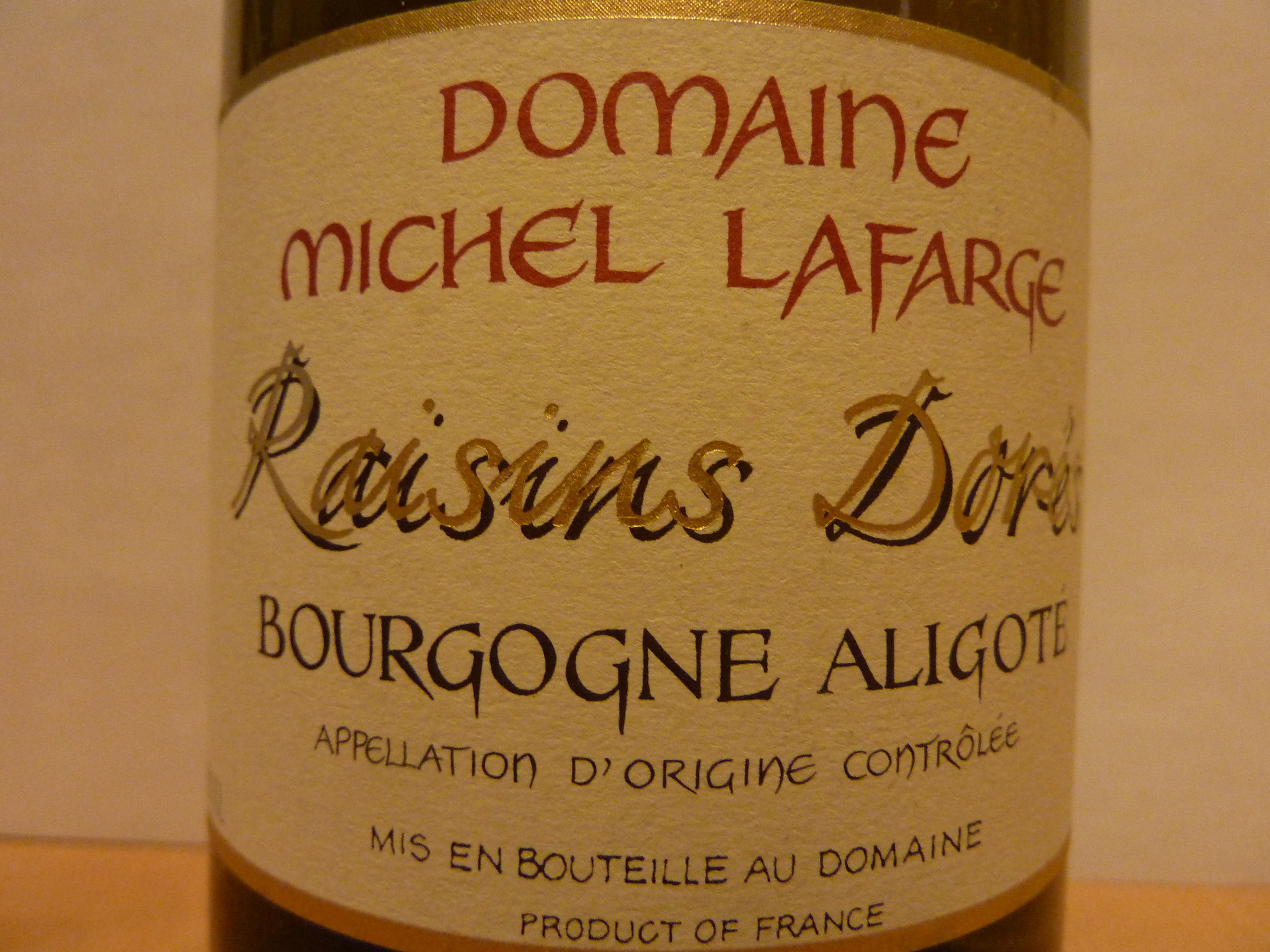
Pierre Morey and Michel Lafarge are two outstanding producers to look for.

Burgundy’s sparkling wine, Crémant de Bourgogne, may also be comprised of Aligoté.

Eastern Europe shows more love to Aligoté.  It can be found in Bulgaria, Romania and many of the ex-Soviet republics: Ukraine, Moldva, Georgia, Azerbaijan and Kazakhstan. I will resist the urge to make any Borat jokes.

1 Comment

Filed under Alphabet Soup, Wine

Martini madness

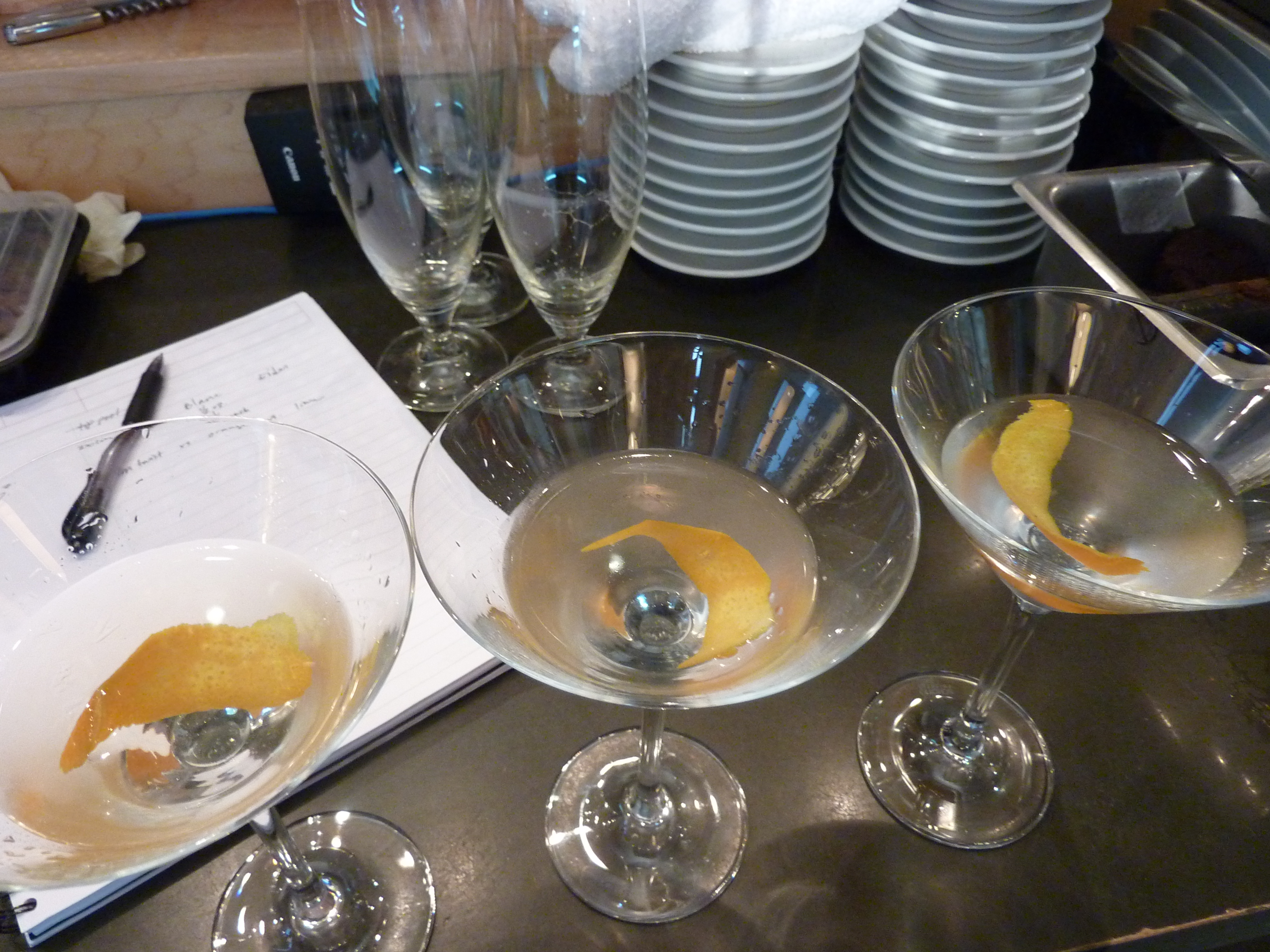
In preparation for Saturday’s Martini Bowl at Union Square Wines, I’ve been doing some experimenting.

Which garnish will come out on top - the peel of an orange, lime or lemon or something else all together?

Which vermouth will come out on top? Notice there's no Italian representation.

It’s odd that no one can agree on the origins of the most popular cocktail.  In his latest book, David Wondrich presents four different theories, ranging from The Jerry Thomas Theory (that Jerry, while working in San Francisco, made the drink for someone headed east to Martinez who had asked for something new), dubbed “exremely unlikely” to The Judge Martine Theory (that Judge Martine invented it at New York’s Manhattan Club), which he called “possible, but not proven”.

The style of the martini has changed over the years, becoming drier over time.  Pre-Prohibition recipes were usually equal parts gin and vermouth or a 2 parts gin to 1 part vermouth ratio.  Pre-World War II recipes often called for a 4 to 1 gin to vermouth ratio, while post-World War II ratios crept up to 15 to 1. 

My Grossman’s Guide to Wines, Beers, and Spirits says that the Martinez Cocktail is the earliest martini-esque recipe they could find.

1 dash bitters
2 dashes (1 tsp) maraschino liqueur
1 pony (1 oz.) Old Tom gin
1 wineglass (2 oz.) vermouth
2 small lumps of ice

Shake thoroughly and strain into a cocktail glass.  Garnish with a quarter slice of lemon and if the guest prefers it sweet, add 2 dashes of gum syrup.

Is it better to shake or stir? Serve it up or on the rocks? Shaved ice while shaking?

You’ll have to stop by on Saturday to see what we decided to go with, but in the meantime, we can all agree on the beautiful relationship between gin and vermouth.

1 Comment

Filed under Cocktails

“If your body can take it, you might as well buy the cheaper liquor”

This is a great quote from a  Washington Post article that ran today. 

No surprises were revealed – people are drinking more in this economy, but they’re doing it at home instead of out at restaurants or bars, and many of them have switched to cheaper brands.  Folks outside New York are taking the Costco approach, buying big to save money. 

My advice from yesterday’s post still stands.  Popov will do bad things to you.

2 Comments

Filed under Alcohol in the News, Noteworthy articles

Buy local booze

I have three upcoming tastings and I hope to see you there!

This Friday, 2/5 from 5:30-7:30 pm, I’ll be pouring McKenzie Rye at Crush.  153 E. 57th (between 3rd and Lex)

On Saturday, 2/6 from 2-5 pm, we’ll be mixing some Seneca Drums Gin cocktails at Union Square Wines for their annual Martini Bowl.  Get jazzed up for the Super Bowl and sample over a dozen spirits featured in classic and seasonal martinis.  We have a few tricks up our sleeve and we hope to be the Martini Bowl Champs this year.  140 Fourth Avenue (at 13th St.)

Keep it going on Saturday and drop by Bowery and Vine.  We’ll be there from 4-7 pm, pouring Vintner’s Vodka, Glen Thunder Whiskey, FLD Cassis and maybe a surprise or two.  269 Bowery (at Houston)

1 Comment

Filed under Events, Spirits

Hearts and Cocktails for Haiti

Bar Celona, a relatively new tapas and cocktail bar Williamsburg, is hosting Hearts and Cocktails for Haiti this Sunday from 6-10 pm.  For $40, you’ll enjoy 4 hours of an open bar featuring rum punch, beer, cocktails and wine served by folks like Jim Meehan of PDT and Lynette Marrero of Rye House

More importantly, you’ll be contributing to an important cause.  They hope to raise $20,000 for the Red Cross.  Go show everyone your thirsty (and giving) spirit.

3 Comments

Filed under Cocktails, Events

Blood and Sand

Blood and Sand was a silent film released in 1922, starring Rudolph Valentino, Lila Lee and Nita Naldi.  The hero is a matador and there’s a love triangle.  Olé! 

It was based on the 1909 Spanish novel Sangre y arena by Vicente Blasco Ibáñez.  Ibáñez shot a version himself in 1916 and others were made in 1941 and 1991.

Xena: The Warrior Princess’s new series “Spartacus: Blood and Sand” is not related. 

What I’m excited about is the cocktail that was inspired by the 1922 version. 

This is yet another goodie I found in my Ted Haigh book.  Coincidentally, I recieved sample bottles of the Finger Lakes Distilling cherry liqueur today.  For all of you bartenders out there using Cherry Heering, you gotta try this!

Scotch cocktails should be more popular.  Sure, everyone knows the Rusty Nail (Scotch, Drambuie) and the Rob Roy (a Manhattan using Scotch instead of rye or bourbon), but people assume if they’re not Scotch drinkers, they won’t like Scotch cocktails.

You could use this one to prove them wrong.

1 oz. Scotch (I used Dewar's), 1 oz. orange juice, 3/4 oz. cherry liqueur (I used Finger Lakes Distilling), 3/4 oz. sweet vermouth (I used Dolin). Combine all ingredients over ice, shake and strain into a chilled glass. Garnish with a cherry.

I poured it for two regulars sitting at the bar.  One commented, “it’s nice and tart”.  The other said, “I don’t usually drink cocktails, but I could drink this.  I’m picturing myself in a Hawaiian shirt, with no shoes on, sitting on the beach.”

My work here is done.

3 Comments

Filed under Cocktails

Pouring tableside

Over the summer I wrote a short piece about how a restaurant can show it cares about wine. 

I didn’t include pouring wines by the glass tableside on my list, but I should have.  The Detroit Free Press ran a great article on the subject a few days ago, citing how it’s a disappearing courtesy. 

I certainly understand the need to control costs – the main reason given for the decline of tableside pouring – but I also believe in the power of staff training.  If, as an owner or manager, you don’t trust that your staff will be able to pour the 5 or 6 ounces that comprises your glass of wine, what does that say about you?  The more you empower your staff, the better they will perform for you.   In the long run, you will also save money by allowing the guest to sample the wine prior to commiting to a full glass. 

The article didn’t mention it, but seeing the bottle is an important part of the drinking experience.  It’s nice to know that what you’ve ordered is what you’re getting and seeing the label can be a helpful tool when it comes time to remember the wine that you liked (or would like to avoid).

Leave a comment

Filed under Noteworthy articles, Wine

Pinot blanc, Trapp style

A few weeks ago I went cross-country skiing in Vermont at a place called the Trapp Family Lodge.  The Trapp family is the inspiration behind the classic musical and movie “The Sound of Music”.   We were attempting to sing this song in the car.  This video shows the lyrics, not that it helps much.

After a few hours out on their 60+ miles of trails, I have come to understand why NordicTrack claims “no other machine offers the calorie-burning, total-body workout of the original Classic Pro Skier”.

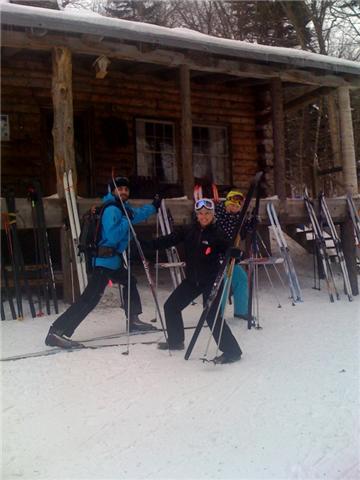
Horsing around in front of the lunch lodge.

At the end of the day, we hobbled to the gift shop, where I discovered that the Trapp Family Lodge features estate bottled Austrian wine. 

I picked up the 2008 Pinot Blanc from Höpler.  Pinot Blanc is a white mutation of Pinot Gris, which is a lighter-berried version of Pinot Noir.  It goes by Pinot Bianco in Italy, Klevner in Alsace,  Beli Pinot in eastern Europe and Weissburgunder in Germany and Austria.  This grape accounts for 6 percent of Austria’s total plantings and some argue it has its best expression here.  When dry, it tends to be fuller-bodied, round, with medium to high alcohol, notes of almonds and the ability to age. 

The wine had notes of honey, musk melon, white flowers and fresh herbs. The back label suggested ossobuco of rabbit, but it did just fine with Serrano ham, Manchego and Bleu d'Auvergne.

1 Comment

Filed under Wine