Category Archives: Spirits

The Colbert Bump

What cocktail would you serve Stephen Colbert

I asked a few friends this question and got some funny responses.   One suggested a French cocktail due to Colbert’s tendency to pronounce things with a French accent.  Another submission was a cocktail ending in a soft “t”.  A third idea was a drink with a disconnect between what it looks like (or its ingredients) and what it tastes like, to reflect the satirical nature of his program.  Another clever proposal was a hyper patriotic cocktail – bourbon (which by law must be made in the U.S.) with blue curaçao, grenadine and coconut milk – stars and bars!  An American beer-based cocktail could fall into this category, too.

On a recent visit to Colbert’s show, David Wondrich, a cocktail historian, made him a “Colbert Bump”.  He based it on the “Cherry Bounce”, one of our country’s oldest cocktails.  I’ve come across several versions, but most involve cherries, whiskey, sugar and time (probably why Mr. Wondrich went right for the cherry brandy). 

Check out the amusing exchange below. 

Vodpod videos no longer available. 
 

Leave a comment

Filed under Spirits, Videos

It didn’t make me crazy

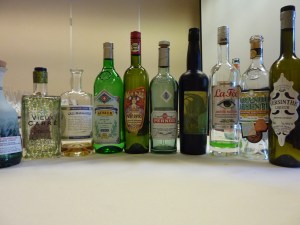
Here’s a recent tasting I did:

10 from around the world

10 absinthes from around the world

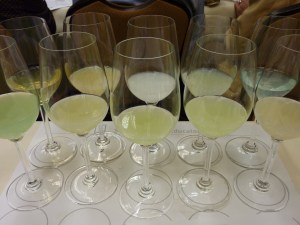
The colors are like easter eggs

The colors are like easter eggs

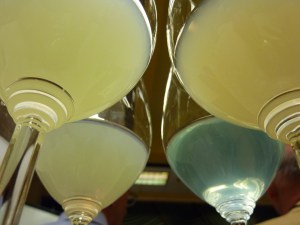
Thirsty yet?

Thirsty yet?

As you can see from the photos, we didn’t quite have the sexy presentation like you might find in an absinthe bar; a special, slotted spoon for the sugar and an attractive water dispenser to appreciate the impact of each drop on the color and opalescence of the absinthe, but I plan to report on that next month when I visit Barcelona (thanks for the tip, Trin). For an animated version of what I’m talking about, click here www.versinthe.com

I’ve briefly touched on absinthe before. So, why all the fuss over this once-banned spirit?

For one, the principle flavoring ingredient, Artemesia absinthium or Grand Wormwood, contains thujone, considered a carcinogen and/or a hallucinogen at very high concentrations. Secondly, its high alcohol content was often mishandled. Producers have always recommended diluting absinthe with water, but this advice was often ignored.  Third, absinthe’s historically been made with cheap base alcohol and even cheaper dyes, some of which were toxic. To top it off, the anti-alcohol groups were exerting pressure to have it banned and that’s just what happened in 1912 in the United States.

We have the French to thank for absinthe’s return to the market. Turns out that while France had banned the sale of absinthe, it had never bothered to ban its production – they were ready to go with product once the ban was lifted. This little tidbit combined with the work of George Rowley (of La Fée Absinthe Parisienne), who convinced the EU that absinthe has less than 10 ppm of thujone has allowed us once again to dance with the green fairy.

Sure, Pernod may have similar anise notes, but as our instructor noted, it’s simply a “training bra” for real absinthe.

For standardization purposes, all of the absinthes we tried were diluted 5 parts water to 1 part absinthe, even when producers may have recommended a different ratio. We also didn’t use any sugar. Here’s what we tried:

  1. Vieux Carré Absinthe Supérieure, Pennsylvania, 120˚ – this is the first one to come from the East Coast and it’s from the same folks who brought us Bluecoat gin. It was overdiluted (they recommend 3:1), but I got anise and carrot notes.
  2. St. George Absinthe Vert, California, 120˚ – most absinthes are made with a grain neutral spirit base (often sugar beets), but these guys use a blend of Chardonnay and Sauvignon Blanc – it could be the power of suggestion, but it did seem to have a creamier mouthfeel than some of the others. Olive green in color with notes of hyssop, basil and pine.
  3. Kubler Swiss Absinthe Superieur, Switzerland, 106˚ – the only white one in the bunch (how Swiss!). This producer doesn’t add any additional spices following distillation; an anomaly in this group. Spicy and earthy, with cardamom as a standout.
  4. Mata Hari Absinthe Bohemian, Austria, 120˚ – they claim no added color and their spirit was a beautiful mother-of-pearl that smelled like cinnamon chewing gum.
  5. Le Tourment Vert, France, 100˚ – you’ll notice the lower proof on this one and the company says they created this absinthe for making cocktails. Don’t you want higher proof spirits for cocktails to help the inevitable dilution? It’s freakish (yet beautiful) teal color has been getting flack, too, so they may change it back to the green family. I got Listerine, pine, pepper and juniper notes.
  6. La Fée Absinthe Parisienne, France, 136˚- the first one in France, this absinthe was emerald green and earthier as opposed to spicy, with lots of anise on the finish.
  7. La Muse Vert Absinthe Traditionnelle, France, 136˚ – this producer claims to be the only one using fresh cut grand wormwood – it happens to grow on their property. They also use a black bottle to protect their spirit from light. It was mellow and floral, with chamomile and dandelion notes and a bitter finish (in a good way).
  8. Pernod Aus Plantes d’Absinthe Superieur, France, 136˚ – light lime in color, this absinthe struck a nice balance between earth and spice. The sugar they added was noticeable, but pleasant.
  9. Grande Absente Absinthe Originale, France, 138˚ – the sweetest of the lot, their herbs hail from the Alps. It tasted of blackjack chewing gum with a bite on the finish.
  10. Versinthe, France, 90˚ – jade in color and boasting over 20 plants and herbs, this was light and elegant with notes of fennel.

You may have noticed that we didn’t taste in order of alcoholic strength. The instructor wanted to highlight the different regional styles, so we tasted the Americans (very different from one another and the others), then the Swiss (so clean!), followed by the Austrian (Bohemian!) and finished with the French (several claiming the “original recipe” – go figure).

3 Comments

Filed under Spirits

Gin-o-matic

Throughout beverage history technology has brought many new and improved ways to imbibe; bottled wine (rather than clay pots), wide-mouth beer cans, and of course the wine glass on a rope.  Unfortunately, sometimes technology moves in reverse.  For example, back in the 18th century there were gin vending machines; nowadays we have to talk to a bartender.

That’s right, over 200 hundred years ago in London, drinkers could walk up to the outside wall of a bar, put their mouths on an “Old Tom” (I’ll explain) and for a penny, get a mouthful of gin.

The “Old Tom” was a cat-shaped plaque mounted on the bar’s outside wall.  Drinkers would drop a penny in the cat’s mouth and put their own mouth over a tube near the cat’s paws.  A bartender inside would then pour a shot of gin into this early gin-o-matic, and voila!  Can you imagine how this would go over in the East Village today?

Old Tom gin is a sweeter version of London Dry gin – simple syrup was added to distinguish it from the other gins on the market. This style was wildly popular in England during the 1700s. It also happened to be the gin of choice for making a Tom Collins (gin, lemon juice, soda) in the 19th century. As of the 1950s, this style of gin was not available in the United States.

Luckily, Hayman’s has arrived back on the scene. It’s round on the palate and the touch of sweetness really highlights the botanicals. The founder of the Hayman’s distillery also happens to be the same guy who invented Beefeater gin.

This gin is great in some classic cocktails like a Martinez or Ramos Gin Fizz or you can try my Violette Femme.

Leave a comment

Filed under Spirits

Playing second fiddle

Instead of heading north of Bordeaux, we’ll head south-east to a drier, warmer climate where there’s a long, rich history of local consumption of spirits made by individual producers rather than major brands.  We’ve covered Cognac so now we’re going to Armagnac (are-muhn-YACK), France’s second great controlled appellation for grape spirits.

The center of the trade is the city of Condom (tell that to your friends with a straight face).  While Cognac is broken down into 6 regions, Armagnac has 3 that were defined in 1936: Bas-Armagnac, the most westerly and home to the best spirits, Ténarèze in the center where the fullest-bodied styles come from and Haut-Armagnac to the east, where the wines are often sold off rather than distilled – you’ll see them labeled as Vin de Pays des Côtes de Gascgone. When purchasing an Armagnac, the name of the subregion will appear on the label.

Only white grapes can be used for Armagnac production and you’ll recognize some of the names from Cognac production like Ugni Blanc and Folle Blanche.  There are a few others, too – Colombard, Meslier, Jurançon and a hybrid called Baco 22A (sometimes called Baco Blanc).  It’s a hybrid because it’s a cross between the French vitis vinifera Folle Blanche and the American vitis labrusca Noah.  Noah itself is a cross between vitis labrusca and vitis riparia.  Hybrid=cross across species.

Since 1972 the use of pot stills has been allowed, just like in Cognac, but many producers still use the more primitive and traditional Armagnac still, a continuous still with two copper columns.  Another difference between the two regions lies in the oak aging.  Most Armagnac producers use the local, sappy Monlezun oak.  The combination of still and aging tends to make Armagnac a more rustic version of Cognac.  Cognacs may have more floral and grape-y notes while Armagnacs will have more dried fruit and prune characters.  Cognacs retain their bite, while Armagnacs are fuller-bodied and rounder.

Some of the labeling terms will be familiar to you, but the minimum aging requirements are a touch different.  *** (often written as VS) is one year old, VSOP is 4 years old and XO is five years old.  Hors d’Age means the youngest component in the blend is 10 years old.  Many producers will age individual casks from a single distillation and sell these with a vintage date.

For a fun and refreshing drink, look for Floc de Gascogne, a fortified sweet wine made with 1/3 Armagnac and 2/3 grape juice from the region.  The alcohol clocks in at 16-18%  and there are notes of honey, almond and jasmine.  I kept my bottle in the fridge and used it as an aperitif.

2 Comments

Filed under Lessons, Spirits

Cone-yack

All Cognacs are brandies, but not all brandies are Cognacs.  The best ones are made from low alcohol, high acid grapes.  Sounds a bit like Champagne, don’t you think?  No wonder I like it!
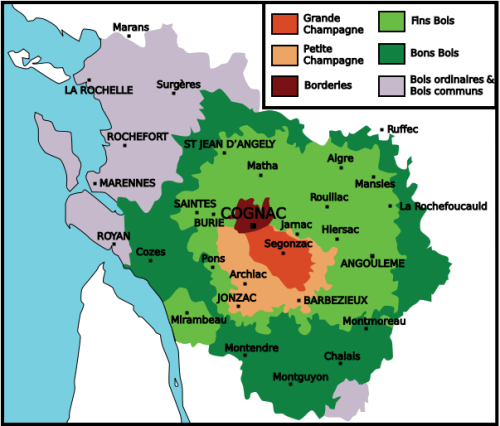
Cognac MapThe Cognac region is just north of Bordeaux in the Charente and Charente-Maritime départments or districts of France.  The ancient city of Cognac, which sits on the Charente River is at the heart of the district.  The region was delimited by law in 1909 (i.e. to call your product a Cognac, it has to be made within the designated geographical area).  There are 6 districts or crus of Cognac: Grande Champagne (best), Petite Champagne (second best), Borderies (yup, 3rd best), Fins Bois, Bons Bois and Bois Ordinaires/Bois Communs.  You might also see Fine (feen) Champagne on a label and that means it’s a blend from the 2 best areas – Grande and Petite Champagnes.  The term Champagne here has nothing to do with the Champagne region, though both areas have very chalky soils. 

Since this region is on a navigable river close to the ocean, its wines have long been popular in England and the Low Countries.  The wines didn’t travel well since they were fairly light, so distilling them became the way to go.  Distillation became pretty common in the 17th century, but really took off in the 18th century when a number of families came to the region to control the trade: the Martells from Jersey, the Hennessys and the Hardys from Ireland, the Hines from Dorset and the Otards from Scotland.

Cognac is the 3rd largest vineyard area in France and up to 8 different grape varieties are permitted.  The two most important are Ugni Blanc – pronounced ooh-knee and also known as Saint-Émilion or Trebbiano (in Italy) and Folle Blanche.  The distillation season begins the November after harvest and runs through the end of March.  The Cognac is double-distilled in a copper pot still and aged in casks of Tronçais or Limousin oak for a minimum of 2 years.  During this process, the spirit mellows and softens, taking on color and flavor from the wood.  Some will evaporate, too and this is called the “angels’ share”. 

Let’s touch on a few other things you might see on the label:

C means Cognac

P means Pale

E means Extra

S means Superior

F means Fine

V means Very

O means Old

X means Extra

You’ve probably noticed that the letters represent English rather than French words, pointing to the traditional importance of the English market.  Usually these letters are used together and since 1955, they’ve had age significance.  For example, VS is at least 2 years old, VSOP is at least 4 years old, XO is at least 6 years old.  The years represent the minimum amount of time the spirit spent in barrel. 

Cognac can improve in wood for up to 55 years, but this is risky – there will be significant loss from evaporation and there’s a risk of over-aging, making the prices exorbitant.  Keep in mind that once the Cognac is bottled, it neither varies nor improves.  The producer has already done the work for you, so once you buy a bottle, just drink it (ideally not in one sitting) and once the bottle’s been opened, consume it within 6 months.

5 Comments

Filed under Lessons, Spirits

Cucumber Coolest

Maybe you’ve tried the cucumber cooler.  If you haven’t had a chance, try this one first.  Similar idea and ingredients, but even tastier:

Seneca Drums Gin

Seneca Drums Gin

This time around, however, I subbed St. Germain for the Dolin Blanc.  The recipe now looks like this:

2 oz. Seneca Drums gin
1 oz. St. Germain
juice of 1/2 lime
2 oz. cucumber chunks
dash salt
splash club soda

Muddle cucumber with lime juice, add gin, St. Germain, dash salt and ice, shake and pour into rocks glass over ice.  Top with club soda and garnish with cucumber wheel.

The flavors were incredibly well integrated.  Was it the greenmarket cucumber (I didn’t skin or de-seed this time)?  Was it the St. Germain?  The sweet, floral quality was a great match with the herbaceous gin.  Regardless, this cocktail did a nice job of extending the weekend.

Cucumber Coolest

Cucumber Coolest

2 Comments

Filed under Cocktails, Spirits

The thirsty bird gets the worm

I remember watching Hanna-Barbera cartoons when I was little and seeing the empty bottle of alcohol with the triple X on the label and the worm smiling out from the bottom.  The person who had consumed the spirit inside would be wearing a cowboy hat as well as a dark mustache.  I had no idea what had been in the bottle, but I remember thinking that worm must be one tough cookie.

Turns out those worms were originally used to help test the strength (and safety) of the spirit before hydrometers and other analytical equipment was developed – just like how the sailors used to light their rum on fire to make sure it hadn’t been diluted.  If the worm pickled and was preserved, the spirit was good.  If the worm decayed, the spirit had to be re-distilled.

Contrary to popular belief, the spirit in question is mescal, not tequila.  All tequilas are mescals, but not all mescals are tequilas.  Sure, they’re both Mexican and made from agave (which is NOT in the cactus family), but here are some differences:

  1. Mescal is made from a number of different agave varieties, while tequila only uses the blue variety of agave.
  2. The agave used to make tequila is cooked using ovens or autoclaves, while the agave used to make mescal is cooked in underground ovens using charcoal.  The smokiness imparted from this charcoal accounts for the major taste difference between tequila and mescal.
  3. Traditionally, mescal was distilled once and tequila twice.  Most mescal on the Mexican market today though has been distilled twice, too.
  4. Tequila is originally from the Jalisco state in Mexico and mescal is from the Oaxaca State.

So, where did these worms come from?  The worms are moth larva and live inside the agave plants.  Two types are found – a white one called blanco and a red one called rojo.  The white worm prefers the leaves, while the red one lives closer to the roots.  I guess enough people found the worm as charming as I did because now they’re grown commercially for inclusion in mescal bottling.

6 Comments

Filed under Lessons, Spirits

It’s not just for the birds

LimeLiming has many definitions: “liming the soil” or “liming the lawn” – applying lime (calcium hyrdroxide) to acidic soils to raise the pH, soaking hides for the production of parchment or to remove the hair before tanning, using birdlime (a sticky, plant-based substance) to catch birds and most appropriate for our purposes, a Caribbean expression for hanging out.
In the 18th century, liming came about as a term for relaxing in the islands with friends at the end of the day, sharing stories and drinking rum.  In terms of etymology, was it the British soldiers (limeys) in the colonized Caribbean or the fact that rum is really tasty with lime?  It was a practice of the Royal and Merchant Navies of Britain to supply their sailors with lime juice (limes were more prevalent than lemons) to prevent scurvy. James Lind, a surgeon and pioneer of naval hygiene, was responsible for determining the link between citrus fruits and scurvy.  He was inspired to conduct one of the world’s first clinical trials after noticing that Dutch sailors who ate cabbage had little problems with scurvy.

Can you imagine how it smelled below decks on those Dutch ships?

Leave a comment

Filed under Lessons, Spirits

Rumbullion

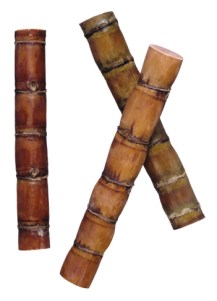
sugarcaneThirsty humans can be a creative lot, making a spirit from a perennial tropical grass.

Rum is produced in over 100 countries today. While many consider the Caribbean to be rum’s home, accounts from the time of Alexander the Great mention the use of sugarcane.

While the exact origin of sugarcane is not known, it was introduced to Europe by the Arabs around 636 A.D. It never took off though, because it needed a longer growing season and warmer temperatures than Europe could offer. Columbus took cane cuttings from the Canary Islands to the West Indies. The early Spanish settlers working in sugar factories in the West Indies realized that the residual molasses from sugar production fermented easily.

The name rum could come from the Spanish ron – chances are good the Spanish were on to distilling before the British decided to use the sugarcane plantations in their colonies as a source of economic growth. It could also be from the Latin saccharum, meaning sugar, or from rombustion, meaning a strong liquid or my favorite, rumbullion, meaning a great tempest.

The two main types of rum depend on which form the sugar cane is in at the time of fermentation. Continue reading

2 Comments

Filed under Lessons, Spirits

New York Spirit Awards

This past Monday, the New York Spirit Awards (NYSA) announced the winners from this year’s inaugural competition.  NYSA was founded by 2 thirsty spirits – Adam Levy, a spirits writer who named his dog after Brooklyn Brewery’s brewmaster (Garrett Oliver) and Dori Bryant, the founder of The Polished Palate who has been given the title “The Rum Queen” by the St. Petersburg Times.

The closed-to-the-public tasting took place on June 14 and 15 at the Javits Center in Manhattan, with 265 brands of spirits (both big and small).  The judges were an impressive mix of buyers, sommeliers, mixologists and other trade folks.  78 awards were given at 3 different levels – “Best of Show” (brand with highest number of points), FDR Awards for “Best in Category” (highest scoring brand in each category, giving props to the President who repealed Prohibition) and Best of Class for “Top Performers” (top scoring 20% of brands in each category).

You may be beginning to wonder why you should care.  Well, turns out that my friends from Finger Lakes Distilling took Best of Class awards for both the brands they entered – Vintner’s Vodka and Seneca Drums Gin!  Right now, they’re available in these markets – Watkins Glen, Ithaca, Elmira, Corning, and Penn Yan – but fear not thirsty friends, I’ll keep you posted as they grow.

1 Comment

Filed under Events, Spirits