Monthly Archives: July 2009

The Rockies strike again

check out those dames

check out those dames

I tried a perfect summer beer today from Avery Brewing Company – their Sixteenth Anniversay Saison Ale.  Those foxy chicks on the front represent the three major ingredients in the brew – jasmine, peach and honey.  These three are combined with Rocky Mountain water, malted barley, Belgian candy sugar, hops and Belgian yeast. 

French for season, the name saison was given to low-alcohol pale ale styles brewed in the French-speaking region of Belgium.  The name came about because the beer was brewed in the fall or winter so that the hardworking farm hands could have some summer refreshment – now they’re brewed year-round.  Historically, they had low alcohol (around 3% abv) and were often a safer choice than water for the farmers (most commerical brews today clock in at 5-8% abv – the Avery in question is 7.69% abv).  Extra hops were added to help preserve the ales through the summer since the low level of alcohol wouldn’t provide too much protection from spoilage.

My all-time favorite is Saison Dupont from Basserie Dupont in Tourpes, Belgium – it’s full-bodied, fruity and spicy with a nice dose of funk.  It’s a little much for summer and that’s where Avery comes in.  The Sixteen Saison has light spice and a touch of sweetness from the peaches, but it’s very clean with a super dry finish. 

Op uw gezondheid or maybe a votre sante!

Leave a comment

Filed under Beer

If you’re in the city this weekend

You should come by and cool off with a L’Ecole brunch cocktail.  Here are just 3 of the libations we’ll be serving up Saturday and Sunday:

Going Green

Going Green

Violette Femme

Violette Femme

Rhubarb Iced tea

Rhubarb Iced Tea

For the Going Green recipe, click here.  For the Violette Femme recipe, click here.  For the Rhubarb, combine 2 oz. gin, 2 oz. rhubarb mix (recipe below) and the juice of 1/2 lime in a shaker, shake, strain and serve over ice in a rocks glass.  For the rhubarb mix, combine 500 g. rhubarb, 200 g. sugar, 50 g. ginger (2-3 fingers), 3 sprigs mint and 2 L water.  Bring to a boil and when rhubarb is soft, turn off the heat and add 4 tea bags (we used Chinese black tea from Harney – each bag yields about 1 gallon of tea).  Wait 15 minutes, remove tea bags, ginger (leave a bit if you want it spicier) and mint, strain (chinoise is best) and blend rhubarb until very smooth and add more tea liquid back in to taste.  So, yes, this is a restaurant-sized recipe, yielding 5 quarts, but you get the idea.  Plus, it’s just one more reason to have one with us.

1 Comment

Filed under Cocktails

Check out the stein on that seal

Good Beer SealThe Good Beer Seal was formed to recognize establishments serving artisan suds and to promote NYC as a beer lover’s destination.  It was started by the proprietors of some incredible beer bars: Gary Gillis (Burp Castle and Standings), Ray Deter (DBA and DBA Brooklyn) and Jimmy Carbone (Jimmy’s No. 43).  In order for the bar to feature this thirsty seal of approval, the list must contain at least 80% craft or special imported beers, a good percentage of the beer served must come from a draft or cask system, the bar must have a strong community presence as well as a good “pub” vibe, and last but not least, serving good beer should be central to the bar’s operating philosophy.

The list of good beer bars includes the usual players – Blind Tiger, Spuyten Duyvil, Against the Grain, etc. – for a full list, click here.  The founders wrote a letter to Mayor Mike Bloomberg describing their efforts and he issued a proclamation that July 2009 is “NYC Good Beer Month”.   Two major events are lined up so far – a grill-off featuring amateur chefs at Water Taxi Beach in Long Island City to benefit Slow Food NYC and “Good Beer at BAM” in collaboration with Edible Brooklyn and Manhattan Magazines (for tickets, click here).  There’s a blog about the project as well and it lists what the good beer bars are serving up in July.

Leave a comment

Filed under Beer, Events

Wines of summer, Part I

I got a request for my recommended wines for summer (honest!).  I’ll introduce some off-the-beaten path varietals that will still appeal to all of you Pinot Grigio drinkers out there.  Summer’s certainly about drinking wines that are light, crisp and refreshing, but that doesn’t mean they have to be boring.  Today, we’ll start with the letter V. 

First up is Verdejo (vehr-DAY-ho); aromatic and herbaceous, it’s Spain’s Sauvignon Blanc.   Rueda is the spot in Spain to find Verdejo.  It’s northwest of Madrid in Castilla y León.  Wine has been made in this region since the Middle Ages, but found its stride in the 1970s, when Bodegas Marqués de Riscal of Rioja recognized the area’s potential for dry, white wines.  They began selling fresh Rueda alongside their Rioja reds and in 1980 Rueda was awarded its DO status (Denominación de Origen; controlled appellation, think France’s AC). 

Verdejo is sometimes blended with Viura (also known as Macabeo), the white grape of the Rioja region or with Sauvignon Blanc – in both cases, Verdejo must account for at least 50% of the blend.  If the label says Rueda Superior, the wine must contain at least 85% Verdejo.  Verdejos are fragrant, often with notes of apple, mint and fresh-cut grass.  In warmer years, they can take on aromas and flavors of tropical fruits.  When they’re well done, they have both juicy citrus as well as an underlying minerality.  Here’s more good news – they’re usually inexpensive – you should have no trouble finding some in the $9-$15 range.  Here are some producers to look for: Cuevas de Castilla “Con Class”, Martínsancho and Bodegas Hermanos del Villar “Oro de Castilla”. 

Next up is Vermentino (ver-mehn-TEE-noh), which is also called Rolle in Provence.  It’s grown primarily in Sardinia, Liguria and Corsica, with increasing amounts in Languedoc and Roussillon and a touch in California and Australia.    Some think the grape has Spanish origins, while others think it’s related to the Malvasia grape and to a grape called Favorita grown in Piedmont (who wouldn’t want to drink that?).  Vermentino produces a lively wine, with lots of citrus and great acidity.  Acidity=refreshment during the heat of the summer.  It’s a great partner with seafood or grilled vegetables.   Styles from Liguria tend to be a bit lighter than those from Sardinia.  Check these out: Cantina Santadi “Villa Solais”, Santa Maria la Palma “Aragosta” and Bibi Graetz “Bianca de Casamatta”. 

Last but not least for your summer sipping I present Vinho Verde DOC (VEE-nyoh VEHR-deh) (Denominação de Origem Controlada; again, controlled appellation).  I’ve switched gears now from varietal to region and I’m taking you to northwest Portugal.  Vinho verde means green wine, but not like green beer for St. Patrick’s Day – the green here refers to the youth and vivacity of the wines from this region.  These wines are slightly effervescent too, and you know how I feel about wines with bubbles.  Whites from this region are crisp, fresh and quite zippy.  They’re made from these grapes: Alvarinho (yup, Spain’s Albariño), Loureiro, Trajadura and Avesso.  Look for these in the store: Sogrape “Gazela” (I’ve seen it for $4.99!) and Auratus – a mix of Alvarinho and Trajadura and a bit more complex than most on the market. 

Leave a comment

Filed under Lessons, Wine

Sugar showdown

73408082

Blue agave plant in Jalisco State, Mexico

Agave (ah-GAH-vay) nectar is the new simple syrup at many bars in NYC.  It’s produced from the same blue agave plant used to make tequila – large, spiky and in the succulent family, like aloe vera.  Species of agave abound, but blue agave has a high carbohydrate content which turns into a high fructose content in the nectar, making it the most desirable variety.  The sap or nectar from the plant is called aguamiel or honey water in Mexico and it’s extracted from the piña or core of the 7-10 year old agave plants.  After extraction, it’s filtered and heated, breaking the carbs down into sugars. 

Light and dark varieties are made – both can be made from the same plants; the differences stem from filtering and heating temperatures.  The lighter ones are compared to honey and represent the style you’ll mostly find at the bars, while the darker ones are compared to maple syrup.  You can find it at health food stores, Whole Foods or online.

In a recent conversation with my boss, Nils about my home bar, I mentioned my bottle of agave nectar.  He asked why I bothered, citing that it’s just a more expensive version of simple syrup.  My response was that I didn’t need to use as much because it was sweeter.  He then said, well, it depends on how you make your simple syrup.  Duh. 

Historically, I’ve used a one-to-one ratio of sugar to water when making simple syrup.  Dissolve 1 cup of sugar in 1 cup water on the stovetop – pretty simple, right?  Nils advocates using 2 parts sugar to 1 part water, making the excellent point that he prefers not to dilute his cocktails. 

I was also a sucker for the packaging of the agave nectar – a clean, little squeeze bottle – as opposed to the unwieldy Tupperware I’ve used to store simple syrup in the past.  Getting the sticky liquid from the tub of plastic often yielded more syrup on the inside of the refrigerator/floor/counter than it did into the cocktail-in-the-making. 

What about the difference in taste between simple syrup and agave nectar?  Which is tastier?  In a recent hydrocolloids class, Nils and Dave did a quick experiment and got mixed results – some preferred the simple, some the agave. 

When my current bottle of agave runs out, I’m going to give Nils’ recipe a shot.  He keeps his in the fridge and says it lasts a few weeks.

3 Comments

Filed under Cocktails, How to

Cucumber Cooler

I’ve been playing around with some cocktails using the spirits from Finger Lakes Distilling (FLD).

lake view from distillery

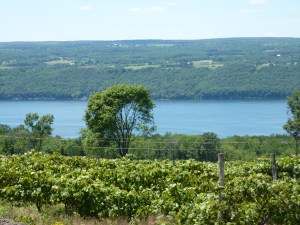
view of Seneca Lake from FLD

First up is their Seneca Drums Gin.  A little about the name – Seneca is the name of the lake the distillery overlooks and it’s one of 11 lakes that comprise the Finger Lakes in upstate NY – it’s 38 miles long and at one point, 618 ft deep.  The Seneca Drums refer to the booming sounds that can occaisonally be heard over the lake on warm summer evenings – some attribute the noise to geothermal reactions while the more mystical among us think it’s a message from the Iroquois who used to inhabit the area.  Given the other things I’ve heard them referred to as – “guns of the Seneca” and “lake farts” – I think FLD made the right choice.

The gin is 86 proof with a 75% (local) grape base/25% grain base.  It’s zippy and fresh and will keep you coming back for more.  The signature blend of 11 botanicals gives notes of citrus peel, juniper, cucumber, clove and light anise.

CucumberSince we’re finally starting to feel a little summer, I decided on a very refreshing cocktail.  I started with a cucumber – it’s a great partner with gin and who doesn’t want to be cool as a cucumber?  I removed the skin and the seeds and cut it into small pieces.
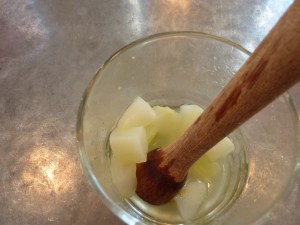
I cut enough to fill the bottom of a rocks glass with a single layer, I added the juice from 1/2 a lime and a pinch of salt and then I muddled.

muddler

After the cucumbers were sufficiently muddled, I added 2 oz. of the Seneca Drums Gin, 1 oz. of Dolin Blanc Vermouth, and enough ice to almost fill the glass.  I chose the Dolin Blanc because it has a touch of sweetness and I wanted to balance the tart citrus from the lime and the herbal qualities of the gin.  Then I transferred everything back and forth between the glass and a shaker a few times to cool everything down as well as to mix the ingredients.  I topped it off with a splash of tonic water and garnished it with a cucumber ribbon (which I made using a vegetable peeler) and a lime segment.  Voila – summer refreshment in a glass.

SDG and cocktailclose up cooler

4 Comments

Filed under Cocktails

The thirsty bird gets the worm

I remember watching Hanna-Barbera cartoons when I was little and seeing the empty bottle of alcohol with the triple X on the label and the worm smiling out from the bottom.  The person who had consumed the spirit inside would be wearing a cowboy hat as well as a dark mustache.  I had no idea what had been in the bottle, but I remember thinking that worm must be one tough cookie.

Turns out those worms were originally used to help test the strength (and safety) of the spirit before hydrometers and other analytical equipment was developed – just like how the sailors used to light their rum on fire to make sure it hadn’t been diluted.  If the worm pickled and was preserved, the spirit was good.  If the worm decayed, the spirit had to be re-distilled.

Contrary to popular belief, the spirit in question is mescal, not tequila.  All tequilas are mescals, but not all mescals are tequilas.  Sure, they’re both Mexican and made from agave (which is NOT in the cactus family), but here are some differences:

  1. Mescal is made from a number of different agave varieties, while tequila only uses the blue variety of agave.
  2. The agave used to make tequila is cooked using ovens or autoclaves, while the agave used to make mescal is cooked in underground ovens using charcoal.  The smokiness imparted from this charcoal accounts for the major taste difference between tequila and mescal.
  3. Traditionally, mescal was distilled once and tequila twice.  Most mescal on the Mexican market today though has been distilled twice, too.
  4. Tequila is originally from the Jalisco state in Mexico and mescal is from the Oaxaca State.

So, where did these worms come from?  The worms are moth larva and live inside the agave plants.  Two types are found – a white one called blanco and a red one called rojo.  The white worm prefers the leaves, while the red one lives closer to the roots.  I guess enough people found the worm as charming as I did because now they’re grown commercially for inclusion in mescal bottling.

6 Comments

Filed under Lessons, Spirits

It’s not just for the birds

LimeLiming has many definitions: “liming the soil” or “liming the lawn” – applying lime (calcium hyrdroxide) to acidic soils to raise the pH, soaking hides for the production of parchment or to remove the hair before tanning, using birdlime (a sticky, plant-based substance) to catch birds and most appropriate for our purposes, a Caribbean expression for hanging out.
In the 18th century, liming came about as a term for relaxing in the islands with friends at the end of the day, sharing stories and drinking rum.  In terms of etymology, was it the British soldiers (limeys) in the colonized Caribbean or the fact that rum is really tasty with lime?  It was a practice of the Royal and Merchant Navies of Britain to supply their sailors with lime juice (limes were more prevalent than lemons) to prevent scurvy. James Lind, a surgeon and pioneer of naval hygiene, was responsible for determining the link between citrus fruits and scurvy.  He was inspired to conduct one of the world’s first clinical trials after noticing that Dutch sailors who ate cabbage had little problems with scurvy.

Can you imagine how it smelled below decks on those Dutch ships?

Leave a comment

Filed under Lessons, Spirits

Rumbullion

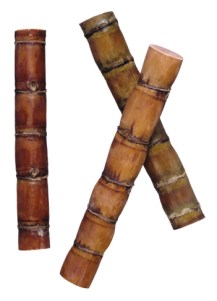
sugarcaneThirsty humans can be a creative lot, making a spirit from a perennial tropical grass.

Rum is produced in over 100 countries today. While many consider the Caribbean to be rum’s home, accounts from the time of Alexander the Great mention the use of sugarcane.

While the exact origin of sugarcane is not known, it was introduced to Europe by the Arabs around 636 A.D. It never took off though, because it needed a longer growing season and warmer temperatures than Europe could offer. Columbus took cane cuttings from the Canary Islands to the West Indies. The early Spanish settlers working in sugar factories in the West Indies realized that the residual molasses from sugar production fermented easily.

The name rum could come from the Spanish ron – chances are good the Spanish were on to distilling before the British decided to use the sugarcane plantations in their colonies as a source of economic growth. It could also be from the Latin saccharum, meaning sugar, or from rombustion, meaning a strong liquid or my favorite, rumbullion, meaning a great tempest.

The two main types of rum depend on which form the sugar cane is in at the time of fermentation. Continue reading

2 Comments

Filed under Lessons, Spirits

New York Spirit Awards

This past Monday, the New York Spirit Awards (NYSA) announced the winners from this year’s inaugural competition.  NYSA was founded by 2 thirsty spirits – Adam Levy, a spirits writer who named his dog after Brooklyn Brewery’s brewmaster (Garrett Oliver) and Dori Bryant, the founder of The Polished Palate who has been given the title “The Rum Queen” by the St. Petersburg Times.

The closed-to-the-public tasting took place on June 14 and 15 at the Javits Center in Manhattan, with 265 brands of spirits (both big and small).  The judges were an impressive mix of buyers, sommeliers, mixologists and other trade folks.  78 awards were given at 3 different levels – “Best of Show” (brand with highest number of points), FDR Awards for “Best in Category” (highest scoring brand in each category, giving props to the President who repealed Prohibition) and Best of Class for “Top Performers” (top scoring 20% of brands in each category).

You may be beginning to wonder why you should care.  Well, turns out that my friends from Finger Lakes Distilling took Best of Class awards for both the brands they entered – Vintner’s Vodka and Seneca Drums Gin!  Right now, they’re available in these markets – Watkins Glen, Ithaca, Elmira, Corning, and Penn Yan – but fear not thirsty friends, I’ll keep you posted as they grow.

1 Comment

Filed under Events, Spirits