I want a drinkbot

In the article Just Like Mombot Used to Make in today’s Times, robots are delivering snacks, whipping up omelets, preparing octopus balls and making up to 800 bowls of ramen per day (with human staff reporting to them). 

I couldn’t help but think that while a snackbot is nice, a drinkbot would be nicer.  Unsurprisingly, other thirsty spirits out there share my sentiment.  By the time I got to page 2 of the article, I learned about the group, Roboexotica, who hosts festivals where scientists showcase “cocktail robots” as well as “beerbots”, some of whom will not only mix, serve and consume cocktails, but they might also tell jokes and smoke cigarettes. 

Just for fun, I went to You Tube to see what would pop up with a “drinkbot” search.  No clip on robots is complete without the statement, “Does not compute”.

Leave a comment

Filed under Gadgets, Noteworthy articles

C is for cap

The cap (chapeau in French) is the layer of grape solids that forms on the surface during red wine fermentation. 

Grape solids forming on the top of fermenting Mourvedre at A Donkey and Goat Winery in CA.

Fermenting Mourvedre at A Donkey and Goat winery in CA.

I got to sample a grape and it was like eating pop rocks, because of the CO2 forming as a by-product of fermentation.  The cap limits the oxygen available to the yeast, encouraging them to eat away at the grape sugar to form alcohol.  

The cap must be broken up and mixed back in with the liquid below, however, in order to extract the phenolics, which add color, flavor and longevity to the wine.  Phenolics can be found throughout the grape, but are particularly rich in the skins, seeds and stems (the solids!).  On a smaller production scale, the winemaker will “punch down” the cap several times per day.

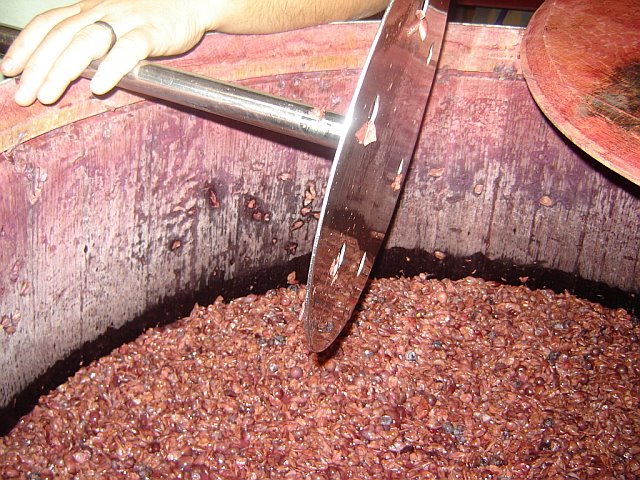
Jared showing off his stainless punch down tool.

The punch down tool breaking through the cap. Notice the bubbles. Jared told me the cap would support his weight and he's not a little guy (he volunteered that information, too).

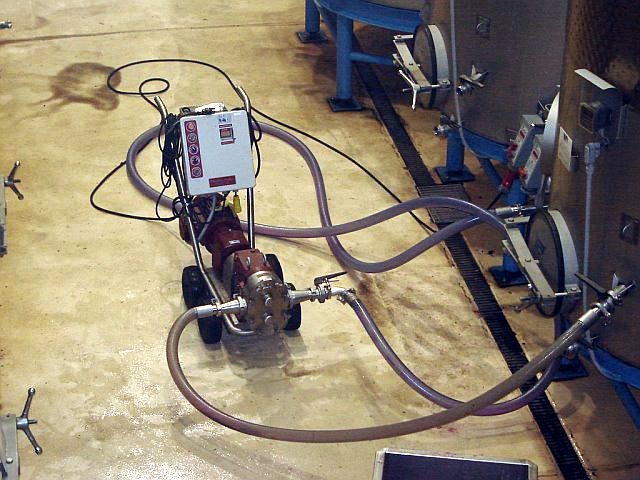
On a larger production scale, the winery will “pump over” the cap.

A pump doing its thing at Miner Family in CA.

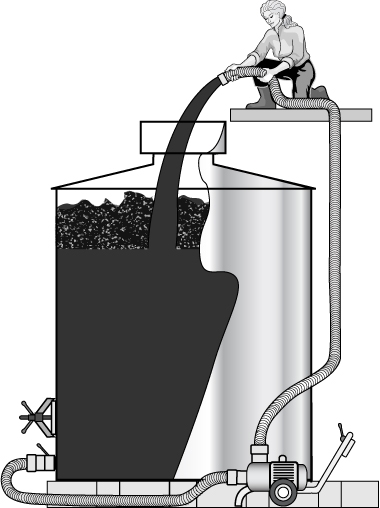
We recently had an illustration created to use in our classes to explain how pumping over works.  Thanks, Laurel.

Flushing the liquid back over the cap to break it up, using a pump. My favorite part of this illustration is the female winemaker.

2 Comments

Filed under Alphabet Soup, Wine

Spirits Review.com

I was recently introduced to spiritsreview.com.  It’s been around since 2005, so I’m a little slow on the draw on this one.

You gotta love a guy who refers to himself as a spiritual advisor.  You’ll find reviews of everything from bar tools to Welsh whisky.  The “adventures” section has great photographs of Carlsson’s booze-themed travels and events.  He also seems to dig the Finger Lakes Distilling products, which is fine by me.

Leave a comment

Filed under Websites

Reinheitsgebot in Vietnam

Beer for sixteen cents a pint?  Crystal Ale draft, a top-fermented beer made with passion fruit and the local, litchi-like rambutan?  Restaurants serving German and Vietnamese fare side by side?  Yes, please!

Follow thirsty Russ Juskalian on his fantastic journey through the streets of Ho Chi Minh City in this great article in this weekend’s Times.

Leave a comment

Filed under Beer

One week from today

Come taste Finger Lakes Distilling products with me at Morrell & Company! 

I’ll be at One Rockefeller Plaza (on 49th between 5th and 6th) from 4-6:30 pm on Friday 2/26, so you can get your weekend started early.  Morrell sells the Seneca Drums Gin, the Glen Thunder corn whiskey and the McKenzie rye, but if you ask nicely, I might have a few other surprises in my bag. 

Hope to see you there!

Leave a comment

Filed under Events, Spirits

Well-suited pair

We hosted a team building event at school last night for the Klingenstein Center, part of Columbia University’s Teachers College.  The group made a 3 course meal and then sat down together to enjoy the fruits of their labor. 

I was not excited about the prospect of selecting a wine when I learned the first course was asparagus soup.

Asparagus, along with artichokes, eggs, garlic, cumin, chocolate and several other tasty things, can be tricky to pair with wine.  Certain chemicals in the asparagus can make your wine taste grassy, vegetal, tinny or just plain gross. 

When I saw the finished product, though, I knew I had to come up with something.

Asparagus soup garnished with a chicken lollipop, wild mushrooms and creme fraiche. It was too pretty to go wine-less.

The general rules when selecting a wine to match these dreaded spears are as follows: go with something crisp and refreshing (think Albariño or Pinot Grigio), try a sparkling wine (don’t go too yeasty here, maybe Cava), opt for an aromatic varietal (Grüner Veltliner is a good choice), and avoid tannic or oaky wines.  Ignoring all this, I chose a Chardonnay.

Specifically, I selected the 2006 Kumeu River Village Chardonnay.  Now to be fair, this is a wine from New Zealand, with notes of ripe peaches, flinty minerals and a distinct nuttiness, as opposed to an oak bomb that you might find from California.  While some of this wine (1/3) saw some oak, most was aged in stainless steel. 

The nuttiness was a perfect match to the earthiness in the asparagus and the mushrooms.  The ripe fruit notes worked really well with the sweet chicken.  The acidity worked perfectly, too, thanks to the addition of the crème fraiche. 

Sometimes it pays off when you don’t follow the rules.

Leave a comment

Filed under Wine

B is for Baco 22A

Most of the wine we drink is made from grapes from the Vitis Vinifera species.  Vitis is the genus for many vine plants and vinifera comes from the Latin “to bear or carry wine”.  This species started out in what is now Iran and made its way out of the Middle East and into the Mediterranean.  From there, the Greeks spread the vines to North Africa and southern Italy.  The Romans then brought them along as they began occupying the western part of Europe, as early as the 1st century B.C.

Simultaneously, North America had land under vine, but the vines were all non-vinifera species, with fun names like Vitis labrusca, Vitis riparia and Vitis aestivalis (there are 15+ total).  When phylloxera (insect/epidemic that kills grapevines) struck Europe, they didn’t want to plant our vines, but they were interested in our phylloxera-resistant rootstock.  The solution was grafting the more desirable vinifera vines onto the  hardier American species. 

Grafted Riesling vine. Grafting is done by cutting a cane (stem of a mature grapevine) of the desired variety in a way that it will fit into a matching cut made in the selected rootstock (think of a puzzle piece).

Grafting took many years to perfect, but it was just the beginning of experiments done by botanists.  By the late 1800s scientists were cross-pollinating different vine varieties and families.  French-American hybrids were born of these experiments.  The idea was to combine the winter-hardiness and phylloxera resistance of the American vines with the fruit and flavor of the French vines.  We’re still developing these varietals, particularly at the Cornell Viticultural Research Station in Geneva, New York. 

At one time hybrids accounted for several million acres of vineyards in France.  This is no longer the case, though hybrids can still be found in the eastern U.S. and Canada, and South America.  Interestingly, one hybrid has survived in France; Baco 22A.  Sometimes called Baco Blanc, it is a crossing of Folle Blance (acidic, French white, ravaged by phylloxera) and Noah (hardy American hybrid developed in the 1860s in Illinois), and was created by François Baco in 1898.  Until the late 1970s, Baco 22A was the primary ingredient in Armagnac.

Ugni Blanc now plays a bigger role than Baco22A, as French authorities try to rid their vineyards of hybrids.

1 Comment

Filed under Alphabet Soup, Wine

Pink Gin

Yup, only 2 ingredients in this cocktail.

This is not a cutesy drink in honor of Valentine’s Day weekend.

After sampling this cocktail, it made perfect sense that it had been created by the British Royal Navy.  Some say they were trying to find a way to make Angostura bitters more pleasant to drink, since the bitters had been shown to ease seasickness.  My guess is that someone on a boat in the middle of the ocean wouldn’t argue much when it came time to receive his booze ration.  Regardless, the Navy brought the idea to bars in Britain and it stuck.

I’ve seen several variations of this cocktail; some are 1 part gin to 1 part bitters, some are topped off with iced water or tonic, some suggest a lemon peel garnish.  If a bartender asks you if you’d like it “in or out”, the “it” (you dirty bird) is the bitters – picture swirling vermouth in your glass before dumping it out while making a martini.

I used the recipe from Vintage Spirits and Forgotten Cocktails:

3 oz. Plymouth Gin
6 dashes Angostura bitters
Shake with ice and strain.  No garnish.

I happen to like both gin and bitters, yet I bet some of you are cringing upon reading this recipe.  Something pretty special happens when you mix these two, though, and I suggest you give it a shot.

Leave a comment

Filed under Cocktails

Bebbo Cocktail

A take on the Bee’s Knees, the Bebbo is a very satisfying cocktail.  While it may not mean the cat’s pajamas, it’s herbaceous and tart on the attack, full and round on the palate, and finishes with a lingering sweetness from the honey.

1 1/2 oz. gin (I used Seneca Drums), 1 oz. fresh lemon juice, 1/2 oz. honey, 2 teaspoons o.j.. Stir all ingredients (without ice) until honey is dissolved, add ice, shake and strain into chilled glass. Garnish with a cherry (mine sunk to the bottom).

 If you have trouble getting the honey to dissolve, you can heat it slightly before using it.  If you hadn’t guessed already, this is another drink I wanted to try from Ted Haigh’s book.

3 Comments

Filed under Cocktails

Snow day happy hour

Yesterday felt like Christmas – a snow day in the middle of the week!  

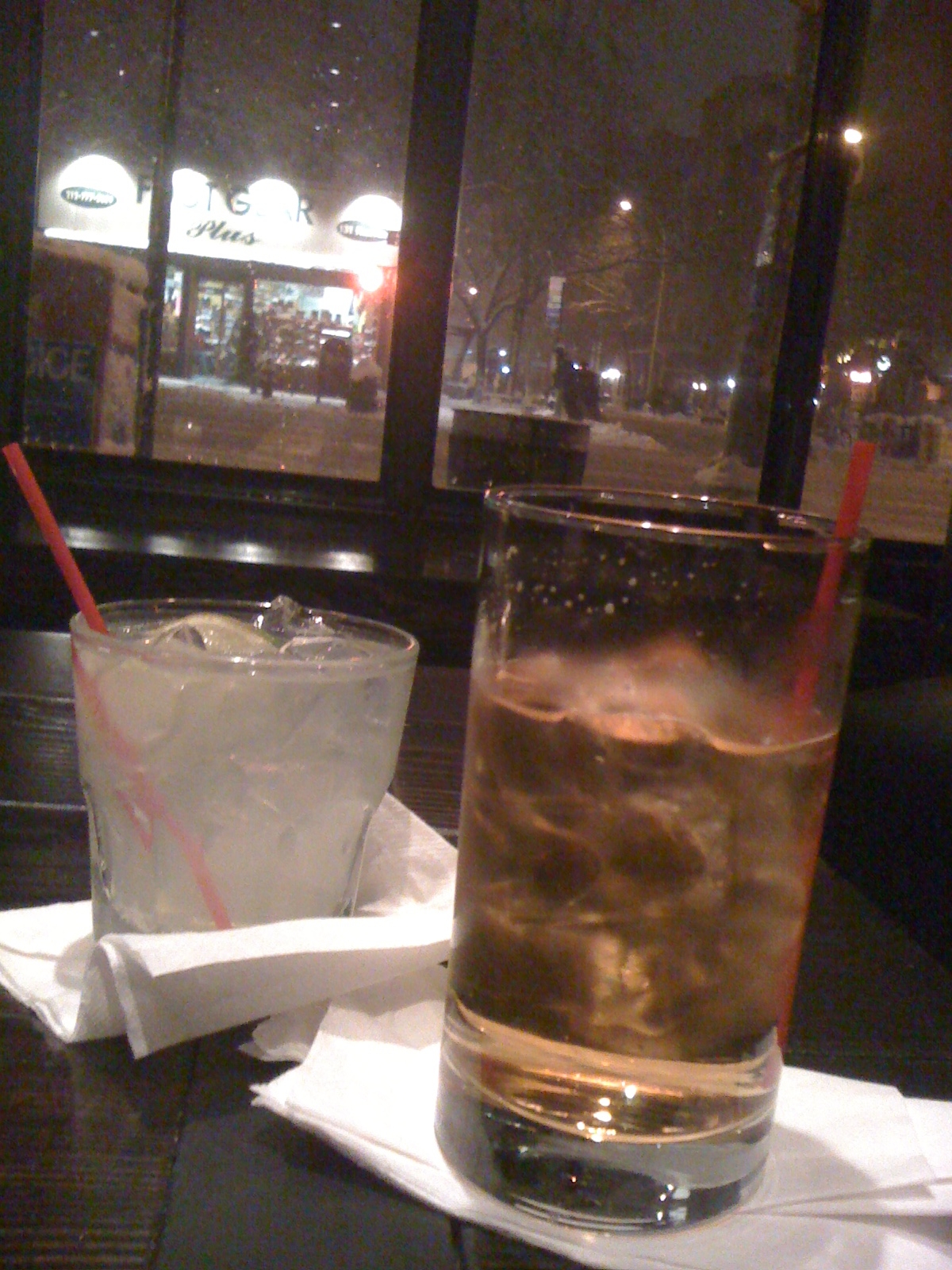
On 1st Ave and 8th St. at the new “V Bar” (in the old Tribe space) we found a cozy spot with great big windows where we could enjoy the snow as well as some cocktails. 

On the left is “Sicilian Margarita” – tequila, orange liqueur, agave nectar and lime. On the right is “Bitter Lord” – whisky, ginger syrup, bitters, soda and lime.

A deep puddle of icy water was hiding under the snow on that very corner and feeling like a kid again because of the snow day, one of my favorite childhood poems came to mind:

Where the Sidewalk Ends by Shel Silverstein

There is a place where the sidewalk ends
And before the street begins,
And there the grass grows soft and white,
And there the sun burns crimson bright,
And there the moon-bird rests from his flight
To cool in the peppermint wind.

Let us leave this place where the smoke blows black
And the dark street winds and bends.
Past the pits where the asphalt flowers grow
We shall walk with a walk that is measured and slow,
And watch where the chalk-white arrows go
To the place where the sidewalk ends.

Yes we’ll walk with a walk that is measured and slow,
And we’ll go where the chalk-white arrows go,
For the children, they mark, and the children, they know
The place where the sidewalk ends.

Of course, this sidewalk ended with a deep pool of slush soaking the feet of unlucky pedestrians.  Remember, this is NYC.

2 Comments

Filed under Cocktails