
The McKenzie Rye is featured in the current issue of Martha Stewart Living.
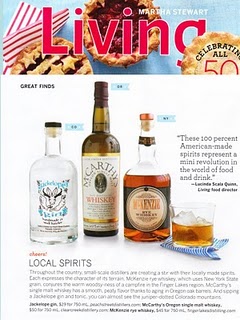
The McKenzie Rye is featured in the current issue of Martha Stewart Living.
Filed under Noteworthy articles, Spirits
Dave and Nils were on Jimmy Fallon’s show this past Friday night. Jimmy does a great job of making fun of Nils’s accent.
Vodpod videos no longer available.
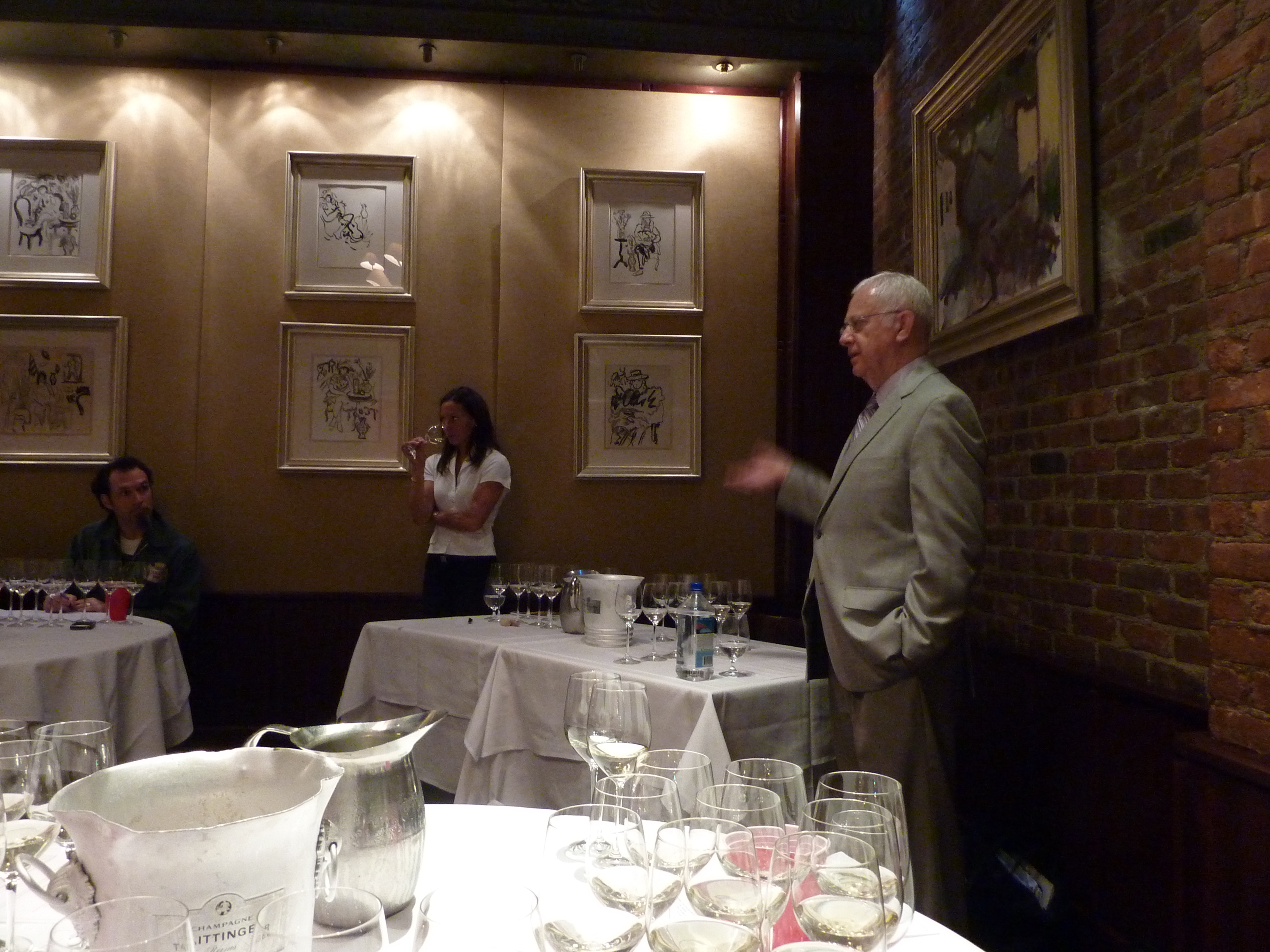
Rudi Wiest and Laura Williamson presenting "The Top Wines and Grosses Gewachs of 2008" at Rudipalooza this week.
Rudi Wiest imports some of the best German Rieslings in the world and he led a seminar at Tribeca Grill this week, where we sampled 9 different wines.
Rudi had some great quotes throughout the seminar, including the title of this post. It is silly to describe wines as intellectual, but this line-up was nuanced.
“If you don’t write it down, you’ve never going to be a good taster.” It’s a good thing I keep this blog.
“Is there another grape that can do what Riesling does?” I couldn’t agree more.
My favorite dry wine was the 2008 Rebholz Riesling Dry Grosses Gewächs, Im Sonnenschein. Grosses Gewächs translates to “great growth” and refers to a system the Germans use to rank vineyard sites. Im Sonnenschein is the vineyard name. The grapes are grown in limestone soil, laden with martime fossils and the resulting wine was very different from another Rebholz we tried, where the grapes were grown on sandstone, just 200 meters away. The Sonnenschein was round, ripe, smoky and had lots of floral, citrus and peach notes. The acidity was the best part; it was so integrated, it had become one with the wine.
My favorite off-dry was the 2008 Reinhold Haart Reisling Spätlese, “Erste Lage”, Piesporter Goldtröpfchen. Erste Lage translates to “top site”, similar to the idea above. Piesporter means near the town of Piesport and Goldtröpfchen, meaning drops of gold, is the name of the vineyard. This wine had a ton going on: flowers, black fruits, stone fruits, minerality and a finish that went on forever. Rudi mentioned that when he has a Piesporter wine, he thinks of peach trees. He was right again.
Filed under Wine
Decanter recently reported on the Reuters Global Luxury Summit, where Taittinger CEO Pierre-Emmanuel Taittinger made several interesting comments.
The highlights:
“I am worried about pensions. I am worried about the debt of our countries. We will have less money, but we will always have the time to make love and drink Champagne, and we will do it even more.”
“Nothing is better than a glass of Champagne to help forget the stress and pressures of the modern world. We are an affordable luxury. For one hour we can behave like the Queen of England.’
He noted that sales were down for his company in 2009, but he expects a bump in 2010, citing his only competitor as Viagra. Sadly, this point was not explained.
Filed under Alcohol in the News
This had the potential to be a disaster, but I was pleasantly surprised by her picks. <insert jokes about “Scenes from an Italian Restaurant” here> I’m in favor of boxed wine and we’ve featured both the Château du Champ des Treilles and the Christian Venier on our list before.

photo courtesy of am New York
Nils and Dave were featured in am New York this week. They put together several delicious bourbon drinks and I’ll include my favorite here:
For the serious mixologist: Bourbon Pecan Sour
Ingredients:
2 oz Maker’s Mark
1 1/2 oz pecan syrup**
1/2 oz lemon juice
½ oz simple syrup (optional – it will sweeten the drink considerably)
pinch of salt
** For the pecan syrup:
Ingredients:
200 grams water
3 grams TIC Pretested Ticaloid 210S (ticgums.com is a good place to find it)
130 grams pecan oil
200 grams sugar
Method for the Pecan Syrup:
Hydrate the Ticaloid 210S in the allspice-infused water with a hand blender. Add pecan oil and blend till smooth.
Add sugar and blend till smooth. This syrup can be stored until needed. It will separate over time, but can be stirred back together by hand.
Method For the Sour:
In a mixer, combine Maker’s Mark, pecan syrup, lemon juice, simple syrup if using and pinch of salt with ice. Shake, strain and serve.
If the idea of using Ticaloid in a drink is intimidating to you, come to class.
Take some wine classes with us! See you there.
Green Wines Demystified. Tuesday 6/15 6:30-8:30 pm
Wines of Napa Valley. Tuesday 6/29 6:30-8:30 pm
No, they don’t, but the margarita I ordered a few days ago was surprisingly good.
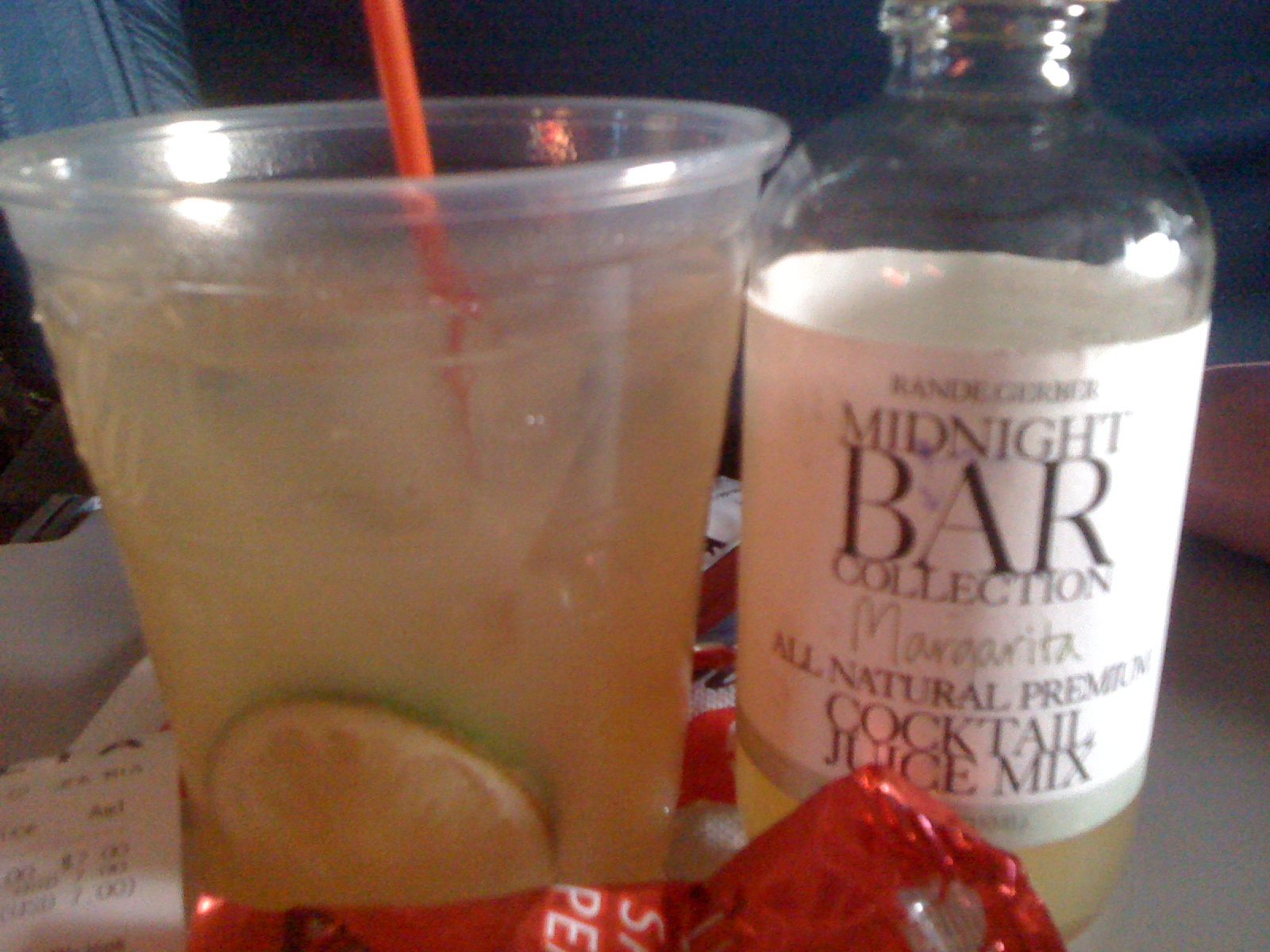
Margarita, with extra mixer and salted peanuts on my tray table. An airplane wonder, at only $7.
The cocktail featured Sauza gold and Rande Gerber’s “Midnight Bar Collection” margarita mix, bottled by Stirrings. Gerber, a former model, is married to Cindy Crawford and runs the Midnight Oil/Gerber Group chain of bars and lounges (over 30 properties, including The Whiskey and Stone Rose Lounge in NYC). He developed a line of cocktails for Delta in 2007. This mixer had real lemon, lime and orange juice and was not overly sweet.
Ted Haigh writes
1 1/2 oz. blanco tequila
1 1/2 oz. Cointreau
1 1/2 oz. fresh lime juice
Shake in an iced cocktail shaker, strain into a large cocktail glass and rim with crusted salt.
Haigh traces this cocktail back to 1937, noting the “Brandy Crusta begat the Sidecar Cocktail, which in turn begat the Margarita.” Some recipes will call for lemon instead of lime juice and others will call for triple sec instead of Cointreau. I wouldn’t recommend either of these substitutions. Even more importantly, do not use “sour mix”; fresh citrus juice is always the way to go.
I also checked my Grossman’s Guide
“The traditional method of drinking Tequila in Mexico is a ceremony in itself. The imbiber takes a wedge of lime or lemon, puts a pinch of salt on his thumbnail or on the back of his hand, and pours a chilled jigger of Tequila. He then bites the lime, licks the salt, and gulps down the Tequila.”

Agoston Haraszthy 1812-69
Many fallacies are associated with this man: he was the first to show the possibilities of grape growing in California, he was the first to introduce superior grape varietals into the state and he was the first to plant the Zinfandel vine (this last point is still unresolved). He’s even been wrongly dubbed the “father of California wine”.
Agoston was born into a noble Hungarian family and left for the United States in 1840, arriving in New York and making his way along the Hudson River to the Erie Canal to the Great Lakes, eventually settling in Wisconsin. He was a busy man there; he built homes and mills, planted corn, grains and grapes, raised sheep, pigs and horses, owned and operated a steamboat, dug wine cellars (the current site of Wollersheim Winery) and became a legendary hunter, even killing a wolf with his bare hands.
Intrigued by the gold rush, he captained a train of wagons along the Santa Fe trail, arriving in San Diego in 1849. Here he planted fruit orchards, operated a livery stable, opened a butcher shop, planted a vineyard, was elected the sheriff of San Diego County, served as a city marshal and in his role as a contractor, built a jail for the city.
Agoston served for a few years on the California State Assembly and began to purchase land around San Francisco, planting European vines near Crystal Springs (now part of San Mateo County). During this time, he started a refinery and when the first U.S. Mint opened in San Francisco in 1854, Agoston was the first assayer. In 1857 he was charged with embezzlement ($151,550 in gold), but he was exonerated by 1861.
While he was under investigation, he moved to Sonoma and started the Buena Vista Winery, eventually holding over 5,000 acres of land. In 1861, as part of the state commission on viticulture, Agoston traveled to Europe and sent back thousands of vine cuttings of over 350 varietals. He wrote about his experiences on the trip and as a wine grower in California (Grape Culture, Wines and Wine-Making) in 1862. This book helped California gain recognition for its grape growing and is considered by some to be Agoston’s main claim to importance in America’s wine history.
Things started to go downhill from there. Agoston had borrowed large sums of money to expand his vineyards and his vines became infested with phylloxera, putting a damper on production. Shareholders forced him out in 1867 and he declared bankruptcy.
The next year he moved to Nicaragua and began developing a sugar plantation, with the idea of making rum and selling it to American markets. In July of 1869 he disappeared in a river on his property, never to be seen again. It was never established if his body washed out to sea or if he was devoured by an alligator.
I could not make this stuff up.
Filed under Alphabet Soup
 My buddy Mike is opening a wine store uptown, on the east side of Lexington between 99th and 100th streets. He’ll feature about 100 selections from all over the world, most falling in the $10-20 range. All have been tasted and I’ve had the chance to throw in my two cents. He’s hoping to open within the next two weeks, but in the meantime, you can find the store on Facebook. Shots of the inside (including a picture of Elton John in a white leisure suit drinking rosé) coming soon!
Filed under What my friends are up to, Wine
 | Vinny on For you tough guys |
 | godingreniya on 4th of July and Colorado |
| Gin fizz- egy időtle… on Wildberry fizz | |
 | Lawrence B on Please don’t go (su… |
 | Marissa Hunt on Cucumber Cooler |


 A Thirsty Spirit