Greenmarket Mixology for Holiday Cocktails

If you’re free in NYC tonight, Union Square wines is presenting, Slow Food U: Greenmarket Mixology for Holiday Cocktails with Allen Katz from 6-8 pm. 

From USQ’s website:

Holidays are a time for good cheer… and good cocktails.  Local, legendary, “slow” mixologist, Allen Katz, promises, “the best damned holiday drinks you ever tasted.”  Join Allen as he mixes up seasonal, Greenmarket inspired holiday libations featuring some familiar, and some not so familiar, spirits and local, seasonal ingredients.  You will learn technique, and a few secrets, while enjoying a festive flight of unique holiday libations you CAN prepare at home to enjoy with friends and family.

Proceeds from this event will benefit the programs and activities of not-for-profit Slow Food NYC, including the Urban Harvest programs of good food education for NYC kids.

I happen to know that at least two of the ingredients involved tonight are McKenzie Rye and Finger Lakes Distilling Cassis.  You need tickets for this event and you can get them here.

Leave a comment

Filed under Cocktails, Events

Mixing a Martinez

For round 2 of our spirits project, we focused on the Martinez cocktail.  Some believe the Martinez is the precursor to the dry martini.  We tried two different recipes, each with two different gins.

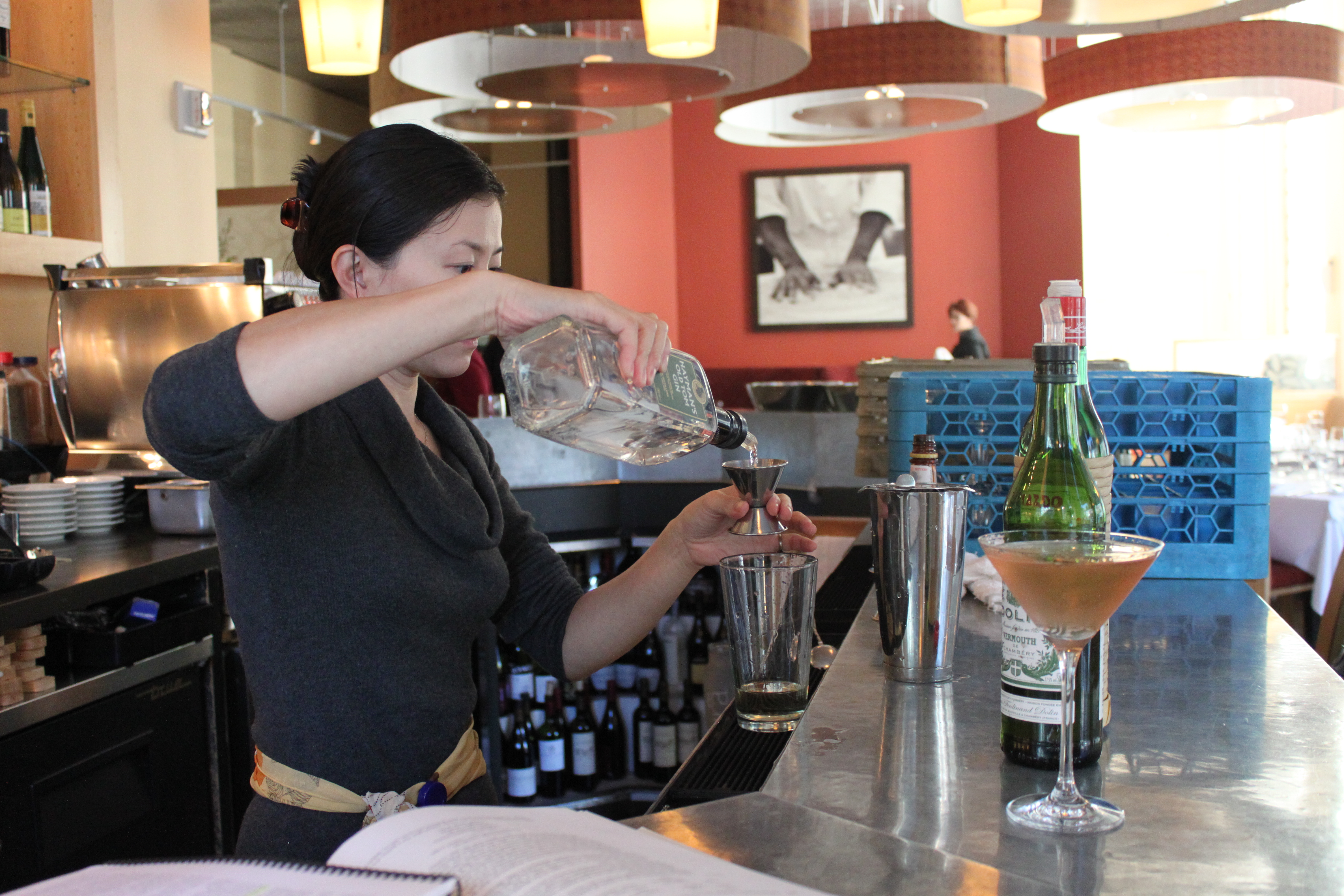
Measuring old tom gin for round 1.

The first recipe we tried:

1 dash bitters (Angostura)
2 dashes Maraschnio (we used 3/4 bar spoon of Luxardo)
1 pony (1 oz.) Old Tom Gin (we used Hayman’s)
1 wineglass (4 oz.) dry vermouth (we used Dolin)

This cocktail did not have enough gin!

The second recipe we tried:

2 dashes Angostura
2 dashes Maraschino
1.5 oz. gin
1.5 oz. dry vermouth

This recipe made a much more balanced cocktail.  We made both of these recipes with Tanqueray and with Hayman’s.  The sweetness provided by the Old Tom gin proved to be key.  We opted to omit the lemon wedge garnish suggested by each recipe, not finding it very classy.

The winning combination.

Looking at the ingredients for this cocktail, I didn’t have high hopes.  With the right recipe, however, it turned out to be a very refreshing cocktail.  Something an old man might reward himself with after mowing the lawn.

Some cocktail porn for your viewing pleasure.

2 Comments

Filed under Cocktails

Bordeaux from the 1980s

I recently joined a tasting group and that was the only instruction I received prior to showing up.

There were 4 of us and we each brown bagged our selections. Scott brought 2. For next time, we agreed to make this step double-blind (i.e. I knew which bag was mine).

It was my job to decant all of the bottles. I'm smiling because I didn't have to wash the glassware and I was told I looked too "serious" by the photographer.

I was using the candlelight to spot for sediment. Yes, at one point, I did light one of the paper bags on fire.

We tasted through the wines and made notes, guessing commune and vintage. Across the board, we were surprised by the great acidity as well as the lightness of the tannins.
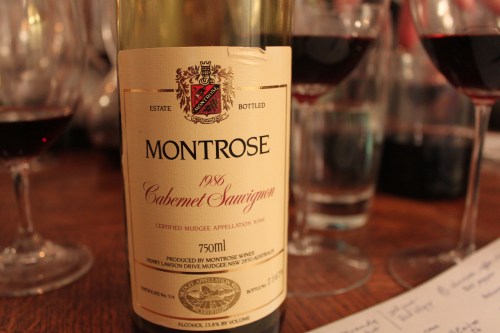
Montrose. Sounds French, right? Wrong, New South Wales in Australia. Wine #1 was a ringer courtesy of Chris. The nose was exciting; cinnamon ribbon candy, coffee, licorice, venison. The palate was diappointing, however; one-noted and hot on the finish. The least favorite of the group.
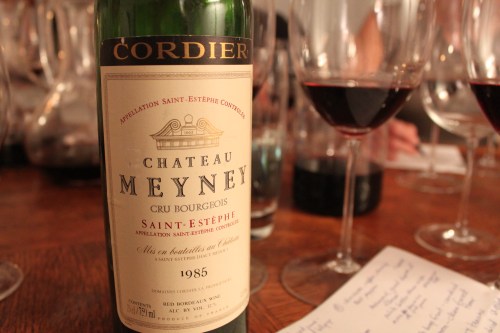
Chateau Meyney 1985. Dried cherries, anise, and brett in a good way. On the front palate, a slight bit of corkiness came through, but it wasn't necessarily unpleasant. I had guessed St. Julien 1987. Doh.
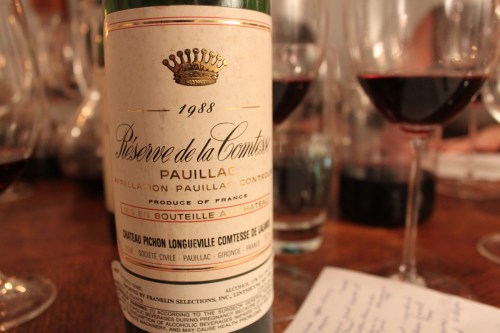
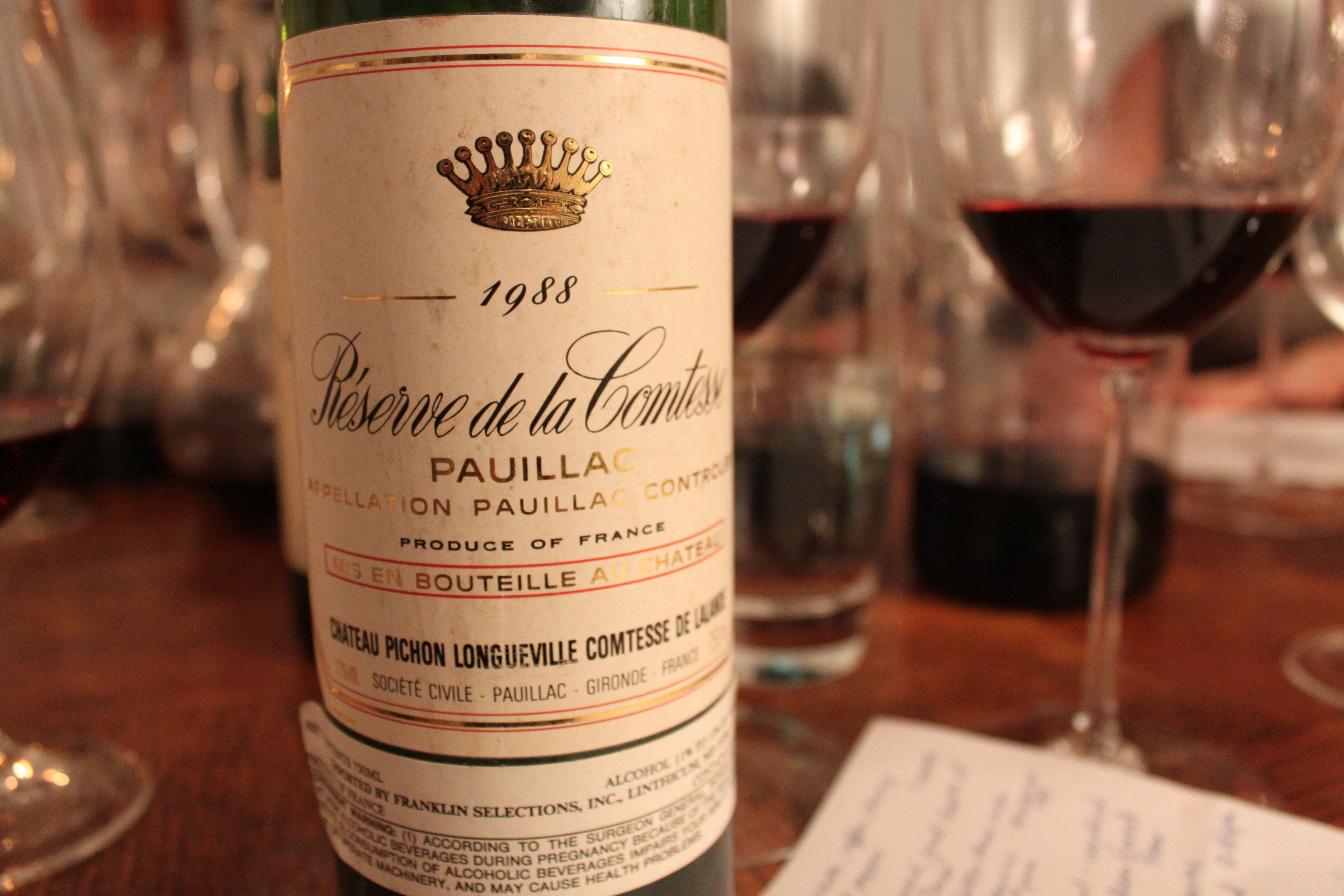
Wine #3, the Reserve de la Comtesse 1988, was the group favorite. Chocolate, coffee, cherry, bell pepper, tobacco; great balance and depth of flavor. The most structured of the bunch.

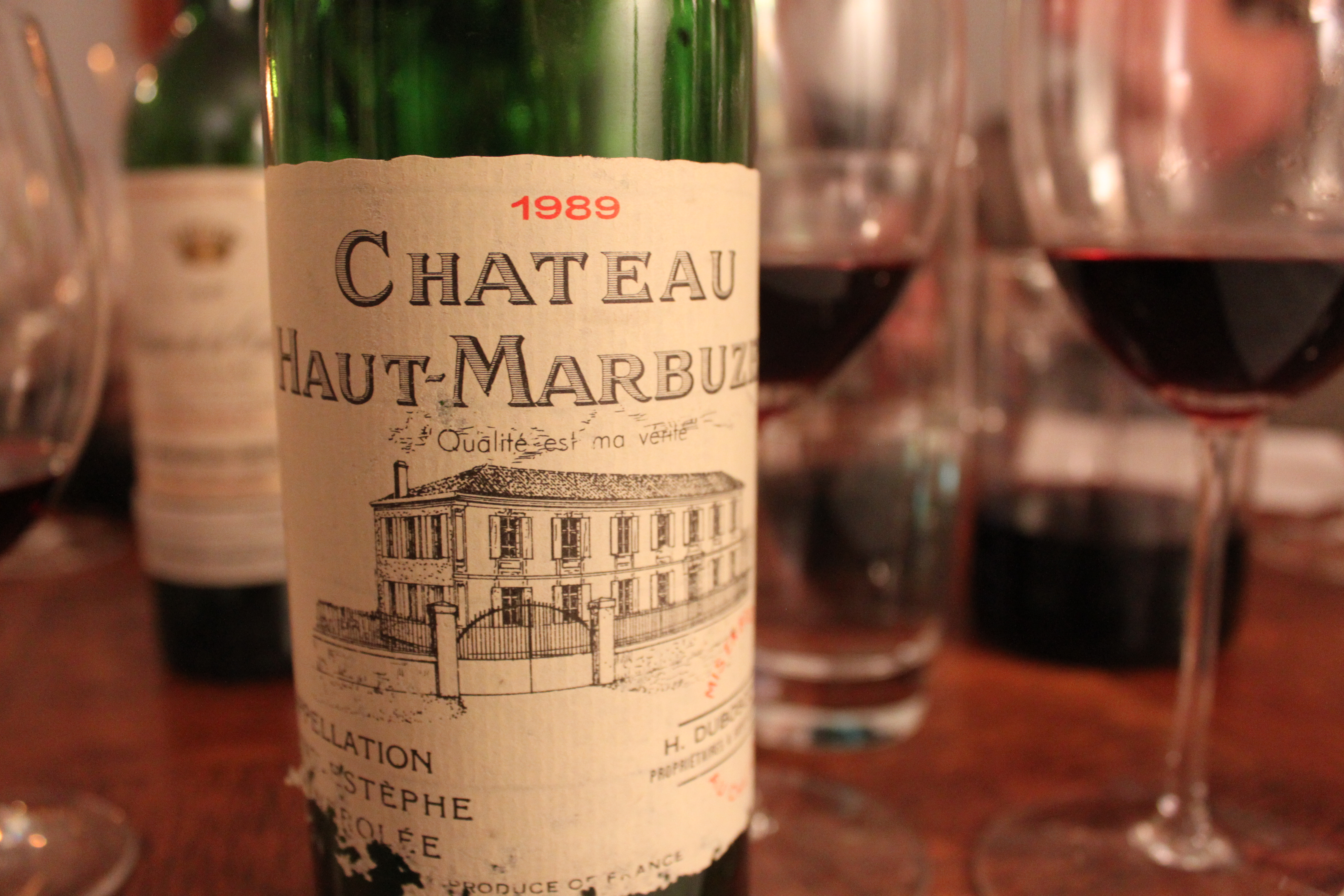
Wine #4, the Chateau Haut Marbuzet 1989, was mine and I was happy that I didn't embarass myself. Candied fruit, forest floor, sundried tomatoes and dusty tannins. Shout out to Chambers St. Wines for making a same-day delivery and only charging me $10 (nothing like waiting until the last minute).
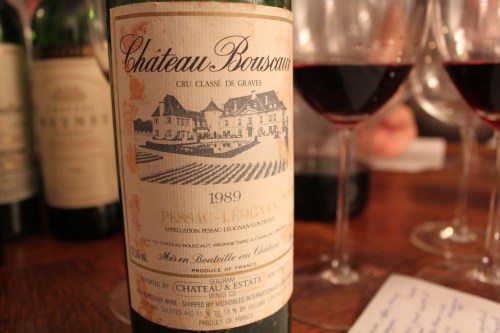
Wine #5, Chateau Bouscaut 1989, was the most tannic of the line-up. It had lots of sweet spice and vanilla, along with an interesting metallic/bloody character.

Chris threw a Sauternes into the mix because it just seemed wrong not to. The wine was very deeply colored, with a spicy horseradish quality on the nose. The botrytis was very clean and the wine had so much acidity, it barely seemed sweet.
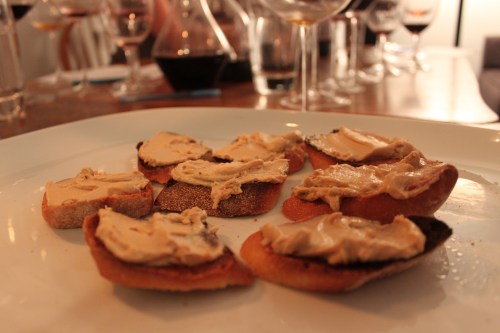
It would have been a lot of wine to have without any food to wash it down, but Chris, the ever-gracious host, had prepared a 4 course meal. Here's the first: foie mousse on toasted baguette. Didn't suck with the Sauternes.

Course 2, coq au vin, happily bubbling away on the stove. You'd think that poultry cooked with wine and mushrooms would be incredibly wine-friendly, but most of the reds in our tasting couldn't stand up to the dish.

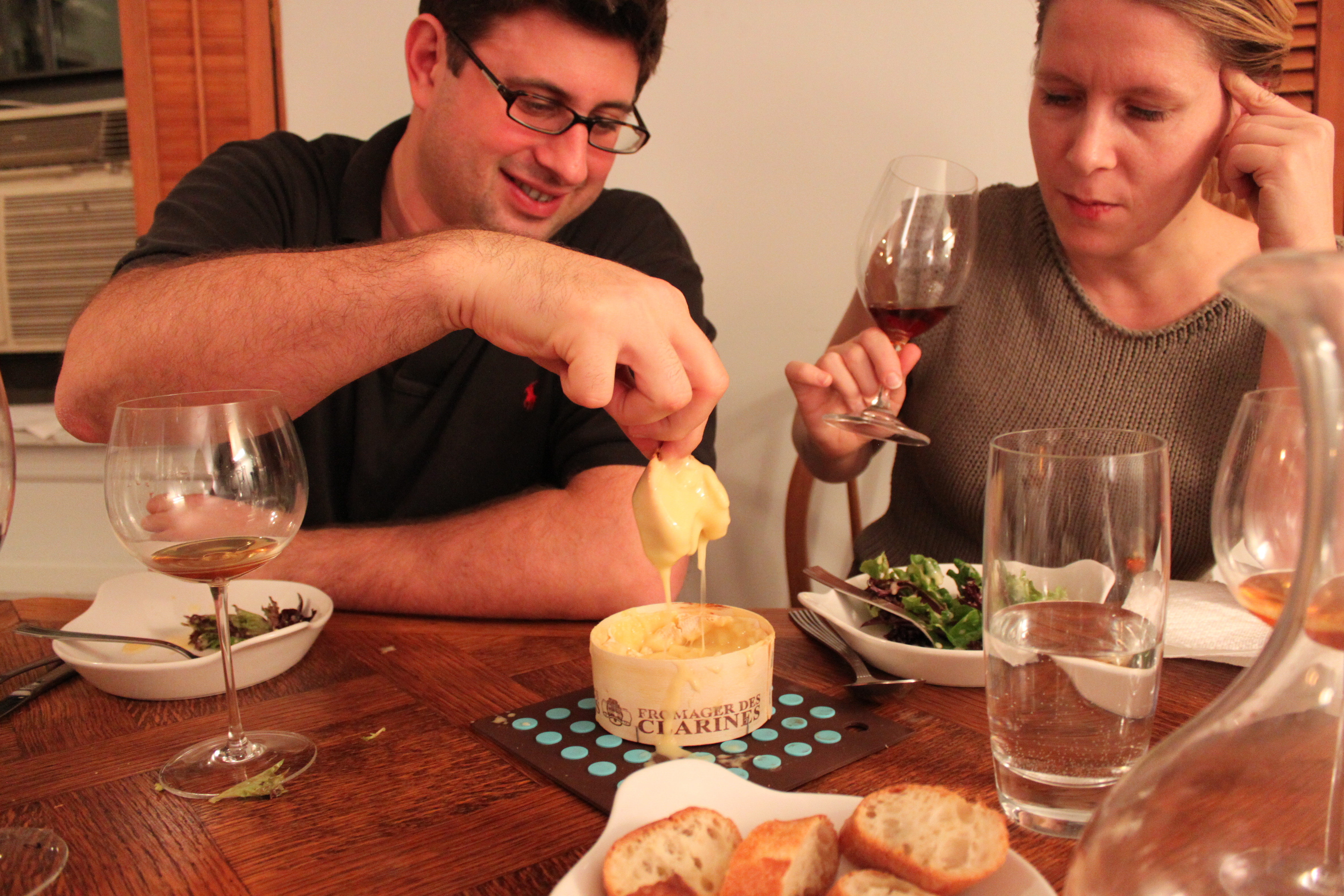
Course 3 was a washed rind cheese that Chris added 2 cloves of garlic and some Sauternes to and stuck in the oven. It came out a fragrant and gooey mess. The side salad was not enough to offset the amount of cheese and foie that we put away.

Last, but not least, an apple tart with honey. The Sauternes ended up being the most versatile wine across all of the food courses. The best surprise was still to come.
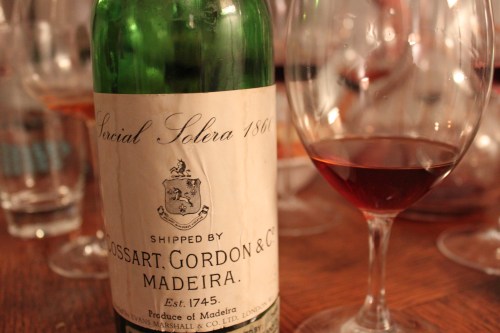
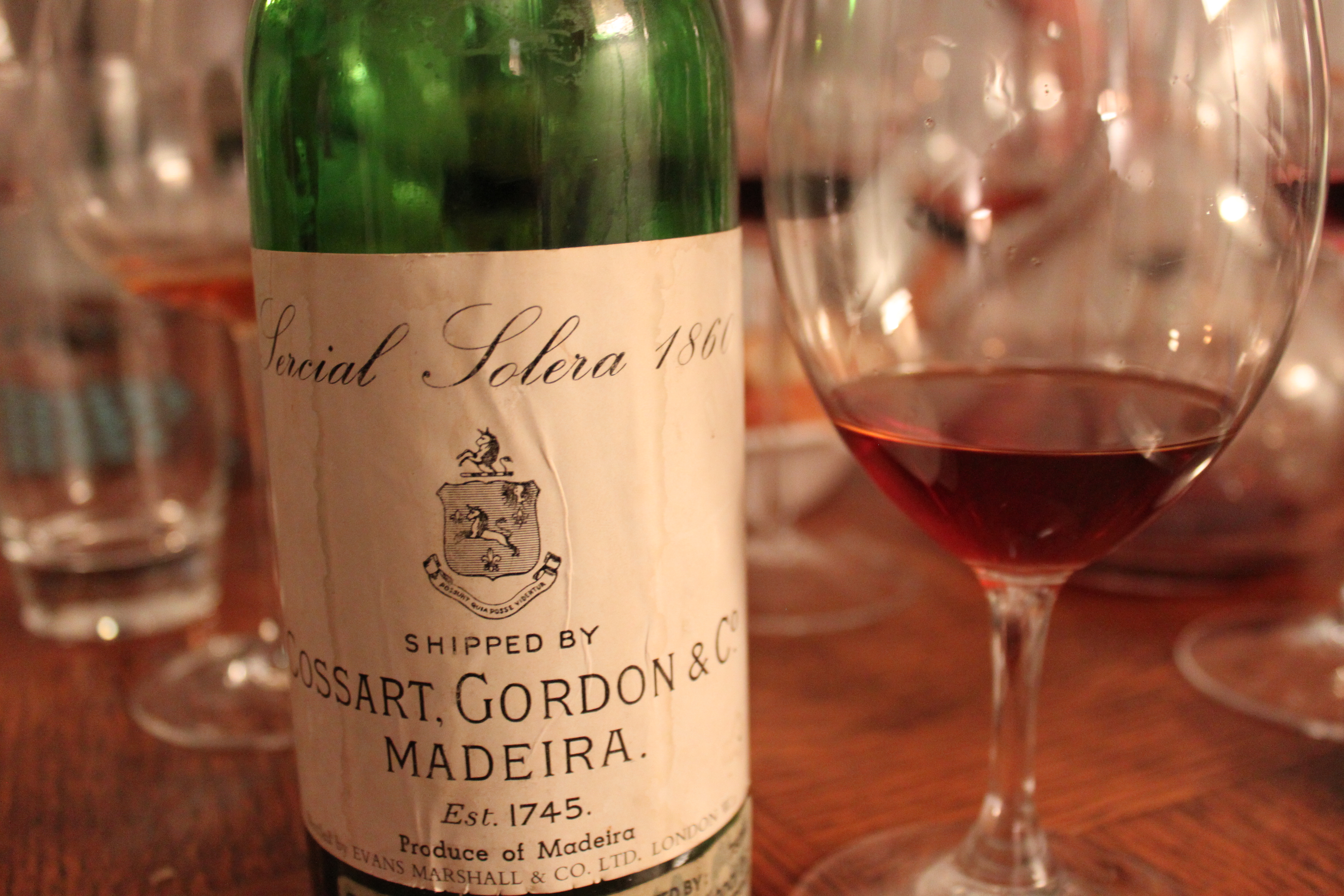
Yup, you read it right, a Sercial Solera from 1860. Amazingly alive and vibrant. You could almost smell the acidity. Guess they call it the dog strangler for a reason.

Lining up the damage at the end of the night. The Grunhauser was because we got thirsty while setting up and the Dead Arm Chris just happened to have sitting open in his kitchen. Thanks everyone. Looking forward to the next one!


1 Comment

Filed under Wine

New record-holder for world’s most expensive beer

photo courtesy of http://www.luxist.com

Over the summer, I posted about Scottish brewers who wrapped their “End of History” ale in animal carcasses and sold them for over $700

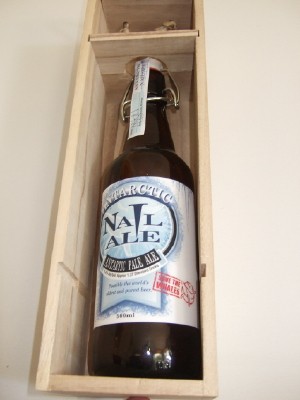
The priciest beer has now moved from Scotland to Australia, when last week a bottle of Antarctic Nail Ale sold for $800 at auction.  30 bottles were made by John Stallwood at Nail Brewing headquarters at Edith Cowan University in Perth. 

The bottle was sold at an auction benefiting the Sea Sheperd Conservation Society.  The Society seems to do good work.  Those of you who know me know how I feel about sharks.  I do find it odd, though, that this beer was brewed with Antarctic Ice brought back from the Sea Sheperd’s last anti-whaling campaign in the Southern Ocean.

Leave a comment

Filed under Beer

Tackling the Dry Martini Cocktail

We’re launching a new project at school that will require creating and testing cocktail recipes.  Yes, my job is awesome. 

For some reason, we decided to start with a cocktail about which many professionals don’t see eye to eye. We can all agree it’s appetite-whetting, simple to make and storied, but that’s where it ends.  I touched on the history of the martini briefly in this post.

We decided to test two recipes, using three different gins each.

Unsurprisingly, these are boozy cocktails. The ratio you go with probably depends on how much you like gin.

Across all recipes we used Dolin Dry, one dash of Regan’s Orange bitters, and in honor of the orange bitters, a non-squeezed orange peel as garnish.  All drinks were stirred.  For both rounds, we sampled three different gins: Tanqueray, Plymouth and Hayman’s Old Tom.  

First up was equal parts gin and vermouth – 1 1/2 oz. each.  The winner was Tanqueray; well-balanced and you could taste the gin (we like gin here). 

Second time around we went 2:1 – 2 oz. gin to 1 oz. vermouth.  Prior to stirring round two, we anticipated that we would like the equal parts cocktails better.  We were wrong.  The winner was again Tanqueray, and it was an even better martini with this ratio. 

Rich, bold, satisfying, invigorating.  Made you want a big, fat steak, followed by a nap.  Too bad it was 11 am in the middle of the work week and we are aren’t characters on Mad Men.

3 Comments

Filed under Cocktails

L is for ladybird

This is not a post about the First Lady of the U.S. from 1963-1969, a track on a Tears for Fears album, or the 1992 Rodney Dangerfield soccer comedy. Instead, it is about an insect pest new to North American viticulture.

Of the Coccinellidae family, the particular culprit is the Harmonia axyridis, or Asian Lady Beetle. She also goes by Japanese ladybug, Harlequin ladybird and Halloween ladybird (she might try to settle in your home as the weather chills in October).

I always thought these beetles were considered a good sign in the vineyard, as they have voracious appetites for aphids, which tend to suck juices from plants.  

Turns out ladybirds were first observed causing problems in the northeast US during the 2001 vintage.  They like to feed on sugar from damaged grapes late in the ripening process and they are often harvested along with the fruit.  When these little buggers get disturbed (which is quite likely during the crushing process), they emit a yellow-orange body fluid, which taints the wine. 

The goo is released from their legs and is called hemolymph and it contains a high concentration of isopropyl methoxy pyrazine.  Those of you more familiar with winespeak will recognize that this is the stuff which lends green flavors to wine – think Sauvignon Blanc.  Unfortunately, it also imparts a musty, nutty aroma and an astringent peanut-chocolate character to the wine. 

The shocking part of all this is that one adult beetle per 1.7 kg (3.75 lbs) of grapes is enough to cause noticeable funk in the wine!

We introduced the species to our country to control the soya bean aphid, and the ladies can now be found along the eastern seaboard, across central states and in Washington and Oregon.  Over a million liters of wine from Ontario have been dumped, as a solution (other than careful sorting) remains to be found.  Taint has also been reported in Italy, Germany, Holland, Belgium and the UK.

Not very lady-like, if you ask me.

Leave a comment

Filed under Alphabet Soup

Train tipple

We headed to DC this past weekend for the Rally to Restore Fear and/or Sanity and hit up the bar car on the way back last night.

Dewars and peanut m&ms are an amazing combination. Yes, that is Woodbridge Merlot in the background. No judging, please. We didn't leave enough time to wine shop prior to arriving at the station. It was surprisingly palatable.

I’m hopeful that our blogging class starting tonight will give me the kick in the pants that I need for some more regular posting.  Stay tuned!

3 Comments

Filed under Spirits

Corn Tassel, take 5

In preparation for USQ’s Autumn Cocktail Classic, I’ve been playing around with some cocktails featuring Glen Thunder.  

Brian emailed me this recipe:

Corn Tassel
1.5 oz Mellow Corn 4-year old whiskey
1.25 oz fresh lemon juice
1 oz Cointreau
2 tsp orgeat
1 dash of Jerry Thomas’ Own Decanter Bitters

The Glen Thunder plays nicely with citrus, so I decided to use this as a jumping off point.  I didn’t have orgeat (pronounced or-zat, from the Italian orzata, meaning almond), so I woke up this morning with the idea to substitute Velvet Falernum. Sweet, with almond and orange blossom notes, the Falernum also has some fall-friendly spices, like allspice and clove. 

For the event on Saturday, I need something unfussy that I can pre-batch and serve up, without a garnish (though I may break down and go with an orange peel).  Here’s how it went down:

From left to right: Take 1 - following the corn tassel recipe, subbing Velvet Falernum and Angostura: too tart. Take 2 - dialing back on citrus, adding dash of salt and adding a bit more Velvet Falernum: eh. Take 3 - same as take 2, subbing orange juice for lemon juice: getting there. Take 4 - same as take 3, subbing blood orange juice for regular orange juice: almost there. Take 5: same as take 4, dropping blood orange juice to 1 oz. and adding 0.25 oz. lemon juice: bingo.

The as of yet unnamed cocktail:

1.5 oz. Glen Thunder
1 oz. Cointreau
0.5 oz. Velvet Falernum
1 oz. blood orange juice
0.25 lemon juice
dash salt
dash Angostura bitters

I combined all of these over ice, stirred and strained into a rocks glass.  On Saturday, the delivery vehicle will be plastic. 

Sweet and citrusy, with the right amount of spice, here’s hoping it will help sell some booze!

2 Comments

Filed under Cocktails

Study: Americans Get Majority of Exercise While Drunk

I originally came across this video on Eater and I’ve been waiting (im)patiently for someone to post it on YouTube.  Enjoy!

2 Comments

Filed under Alcohol in the News, Videos

Working at Red Tail Ridge

This past Sunday, I got put to work at Red Tail Ridge winery, which is located on the west side of Seneca Lake, in the Finger Lakes.  It’s a husband and wife operation that opened in 2005.  They’ve got 34 planted acres of Riesling, Chardonnay, Pinot Noir and some other fun varietals like Teroledgo (primarily grown in NE Italy) and they’re the first LEED-certified (Leadership in Energy and Environmental Design) winery in the region. 

The main goal of the day was racking (aka moving from one container to another) Lemberger.  Lemberger is the German name for Austrian Blaufränkish or Hungarian Kékfrankos.  Wines made from this grape tend to have great acidity, dark cherry and smoky notes, and medium tannins.

The first step was to prepare the tank by filling it with nitrogen. The nitrogen would form a blanket over the wine once it was in the tank, protecting it from exposure to oxygen.

I spent a lot of quality time with this pump. Gina, a current student in Viticulture and Wine Technology at Finger Lakes Community College, is in the background. She's been interning at RTR since April and was incredibly helpful. I've picked grapes before and I've read about winemaking, but using the equipment was all new to me.

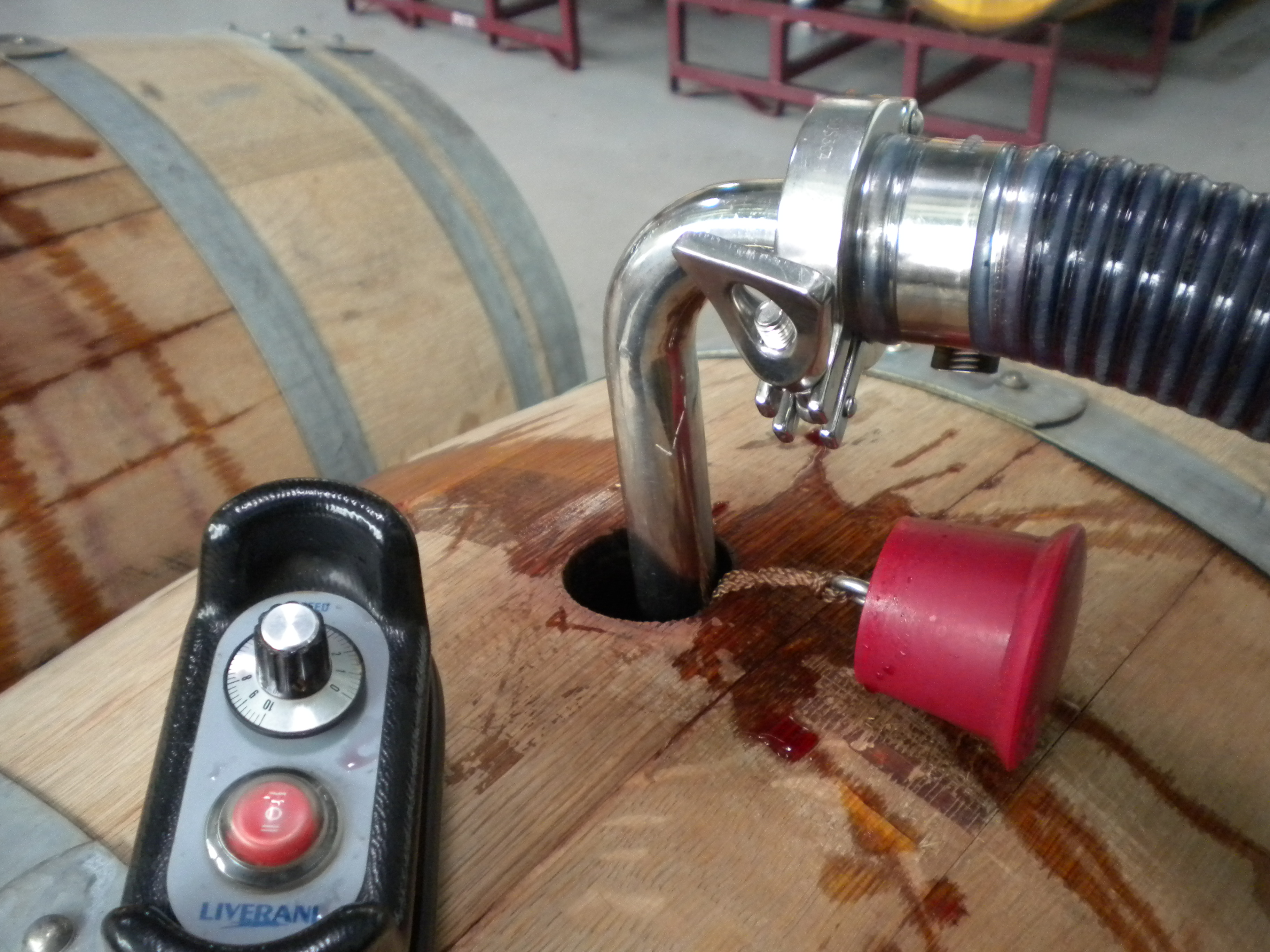
It was my job to empty 16 barrels of 2009 Lemberger into tank. On the left is the remote control for the pump, where I controlled the speed and direction of the wine flow. I had to pay attention and stop the pump at the right moment, so as to not suck up any excess oxygen. I spent most of this time with a flashlight in one hand peering into the bung hole and the remote control in the other.

After the barrels were emptied, they had to be cleaned and this we did with a powerwasher. We had to clean them right away because the next step was to then fill them with 2010 Lemberger that was waiting in another tank.

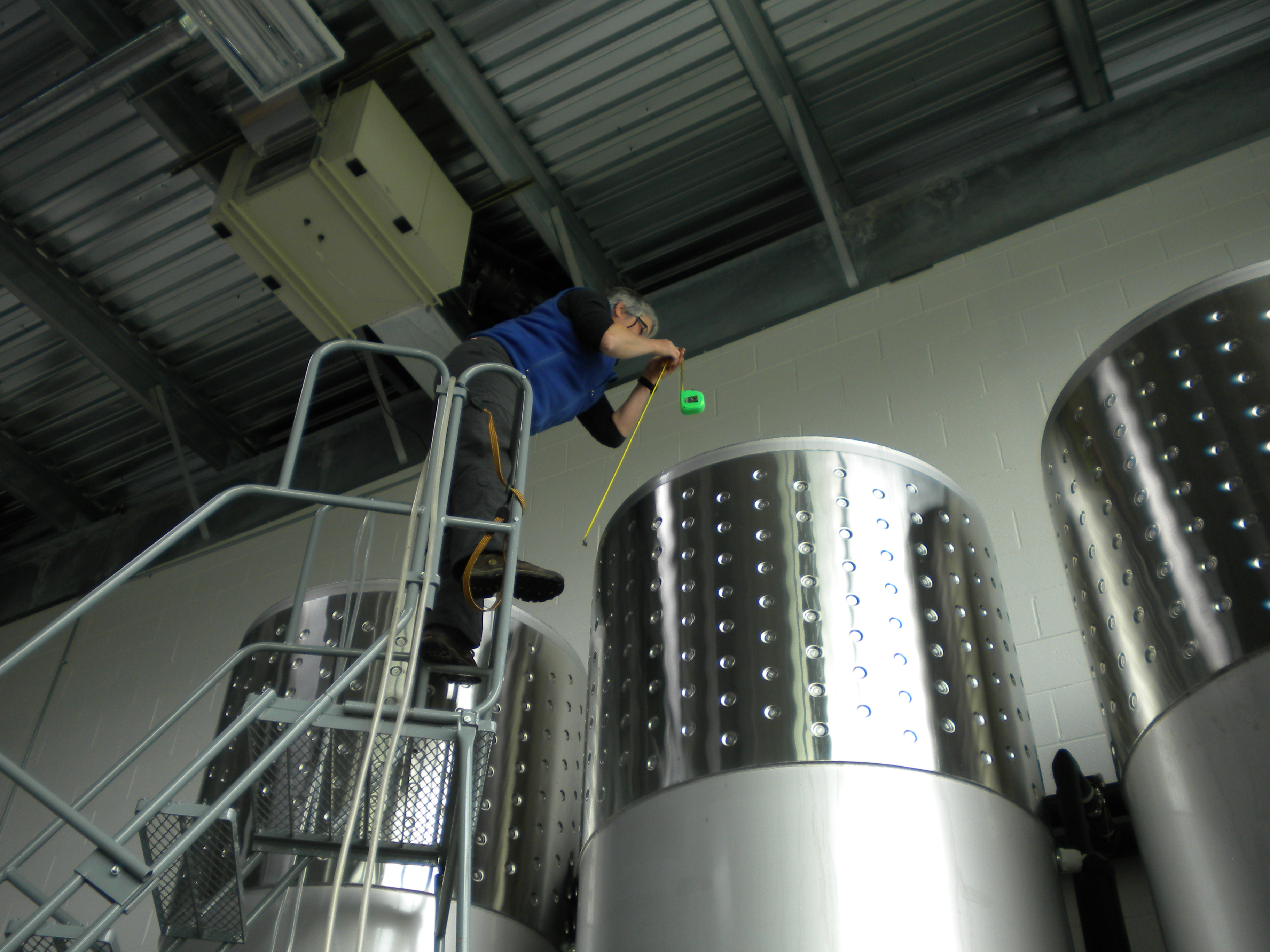
Nancy, the owner, checking the fill level on the tank. Filling the barrels looked a lot like emptying the barrels, just using the pump in the opposite direction. Before I got started, Nancy made sure I had a change of clothes. She doesn't like a lot of head space in her barrels and she anticpated that I might end up with a wine geyser as a first-time barrel filler. Luckily, I didn't embarass myself.

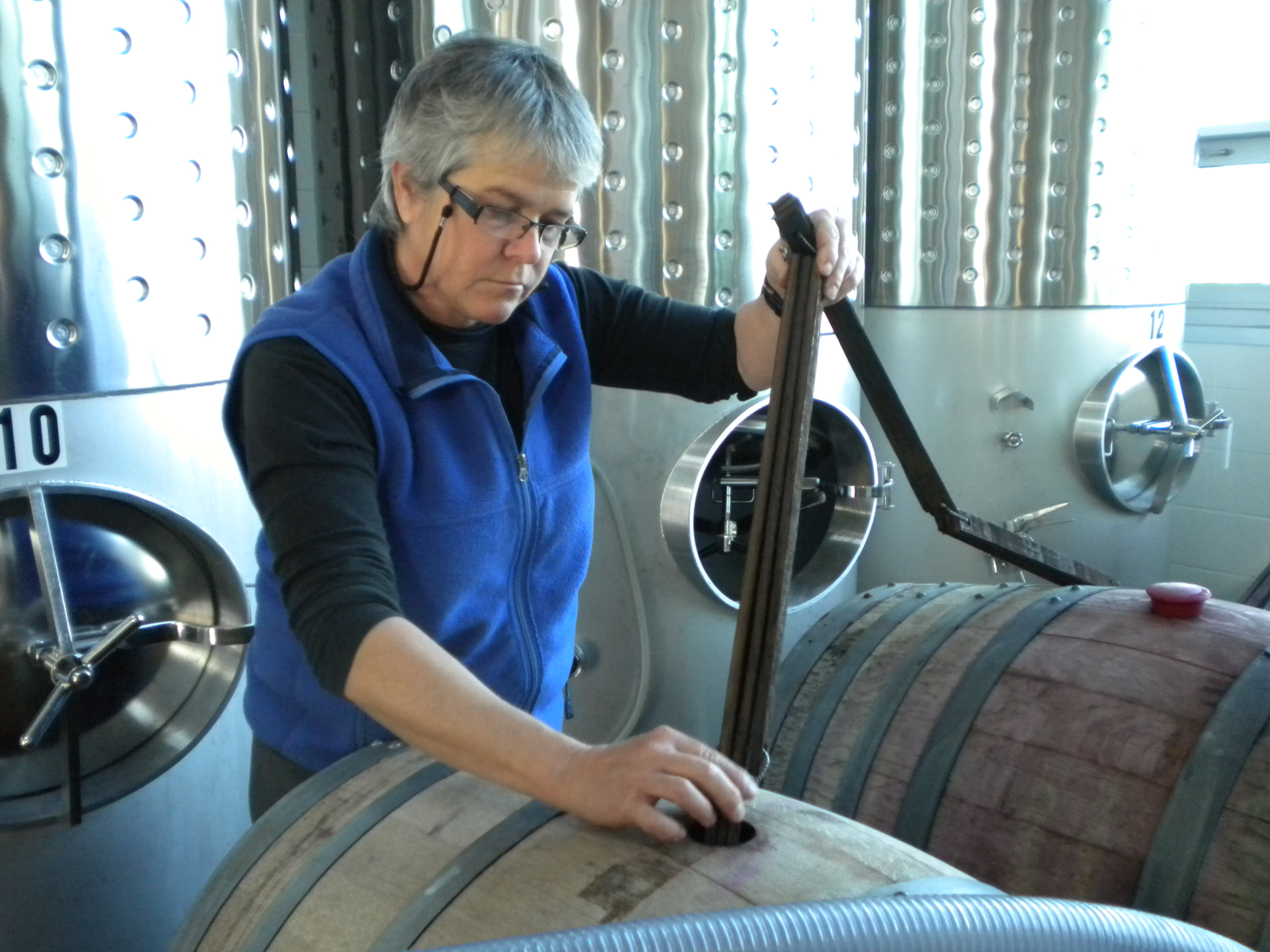
In one out of the 16 barrels, Nancy inserted a stave, which would impart more oak qualities (tannin, structure, sweet spice, etc.) to the final blend. The stave itself smelled like bacon and eggs.

Here's the sludge that was left at the bottom of the tank, once we had filled our barrels. I got to scrape it out with a dustpan. I was told not to inhale very deeply while my head was inside the tank, as there was quite a bit of CO2 left. Very glamorous stuff.

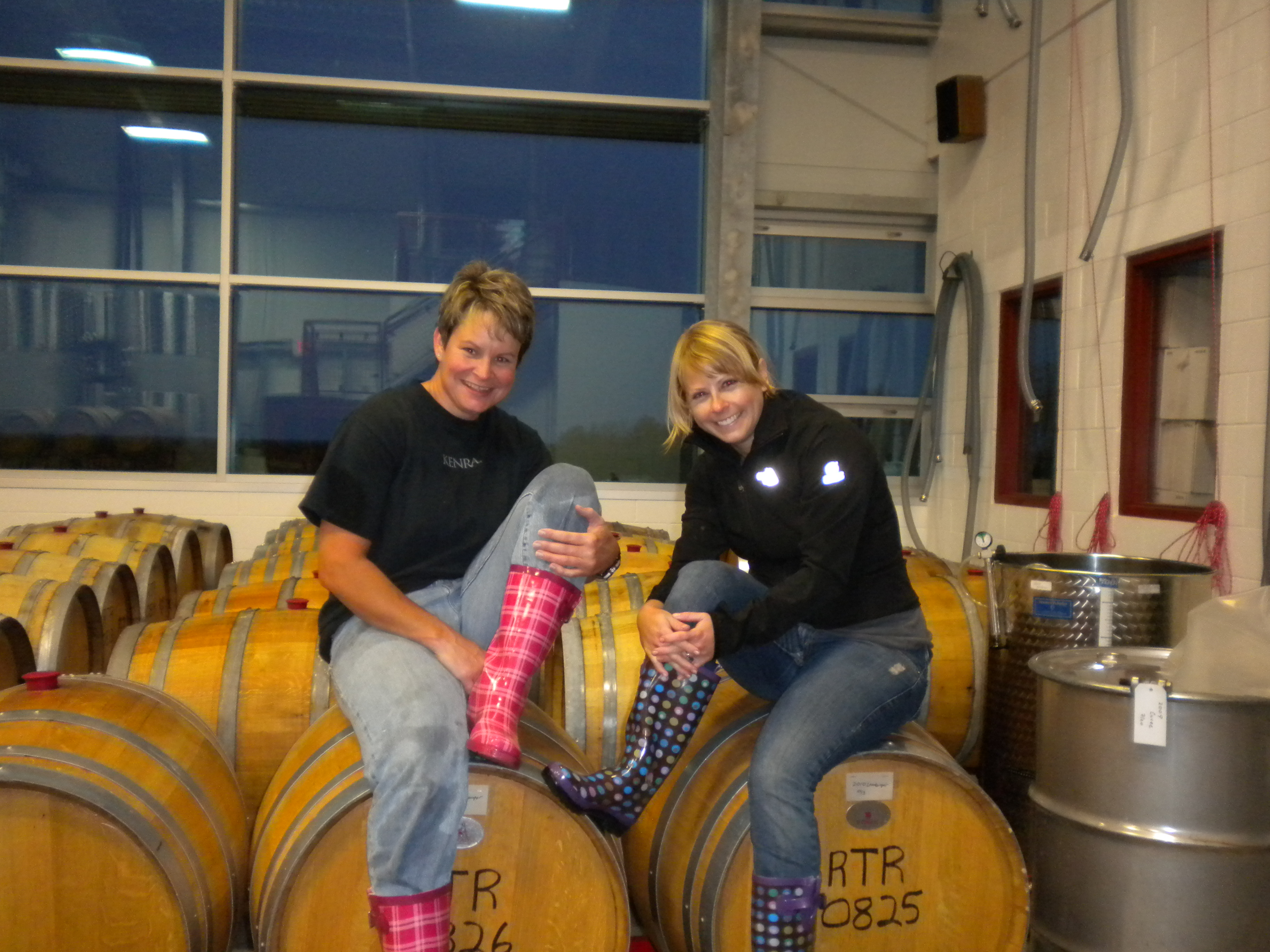
Here we are, still smiling, almost 12 hours later. My rain boots came in handy.

Some take-aways:
*I will never complain about the price of an artisanal wine now that I have a better idea of the amount of work/love/sweat that goes into each bottle.
*I couldn’t help but think of the video I posted a few months ago, where winemaking was described as “49% cleaning shit, 49% moving heavy shit around and 2% drinking beer”.

I was invited back, so stay tuned for more winery adventures!

1 Comment

Filed under Wine