
I’m going to go over a small piece of what you missed by not coming to coffee class today.
The perfect espresso has 5 requirements. Continue reading
I’m going to go over a small piece of what you missed by not coming to coffee class today.
The perfect espresso has 5 requirements. Continue reading
I love exercise tv. Yoga, pilates or classes with the word “bikini” in their title – all without leaving your house or owning a DVD player.
A few of the classes require additional equipment that you’re not warned about in advance. Hence, the scene below:

If you look closely, you’ll notice our instructor has a dumbbell. I do not own dumbbells, but I do always have a few bottles of wine on hand. Still wine in a 750 ml bottle weighs around 3 lbs, while Champagne and liter bottles clock in closer to 4 lbs – perfect for the low-weight, high-repetition exercises often required in workout videos.
Now, I haven’t done a post yet about proper wine storage, but I’m pretty sure you could guess that you might not want to try this with any of the prizes in your wine collection.
Go make Jane Fonda proud.
Filed under Lessons
I grew up in a town where Mark Twain wrote some of his books.
I thought it was appropriate to share his thoughts on one of my favorite beverages. Probably not his best work – it sounds like WC Fields, Churchill or some other quotable drunk – but snappy nonetheless.
“Too much of anything is bad, but too much Champagne is just right.”

Mark Twain, 1835-1910 (or as locals know him, Samuel Langhorne Clemens)
Filed under Lessons

I’ve never had frozen wine, but I’ve definitely left a rosé in the freezer too long when speed-chilling it. Come to think of it, a Riesling slushy doesn’t sound half bad.
As you may have guessed, this post is about serving temperatures. People can be quite particular about the temperature of the wine in their glass. Different wine books, websites and organizations will all offer advice on this topic and exceptions seem to be the rule. Click here for 6 tips
Dorothy Parker (1893-1967) was an author, poet, screenwriter, humorist, critic and defender of human and civil rights. In her time, she was published in Vanity Fair, Vogue and The New Yorker. Not bad considering her formal education ended at the age of 13. She was also a thirsty spirit. Here’s what she had to say about martinis:
I like to have a martini,
Two at the very most.
After three I’m under the table,
after four I’m under my host.
Filed under Lessons

Last week I explained how Champagne is made, but not all producers of bubbly follow the traditional method. There are a few other ways to go.
1. Transversage: a twist on the traditional method. Think about all those different sized bottles that Champagne comes in – half-bottles, the adorable splits (187 ml) and the big boys with fun names like Methuselah (8 bottles) or Balthazar (16 bottles) – going through the strict tradtional method with all of these would get out of hand. Instead, immediately after disgorgement, the sparkling wine is put into a pressurized tank where it receives its dosage and then gets transferred to different sized bottles.
2. Transfer Method: a combination of individual bottle fermentation and bulk clarification. This process follows every single step of the traditional method up to and including the liqueur de tirage, individual bottle fermentation and bottle aging. There is a period of lees aging, too. Instead of riddling, however, the bottles are chilled and their contents are transferred (get it?) to a bulk pressure tank where sediment is removed. The bottles are washed and refilled with the newly filtered sparkling wine. It may say “fermented in the bottle” on the label, but the kicker is that it wasn’t necessarily that bottle. Producers will save some time and money by nixing the riddling process.
3. Continuous Method: was developed in the USSR and is now used in Germany and Portugal. A network of (usually) five tanks are under five atmospheres of pressure – the same level of fizz in most sparklers. At one end, the base wine together with sugar and yeast is pumped in and the second fermentation begins. As you know, this second fermentation will create additional pressure (from released carbon dioxide) in the tank, but the yeast cannot thrive under this pressure, so additional yeast has to be added continuously. The second and third tanks are partly filled with something like wood shavings to provide some surface area for the dead yeast cells to accumulate. This is where autolysis (the breakdown of the yeast cells) occurs, giving us that toasty, nutty bouquet. The fourth and fifth tanks don’t contain any yeast cells. The wine comes out pretty clear, having spent an average of 3-4 weeks in the system.
4. Charmat process or tank method: If two names weren’t enough, you may hear it referred to as cuve close (French for sealed tank) or bulk method. Eugene Charmat developed it in the early 20th century in Bordeaux. It’s cheaper, faster and less labor-intensive than anything we’ve discussed so far. It’s best suited for wines not intended for aging. The base wine is held in a pressurized tank where yeast and sugar are added to provoke the second fermentation. There’s no lees aging here; instead the emphasis is on the youthful, floral and primary fruit aromas – think Prosecco.
5. Carbonation: yup, just like Coca-cola. Also carries the charming names injection and bicycle pump method. Carbon dioxide is pumped from cylinders into a tank of wine which is then bottled under pressure. Since the carbon dioxide is not created within the liquid, it never really integrates – the bubbles are bigger and dissipate quickly. This is the cheapest method of all, but fear not, it only accounts for about 10 percent of sparkling production.
Want to serve better coffee at your restaurant or café? Wish you could enjoy a better cup at home? I’ve got the class for you!
The International Culinary Center has partnered with illycaffè to offer their renowned coffee “sommelier” training program. Ten years ago illy began Università del Caffè at their headquarters in Trieste, Italy as a way to train their employees, purveyors, distributors, retailers and consumers and now we’re launching the first one in NYC.
Join us starting June 1 for an intensive two-day course where we’ll cover everything from the history of coffee and its cultural significance to how it goes from being fruit on a tree to part of your morning routine. We’ll also feature several tastings and interactive discussions and you’ll get hands-on training on the Ferraris of the espresso machine world.
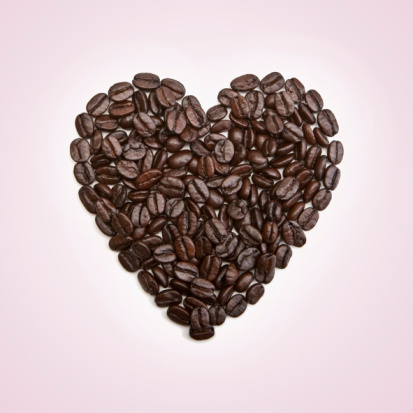
You’ll pick up some pretty nerdy trivia, too. Like, did you know there are 50 beans in a single espresso and that if just one is not perfect, the flavor in your cup will be off? I’ll be there leading some tastings and I’ll be joined by some very charming Italians. For more details and to sign up, go here.
If I could only drink one type of beverage for the rest of my life, it would be sparkling wine (sorry, bourbon). If money were not an issue, it would be Champagne. Most of you probably know this, but please only call it Champagne if it’s from the Champagne region of France.
Prosecco, cava, crémant, spumante, sekt and your Korbel do not count – don’t be fooled because they put California Champagne on the bottle – that simply does not exist. Besides the allowed grape varietals (Chardonnay, Pinot Noir and Pinot Meunier – say MOON-yay), the aging requirements and the terrior, the most unique thing about Champagne is the process that traps those tantalzing bubbles in there; méthode Champenoise (Champagne method) or méthode traditionnelle (traditional method).
I’m going to break it down for you.
1. The first key is to have grapes with high acidity and moderate sugar levels. Here is the basic fermentation equation:
sugar+yeast = alcohol+carbon dioxide (+heat)
Low sugar in the grapes=low alcohol in the wine. This is important because two fermentations happen in the production of sparkling wine and high levels of alcohol are toxic to most yeast. So, the base wine can’t have too high a level of alcohol or the second fermentation won’t take place. Champagne is very far north in France and has a very cool climate, so this part is easy for them.
2. Now that we have our grapes, we have to press them. The traditional press is a wide, shallow basket. These are still used today in addition to the more modern bladder press, which has a gross name, but is very gentle on the grapes. The juice is extracted in phases, called tailles (TIES), which translates to cuts. The cuvée is the first press and contains the juice that is rich with sugars and acids (the good stuff from near the center of the grape pulp). The second cut is called the taille (same word, new meaning here), which is richer in minerals and lower in sugar and acids. This often goes into demi-sec Champagne because the additional sweetness will cover any coarseness. The last press is the rebêche, which is sent to the distillery for spirits or vinegar.
3. After pressing, we have to let the juice settle, called débourbage in French. Sugar may have to be added at this point (chaptalization) because we want the must to reach an alcohol level of 10-11% in the base wine.
4. Fermentation happens now; mostly in stainless steel tanks, some in oak. The process is relatively warm – 60-70°F and quick – 7-10 days. Malolactic fermentation may happen here if the producer so chooses. This process converts malic acid (think citrus fruit) to lactic acid (think milk) and should be called a conversion since it’s not a true fermentation, but let’s not get too technical. It makes the wine rounder, creamier and can add additional flavor and complexity. Once fermentation is complete, the wine is racked, or separated from its sediment and moved to another cask or vat.
5. Assemblage (if you want to be fancy, say ah-SEM-blahge). Separate lots of wine are systematically tasted and blended to achieve and maintain the house style; house=producer= Krug, Bollinger, Billecart-Salmon, etc. Assemblage is a vertical and horizontal blend, meaning it’s a blend of: vintages, grapes, crus – think Premier (prem-E-ā) or Grand – officially recognized as being of superior quality) and vineyard sites.
6. This is followed by fining – removal of matter, racking – moving to another container and cold stabilization – to counter physical, chemical and microbial changes.
7. Now we have to “create the sparkle” or “set the foam” or as the French say, “prise de mousse“. This step represents the second fermentation and traditionally, this takes place in the same bottle from which it is later served. This is what sets Champagne or other sparklers made in the traditional method apart. So, how do we get the wine to undergo a second fermentation? Well, as the wine is being bottled, liquer de tirage (yeast, sugar and usually a fining agent) is added. The yeast will start feeding on the sugar and thus spark a second fermentation in the bottle which will take place over the next 20-45 days. Additional alcohol – about 1.5% – and pressure – from the carbon dioxide will be produced as well. At this stage in the game, the bottle is sealed with a crown cap (think beer).
8. Aging takes place sur lie, or on top of the dead yeast cells. They’re trapped in the bottle, remember? As the yeast cells break down, they break open, releasing amino acids and this is what gives Champagne that toasty, nutty bouquet. Concurrently, the carbon dioxide is dissolving more and more into the wine, creating smaller and smaller bubbles.
Here is a picture of sediment in a bottle:

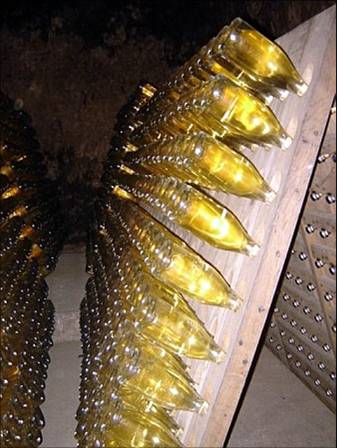
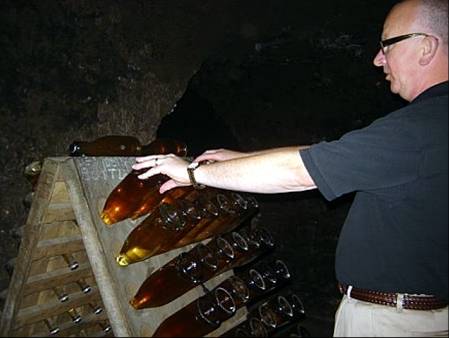
9. Next, we have the riddler. Not the enemy of Batman, but the person or machine (not called a riddler, but called a gyropalette) that rotates the bottles while they’re aging. In French, this process is called remuage. By hand, it takes three months; with a machine, it takes about a week. The idea is to gradually move the bottle from a horizontal position to a vertical one in order to collect the dead yeast cells in the neck of the bottle.
Here is the rack that houses the bottles in a manual system:
Here is someone demonstrating riddling by hand:
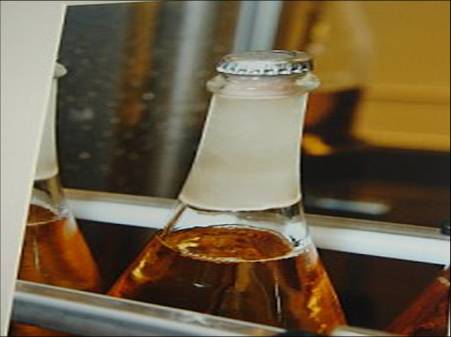
10. Now, we’ll remove the sediment and this is called disgorgement (dégorgement). The bottles will be chilled to reduce the pressure, the neck will be dipped into an icy brine solution to freeze the sediment into a plug of slush, the bottle is turned upright, the crown cap is removed and the internal pressure shoots the ice plug out of the neck of the bottle.
Here is a picture of a frozen plug:
11. Some wine is lost during this slightly violent process, so we’ll replace it with the same or a similar cuvée and this is called the dosage. The amount of sugar here will determine the final sweetness of the Champagne – Brut, Sec, Doux, etc.
12. Final aging – for non-vintage (NV) Champagne, it’s 15 months and for vintage, it’s 3 years.
There, now you understand how Champagne is made. To celebrate, sing along with Don Ho.
Actually that’s not true. I’m more likely to order a second appetizer or a cheese plate instead of dessert, but I do really like sweet wines.
Sweet wines, like Riesling (REES-ling), are underappreciated. They’ve experienced short periods of popularity dating back to ancient times; the most admired wines of classic Rome were white and sweet and in the Middle Ages, several city states in Italy like Venice and Genoa profited from producing sweet wines. After that, the Dutch Wine Trade was making sweet loot from the sweet wines of western France in the late 17th century.
So, how do you get a sweet wine? Well, the most common way is to add some form of sweet grape juice and then stabilize it, so the yeast don’t start feeding on the additional sugar, which would start a second fermentation. The best sweet wines, however, are made by concentrating the sugar in the grapes. You can do this three ways.
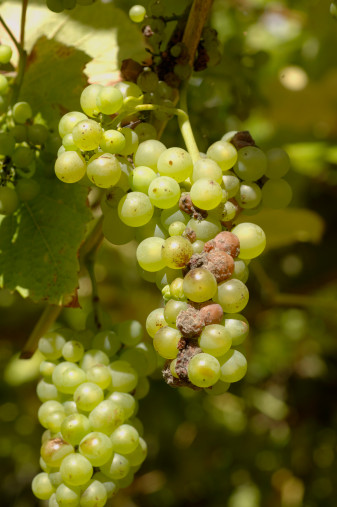
1. noble rot, where a fungus pierces the skin of the grapes and sucks out the excess moisture (this category is called botrytized wines because the technical name for the fungus is botrytis cinerea)
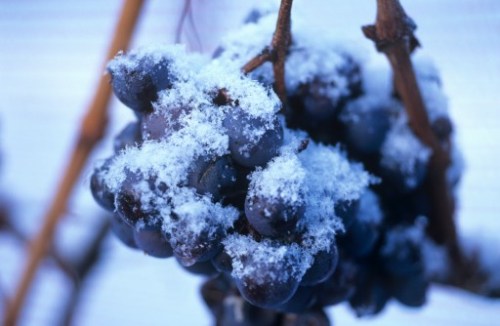
2. Process frozen grape clusters, either by letting the grapes freeze on the vine or by using a freezer after harvest (this category is eiswein)
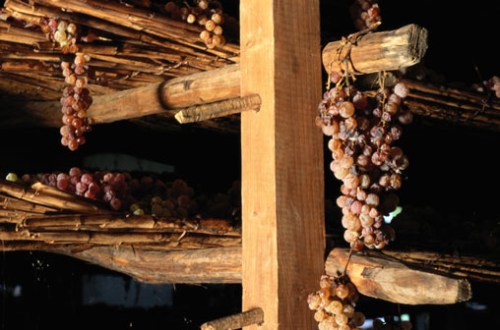
3. Dry mature grapes on the vine or after picking (this category is dried grape wines)
What counts as sweet? Wines taste sweet mostly because of the residual sugar they contain, but our perception of this can be altered by acidity, tannins, presence of carbon dioxide and serving temperature. Alcohol can also taste sweet. For example, a Chardonnay with only 2 g/l of residual sugar that is high in alcohol can taste sweet, while a sweet Vouvray (Chenin Blanc from the Loire Valley) that contains over 30 g/l of residual sugar may taste dry when it’s young. Two other complicating factors: different terms are used in different languages to describe sweetness and only sparkling wine producers are required to indicate the sweetness level of their wines on the label.
I’ve recreated a chart I found helpful in The Oxford Companion to Wine
| Residual Sugar (RS) g/l | English | French | German | Italian | Spanish |
| up to 4 (or not exceeding 9 as long as the acidity is within 2 g of the RS) | dry | sec | trocken | secco or asciutto | seco |
| 4-12 | medium dry | demi-sec | halbtrocken | abbocato | semiseco |
| 12-45 | medium (or medium sweet) |
moelleux | lieblich | amabile | semidulce |
| at least 45 | sweet | doux | süss | dolce | dulce |
So, why don’t more people like sweet wine? New wine drinkers often prefer some residual sugar in their wine, so perhaps sweetness in wine has become associated with a lack of sophistication. Others might fear that a dessert wine will be too sweet or cloying, but as long as there’s enough acidity to balance the sweetness, it will be anything but.
Here’s a food and wine pairing trick to try – pair a sweet wine with something sweet for dessert and together, both the wine and the dessert will seem less sweet. This is not intuitve for most people – 1+1 does not equal 2.
Here are some of my favorite matches: chocolate-based desserts with Banyuls (a fortified wine from southern France) or Tawny Port, nut-based desserts with Oloroso Sherry or Vin Santo (dried grape wine from Tuscany) and fruit-based desserts (especially berries) with Moscato d’Asti (a sweet sparkler from northern Italy) or Muscat de Beaumes-de-Venise (a vin doux naturel from the Rhône Valley). Many sweet wines, like Sauternes (botrytized wine from Bordeaux) or Madeira are brilliant with a cheese course if finishing savory is more your style.
Let your preconceptions go and have a little something sweet. They’re some of the best wines in the world.
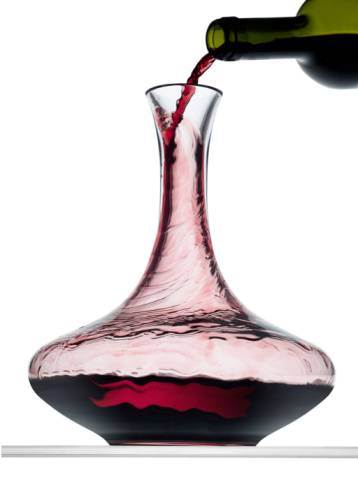
And the answer is: Decant! No, it’s not that easy, but it’s close. Here are some thoughts on how to decide.
The most obvious reason to decant is to separate the wine from any sediment that has formed in the bottle. Sediment won’t hurt you, but it doesn’t look pretty in your glass and can sometimes taste bitter or astringent. Before winemakers knew how to clarify their wines properly, decanting was the norm. Now, it is rare for inexpensive, everyday table wines to throw any sediment. A common culprit is vintage port – it’s bottled early in its evolution, so it will often throw a heavy deposit. Other aged red wines will too, because some of the solids have precipitated out as part of the maturation process. We can save “which wines are ageworthy” for another posting, but if it’s in a box, a jug or if it’s colored pink, drink it up and don’t worry about decanting it.
The other main reason to decant is to aerate the wine and encourage the development of the wine’s bouquet. Don’t laugh because I used the term bouquet – it’s been used since the first half of the 19th century to describe the perfume of the wine. My dad likes to bust my chops about the difference between aroma and bouquet and while many authorities may have a differing opinion about when a wine’s smell stops being an aroma and becomes a bouquet, it boils down to this: aroma is the simple smell of the grape and bouquet refers to the more complex compounds which evolve from fermentation and bottle aging. So there, pops.
Karen MacNeil, author of The Wine Bible advocates decanting very tannic wines (think Barolo, Bordeaux, some Rhônes) and notes that it can be detrimental for more delicate wines (think Chianti or Pinot Noir). Noted oenologist Émile Peynaud on the other hand argues that the action of oxygen dissolved in a sound wine when it’s ready to be served is detrimental – the aroma instead of being pronounced will be diffused and less marked. He suggests only decanting when there’s sediment and just before serving. Keep in mind that if you are following the steps from “swirl it, sniff it and slurp it down”, you’re aerating the wine as you agitate it in your glass.
Some folks claim that decanting softens the tannins in wine and experts have contested that decanting merely alters the perception of sulfites and other chemical compounds through oxidation, therefore making the wine seem easier to drink. One thing we don’t have to argue about is the fact that a decanter looks darn pretty on your table (especially when it’s full of wine) and will get everyone excited for the meal.
 | Vinny on For you tough guys |
 | godingreniya on 4th of July and Colorado |
| Gin fizz- egy időtle… on Wildberry fizz | |
 | Lawrence B on Please don’t go (su… |
 | Marissa Hunt on Cucumber Cooler |


 A Thirsty Spirit