
Here’s a 4 minute clip on food and wine pairing. Very attractive freeze frame don’t you think?
Category Archives: Lessons
My flame burns blue for you
I’m currently studying for a spirits exam and during the next few weeks I’m going to be sharing some fun facts that I’ve discovered in the process.
You’ve probably noticed in my postings that I’ll often give the percent alcohol by volume (ABV) of the beverage in question. In the U.S., the “proof” measurement is used as well. The proof is twice the percentage of ABV at 60°F – i.e. 80 proof=40% ABV.
Alcohol content is easy for distillers to measure these days with hydrometers and other modern equipment, but back in the old days, gunpowder was the analytical tool of choice. Equal parts spirit and gunpowder were mixed and set alight. If the gunpowder didn’t burn or just sparked, the spirit was too weak and if it burned too brightly, the spirit was too strong. If the mixture burned evenly, and with a blue flame, it was considered to be “100% pure” or “100 proof”. Turns out that a blue flame will appear at a 50/50 ratio.
In Britain, the proof to ABV ratio is 4:7. In the 18th century payment to British sailors included a ration of rum. These sailors also used the gunpowder trick, making sure the liquid would ignite and that it hadn’t been watered down – these thirsty fellows didn’t want any spirits that were “under proof”. Rum that passed a sailor’s test was later found to contain 57.15% ABV, which is quite close to a 4:7 ratio of alcohol to total liquid. The definition then became (4÷7) × 175 = 100 degrees proof spirit. 100% alcohol had (7÷7) × 175 = 175 degrees proof spirit, while alcohol with 50% ABV had (3.5÷7) × 175 = 87.5 degrees proof spirit. To convert percentage of alcohol to degrees proof, multiply the percentage by 1.75 (and watch out for scurvy).
Pull back on the reins
 Phenols are a class of chemical compounds commonly found in wine (and chili peppers, cannabis, raspberries and wintergreen to name just a few). In wine they can bestow pleasant aromas like vanilla, wood, cloves, carnations or animal smells such as horse.
Now you may enjoy a little horse leather in your glass, but probably not horse manure. 4-ethyl-phenol is the compound responsible for this horseplay and there’s 4 times more it found in red wines than in white. It shows up more often if the grapes have been macerated without any oxygen before the fermentation process. Continue reading
What has this wine been reduced to?

Better for breakfast than happy hour
Today I’m going to share 4 faults in wine that fall under the “reductive” category. In essence, this is the opposite effect of oxidation and can produce stale smelling wine. If extreme, reduction can cause some pretty foul odors – just-boiled eggs, anybody?
1. Sulphur (SO2). The smell of gassy hot springs is not exactly what you want in your glass of wine. Excess sulphur’s not always easy to detect (and it often blows off with a little time), but in some cases it can lead to heachaches or migraines. Maximum doses are set by law in each wine-producing country. Sulphur gets a bad rap, but keep in mind that it does some important winemaking related things: it inhibits the development of wild yeasts and undesirable micro-organisms, it helps the winemaker control fermentation, it cleanses the wine (and the vessels that hold the wine) and it assists aging wine by helping to prevent refermentation in the bottle and by helping to prevent discoloration through oxidation, especially in white wines. Continue reading
Are you viticulture-curious?
Josh Perilo who writes for New York Press and Our Town attended my last Wine Uncorked class and put this article out today on it. He had a great time at the class and so will you. The next one’s running Tuesday, July 14 from 6:30 pm to 9:30 pm. Get thirsty and sign up here.
This wine’s got the hots for you

Volcanic island of Madeira
You may have heard the word maderized (MAD-uh-rized) before and if it came up in reference to a table wine, it probably wasn’t a good thing. It’s a winetasting term that refers to a wine with over-the-hill characteristics – a heavy, stale smell, often of overripe apples – usually caused by oxidation, often combined with overly warm storage. The French would say maderisé and the English might say sherrified.
If we’re talking about a fortified wine called madeira, however, hot controlled oxidation can be a beautiful (and tasty!) thing. It’s named after a Portuguese volcanic island, 400 miles off the coast of north Africa. Its location in the middle of the Atlantic made it an important port of call for ships traveling to Africa, Asia and South America.
In the 18th and 19th centuries, wine was shipped in cask and routinely fortified with brandy or neutral grape spirit to help it survive the voyage. This additional alcohol helped prevent re-fermentation as well as microbial spoilage. The constant rocking of the ships accelerated the aging process and the heat of the tropics slowly cooked the wine into an amber, nutty, caramelized beverage. When the sailors consumed the wine at the end of the journey it was a heck of a lot tastier than when they had first loaded it aboard. Continue reading
Thirsty live on camera
Here’s an interview I did with cork savvy about how to taste wine. It just came out today.
Is it ageworthy?
Most wine – white, pink or red – is meant to be consumed within a year or two of bottling, especially if it’s in a box, jug or tetra-pak, has a synthetic closure or says “table wine” on the label.
Assuming you have a fine wine, keep in mind that different wines mature at different rates depending on exactly where they’re from, what the vintage was like and how they were made. For both white and red wines, barrel fermentation and barrel aging can extend the wine’s shelf-life.
Generally, wines with lower pH can evolve for longer periods of time. Lower pH translates into higher acidity, which forms part of the wine’s structural backbone. Most wines clock in around 3-4 on the pH scale. Taking you back to junior high for a moment, neutral is 7; below that is acidic, above that is basic (think baking soda). This is why higher acid whites like Riesling or Chenin Blanc may evolve more slowly than the lower-acid Chardonnay.
With reds, higher levels of tannins will allow for a longer life-cycle; a Cabernet Sauvignon should be aged longer than a Pinot Noir.
Here’s my take on a handy entry I found in Jancis Robinson’s The Oxford Companion to Wine
Red Wines (varietal on left, suggested number of years in bottle on the right)
| Aglianico of Taurasi | 4-15 |
| Baga of Bairrada | 4-8 |
| Cabernet Sauvignon | 4-20 |
| Melnik of Bulgaria | 3-7 |
| Merlot | 2-12 |
| Nebbiolo | 4-20 |
| Pinot Noir | 2-8 |
| Raboso of Piave | 4-8 |
| Sangiovese | 2-8 |
| Saperavi | 3-10 |
| Syrah/Shiraz | 4-16 |
| Tannat of Madiran | 4-12 |
| Tempranillo | 2-10 |
| Xinomavro of Greece | 4-10 |
| Zinfandel | 2-6 |
White Wines (same format as above)
| Chardonnay | 1-6 |
| Chenin Blanc of the Loire Valley | 4-30 |
| Furmint of Hungary | 3-25 |
| Petit Manseng of Jurançon | 3-10 |
| Pinot Gris | 1-6 |
| Riesling | 2-30 |
| Semillon (dry) | 2-7 |
| Botrytized wines | 5-25 |
Make note that several of the whites would give the reds a run for their money in terms of aging potential. Hurry up and wait!
The nose knows

As you start exercising your sniffer, you may be able to distinguish between different types of aromas in wine.
In an earlier post about decanting, I made a distinction between aroma and bouquet, but I didn’t tell you where the aromas come from. There’s more!
Smelly game
Its official name is Le Nez du Vin

Jean Lenoir, born into a wine-loving family in Burgundy developed Le Nez du Vin over 25 years ago. Several different kits are available and the one pictured here is the 54 aroma Master Kit. The vials are presented in families: fruity, floral, vegetal and spicy, animal and roasted notes. Each vial is accompanied by an information card that tells you a little more about the scent and what wines you can expect to find it in.
Up close, the vials look like this:
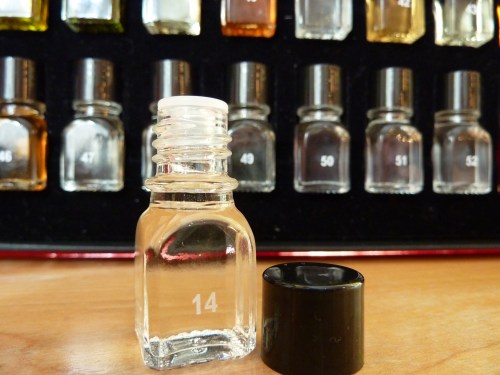
Do not ingest them, mix them with water or apply them as perfume – simply unscrew the top and sniff.
As I mentioned in an earlier post about how to taste, it can be challenging to accurately describe aromas and flavors in wine without developing your tasting vocabulary. Kits like this are a fun way to practice. Well, not as fun as actually drinking, but you get the idea. Continue reading


 A Thirsty Spirit