Monthly Archives: February 2010

Bebbo Cocktail

A take on the Bee’s Knees, the Bebbo is a very satisfying cocktail.  While it may not mean the cat’s pajamas, it’s herbaceous and tart on the attack, full and round on the palate, and finishes with a lingering sweetness from the honey.

1 1/2 oz. gin (I used Seneca Drums), 1 oz. fresh lemon juice, 1/2 oz. honey, 2 teaspoons o.j.. Stir all ingredients (without ice) until honey is dissolved, add ice, shake and strain into chilled glass. Garnish with a cherry (mine sunk to the bottom).

 If you have trouble getting the honey to dissolve, you can heat it slightly before using it.  If you hadn’t guessed already, this is another drink I wanted to try from Ted Haigh’s book.

3 Comments

Filed under Cocktails

Snow day happy hour

Yesterday felt like Christmas – a snow day in the middle of the week!  

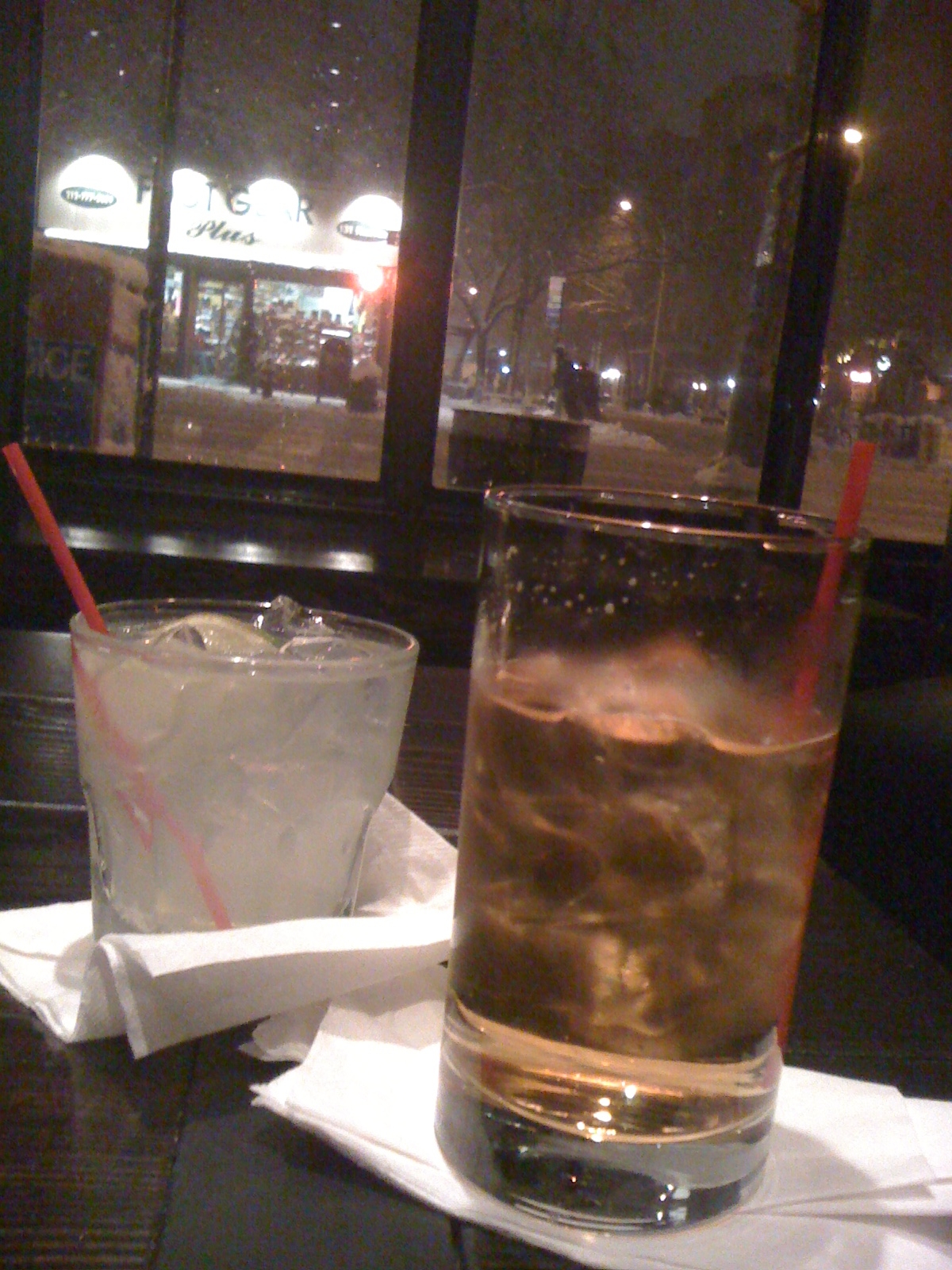
On 1st Ave and 8th St. at the new “V Bar” (in the old Tribe space) we found a cozy spot with great big windows where we could enjoy the snow as well as some cocktails. 

On the left is “Sicilian Margarita” – tequila, orange liqueur, agave nectar and lime. On the right is “Bitter Lord” – whisky, ginger syrup, bitters, soda and lime.

A deep puddle of icy water was hiding under the snow on that very corner and feeling like a kid again because of the snow day, one of my favorite childhood poems came to mind:

Where the Sidewalk Ends by Shel Silverstein

There is a place where the sidewalk ends
And before the street begins,
And there the grass grows soft and white,
And there the sun burns crimson bright,
And there the moon-bird rests from his flight
To cool in the peppermint wind.

Let us leave this place where the smoke blows black
And the dark street winds and bends.
Past the pits where the asphalt flowers grow
We shall walk with a walk that is measured and slow,
And watch where the chalk-white arrows go
To the place where the sidewalk ends.

Yes we’ll walk with a walk that is measured and slow,
And we’ll go where the chalk-white arrows go,
For the children, they mark, and the children, they know
The place where the sidewalk ends.

Of course, this sidewalk ended with a deep pool of slush soaking the feet of unlucky pedestrians.  Remember, this is NYC.

2 Comments

Filed under Cocktails

Barbara West

On Tuesday afternoons, I’ll often go down to the bar and mix cocktails with Gene.  Today, I taped him making a Barbara West cocktail. 

I realize now that I should have given more commentary as he’s making the drink.  It seemed very loud in the restaurant at the time, but I come through loud and clear.

We sourced the recipe from Ted Haigh’s book:

2 oz. gin (we used Seneca Drums)
1 oz. Sherry (we used Lustau Amontillado)
1/2 oz. fresh lemon juice
1 dash Angostura bitters

Shake in an iced cocktail shaker, strain into a chilled glass and garnish with a lemon twist.

I can’t seem to find much on the etymology of this cocktail, though Ted notes you could order a “Creole with bitters” and end up with a Barbara West.  On the CocktailDB, I found a recipe for a Barbara East.

Gene’s comments at the end of the video about the drink being tart are because we had just finished making a Bebbo Cocktail before taping (more on this later).  An easy way to play around with this drink would be to change the Sherry.  Amotillado is dry and nutty and worked well, but I could see substituting an East India or an Oloroso style if you were looking for a touch more sweetness.

2 Comments

Filed under Cocktails

Join in the fun

Another round of Fundamentals of Wine is starting up tomorrow.  Join us on an 8 week journey through the world of wine.

Riesling grapes in Germany

1 Comment

Filed under How to, Wine

A is for Aligoté

White Burgundy is almost always associated with Chardonnay, and with good reason – those wines are some of the most sought-after and expensive in the world.  Aligoté happens to be another white grape used to make dry white wines in Burgundy.   One of its synonyms, Alligotay, should clue you in on how to pronounce it.

The first record of Aligoté was in the 18th century and it’s played second fiddle to Chardonnay ever since.  DNA profiling has shown it to be part of the Pinot family.  The wines tend to have notes of apple and lemon, like many Chardonnays, but will be higher in acid and often show some herbal qualities.  Aligoté is meant to be consumed young.  

Historically, the vines of Aligoté and Chardonnay were inter-planted and producers would often create field blends of the two, relying on the higher acid of the Aligoté to give the wine a little lift.  Sadly, Aligoté is not as profitable and now the vines tend to be relegated to the highest and lowest vineyard sites (as opposed to the sweet spot in the middle of the slope), where the locals serve it with simple meals or mix it with blackcurrant liqueur to make a kir. 

While found throughout Burgundy(even in Chablis), only the village of Bouzeron in the Côte Chalonnaise has its own appellation for Aligoté, called Bourgogne Aligoté-Bouzeron (you’ll see this on the label).  Bouzeron has lower yield requirements for its Aligoté (45 hl/ha, which translates to 2.5 tons per acre vs. 60 hl/ha elsewhere) and many think the best examples come from here.  Another label option is Bourgogne Aligoté (up to 15% Chardonnay can be blended in), indicating it came from outside Bouzeron, but somewhere within Burgundy.  Outside of Alsace, this is one of the few instances where you’ll see the varietal indicated on the label.   

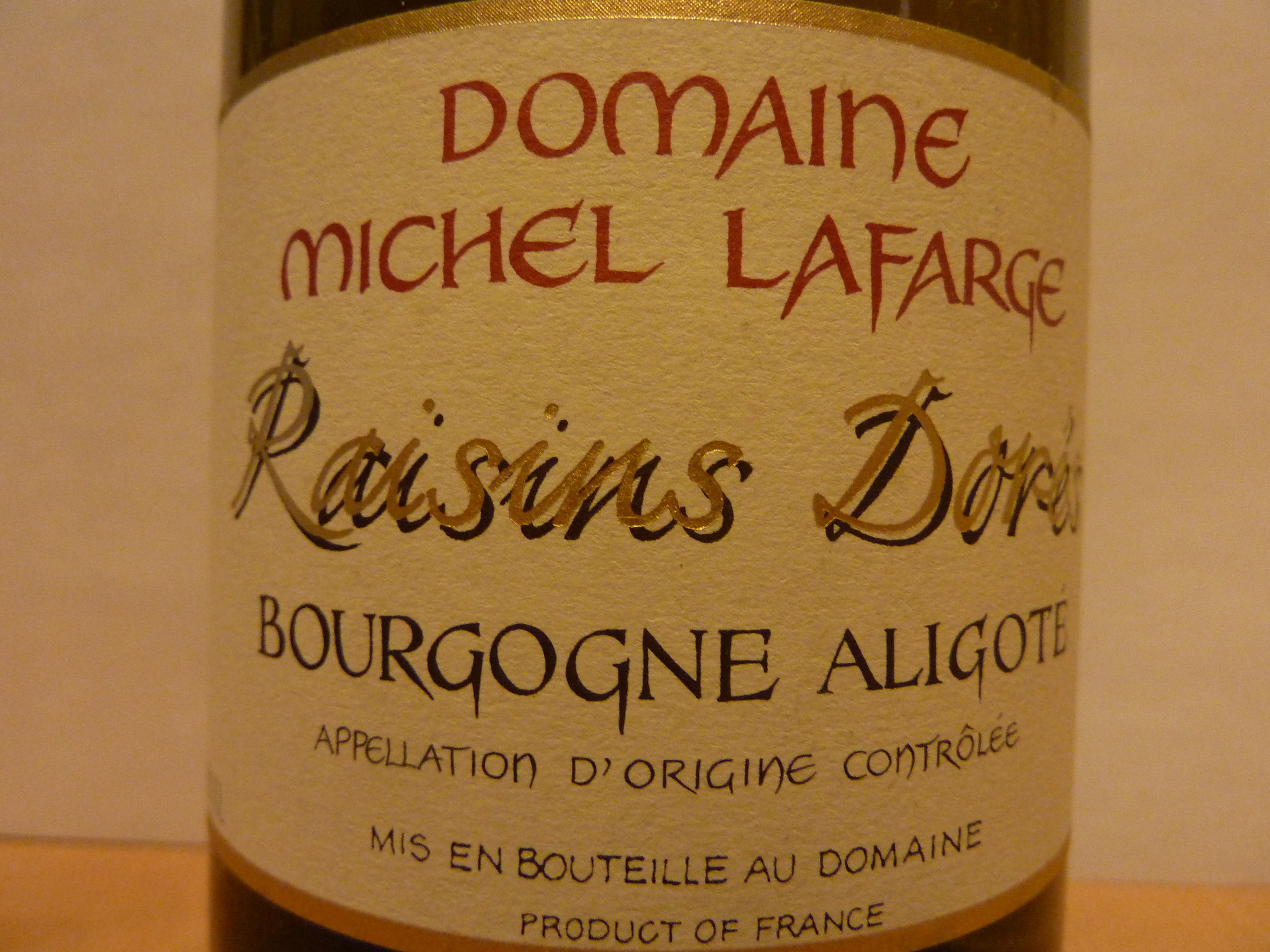
Pierre Morey and Michel Lafarge are two outstanding producers to look for.

Burgundy’s sparkling wine, Crémant de Bourgogne, may also be comprised of Aligoté.

Eastern Europe shows more love to Aligoté.  It can be found in Bulgaria, Romania and many of the ex-Soviet republics: Ukraine, Moldva, Georgia, Azerbaijan and Kazakhstan. I will resist the urge to make any Borat jokes.

1 Comment

Filed under Alphabet Soup, Wine

Martini madness

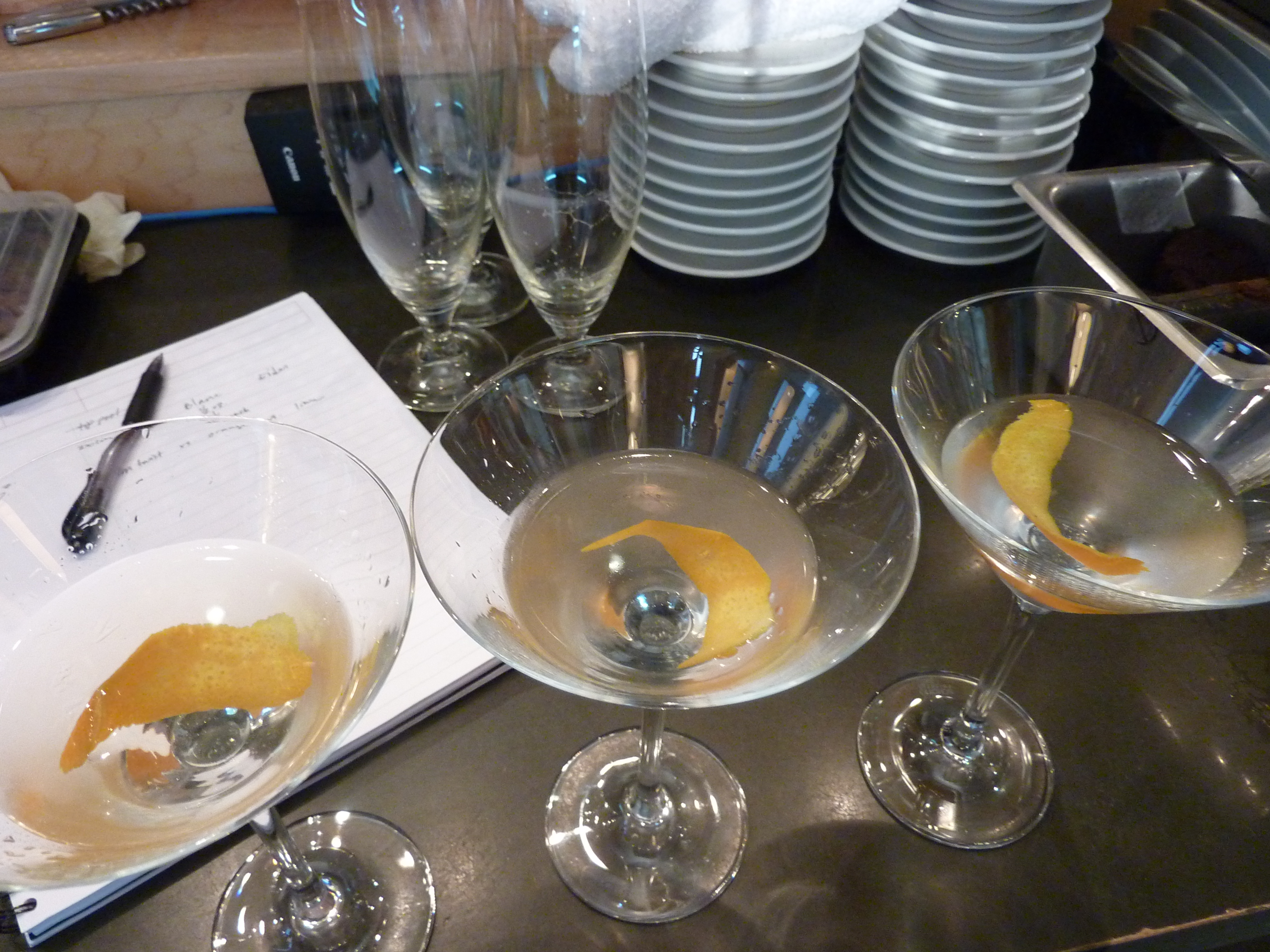
In preparation for Saturday’s Martini Bowl at Union Square Wines, I’ve been doing some experimenting.

Which garnish will come out on top - the peel of an orange, lime or lemon or something else all together?

Which vermouth will come out on top? Notice there's no Italian representation.

It’s odd that no one can agree on the origins of the most popular cocktail.  In his latest book, David Wondrich presents four different theories, ranging from The Jerry Thomas Theory (that Jerry, while working in San Francisco, made the drink for someone headed east to Martinez who had asked for something new), dubbed “exremely unlikely” to The Judge Martine Theory (that Judge Martine invented it at New York’s Manhattan Club), which he called “possible, but not proven”.

The style of the martini has changed over the years, becoming drier over time.  Pre-Prohibition recipes were usually equal parts gin and vermouth or a 2 parts gin to 1 part vermouth ratio.  Pre-World War II recipes often called for a 4 to 1 gin to vermouth ratio, while post-World War II ratios crept up to 15 to 1. 

My Grossman’s Guide to Wines, Beers, and Spirits says that the Martinez Cocktail is the earliest martini-esque recipe they could find.

1 dash bitters
2 dashes (1 tsp) maraschino liqueur
1 pony (1 oz.) Old Tom gin
1 wineglass (2 oz.) vermouth
2 small lumps of ice

Shake thoroughly and strain into a cocktail glass.  Garnish with a quarter slice of lemon and if the guest prefers it sweet, add 2 dashes of gum syrup.

Is it better to shake or stir? Serve it up or on the rocks? Shaved ice while shaking?

You’ll have to stop by on Saturday to see what we decided to go with, but in the meantime, we can all agree on the beautiful relationship between gin and vermouth.

1 Comment

Filed under Cocktails

“If your body can take it, you might as well buy the cheaper liquor”

This is a great quote from a  Washington Post article that ran today. 

No surprises were revealed – people are drinking more in this economy, but they’re doing it at home instead of out at restaurants or bars, and many of them have switched to cheaper brands.  Folks outside New York are taking the Costco approach, buying big to save money. 

My advice from yesterday’s post still stands.  Popov will do bad things to you.

2 Comments

Filed under Alcohol in the News, Noteworthy articles

Buy local booze

I have three upcoming tastings and I hope to see you there!

This Friday, 2/5 from 5:30-7:30 pm, I’ll be pouring McKenzie Rye at Crush.  153 E. 57th (between 3rd and Lex)

On Saturday, 2/6 from 2-5 pm, we’ll be mixing some Seneca Drums Gin cocktails at Union Square Wines for their annual Martini Bowl.  Get jazzed up for the Super Bowl and sample over a dozen spirits featured in classic and seasonal martinis.  We have a few tricks up our sleeve and we hope to be the Martini Bowl Champs this year.  140 Fourth Avenue (at 13th St.)

Keep it going on Saturday and drop by Bowery and Vine.  We’ll be there from 4-7 pm, pouring Vintner’s Vodka, Glen Thunder Whiskey, FLD Cassis and maybe a surprise or two.  269 Bowery (at Houston)

1 Comment

Filed under Events, Spirits